Showing posts with label fiction from Ireland. Show all posts

Thursday, January 20, 2022

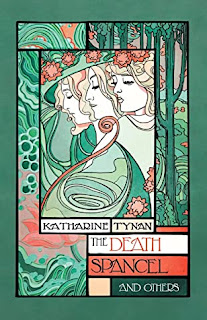
The Death Spancel and Others, by Katharine Tynan

 
9781783807543
Swan River Press, 2020
221 pp

paperback


 "There's few could look on the boorwaugh washa, the death spancel, without terror."  


For me there is no greater comfort than to make a pot of tea, grab my favorite blanket and crawl into my favorite comfy chair with a book of older ghost stories in hand.   Let's just say that it is much more comforting than even my favorite comfort food (a grilled cheese sandwich with some fresh homemade tomato soup  - a childhood holdover), and that the pleasure is augmented when what I'm reading is written by an author whose work I have not previously read.  Imagine my pleasure in finding this book (thanks to one of my like-minded goodreads friends)  -- but I did have to ask myself the following question:  

what the hell is a spancel?

As anyone might do, I googled it and discovered that it's something that "hobbles" or "tethers," with the original usage having to do with cattle.  It's definitely not put to bovine use here though, as I discovered, in not one, but two stories: first, the titular story "The Death Spancel"  and a bit later in the book,  "The Spancel of Death."  In simplest form, it is  skin cut from a corpse from head to heel in one swoop, much like one might do with an apple.  From the second story we learn that the cutting of the skin is done with "ceremonies so awful that it would make this story too ghastly reading to detail them."  In his introduction, Peter Bell notes that it is a "grim artifact of Irish lore;"  William Gregory Wood-martin goes a step further in his description in volume one of his Traces of the Elder Faiths of Ireland: A Handbook of Irish pre-Christian Traditions, calling it a "love charm of most gruesome character."  (Just as an FYI, that link goes to Google Books where you can download the book for free; mine is a paperback copy from Alpha Editions.) In the first story, it "dangles" from the "dusty rafters of Aughagree Chapel," a "devil's charm" of "such power that no man born of woman can resist it, save by the power of the Cross."   This story, which begins with remembrances of a priest fighting "with the demons" over the soul of Mauryheen Holion, has a most gothic atmosphere to it, as evidenced by passages like this one:
"...the servants in Rossatorc Castle said that as the priest lay exhausted from his vain supplications, and the rattle was in Dark Mauryeen's throat, there were cries of mocking laughter in the air above the castle, and a strange screaming and flapping of great wings, like to, but incomparably greater than, the screaming and flapping of the eagle over Slieve League."

The "devil-may-care" Sir Robert Molyneux and the lovely Lady Eva are to be wed in just two weeks' time, but it seems he can't help himself when it comes to the women "of a class below his own."  Even though "the germ of good in him" knows that this is wrong, and even though he  promises himself that he'll never do it again, from the moment he catches "sight of a girl's dark handsome face on the staircase" his fate is sealed. In the other story using this device, "The Spancel of Death," the girl doing the binding is an "Eastern beauty in the wilds of Mayo," Sabina Doheny,  who was once a "lonely, fierce, haunted child" and "pagan at heart" but now  "protegĂ©e"  and maid of the daughter of the local Marquis.  Lady Kathaleen's fiancĂ© is Sir Harry Massey, and once again, as in the case of  Sir Robert Molyneux, once Sabina's eyes lit upon his face, her "heart had awakened with a madness and a violence beyond expressing."  Given that Sabina had once lived in a hut with Mag Holon, the local witch, she knows exactly where to go and what to ask for.  Be warned, old Mag reminds her,  "There's few could look on the boorwaugh washa, the death spancel, without terror."  

While those two stories alone were well worth the price of this book, there are plenty of other topnotch tales included here.  I have to say that I have read more than a few volumes of ghostly/strange tales, some of which are so predictable that they're hardly worth reading, but that is not the case here. Take for example   "A Sentence of Death," which I thought was going to be a sort of rehash of Benson's "The Bus Conductor" from 1906, when something similar happens and a driver offers the main character "Room for one more, madame." But I was pleasantly surprised with what Tynan did with this story, since (as described in the introduction, which should be left until last), the focus was much more on the poor woman as she undergoes a great internal turmoil. It seems that while "Life at the Manor House flowed by in its old, delightful way," Marion Desborough finds no joy either in her upcoming wedding, nor in life itself, as her memory of an event takes a toll on her mental health and she waits for her death which she believes has been sent by portent.  Her loved ones try to convince her it was all a dream, but, well, Marion seems to know better.  And then there's "The Dream House," in which Reggie Champneys is cut off without a penny because of his marriage to a dancehall girl and even worse, Champneys, the family home he loves,  goes to another relative.  His wife, Kitty, is told about the "Champneys ghost," but this is no ordinary haunted house story whatsoever.  

Two stories sort of jumped out in the "most disturbing" category,  "A Night in a Cathedral" and "The Picture on the Wall."  In the first a young officer becomes "obsessed" with a young woman who lives with her father near his regiment's barracks to the point that he follows her every evening as she enters a "gothic" cathedral for Evensong. He does this for months on end, hiding in the shadows to prevent being observed.  One night, not feeling well while "inhaling one knew not what foul vapours" he faints, only to find himself completely alone, locked inside the the cathedral, and realizes he must stay there until the morning, in the dark with no light. It's then that he notices the waters rising over the floors ...  "The Picture on the Wall" begins as a young woman refuses to give the man who loves her a specific wedding date, for reasons she will not reveal.  Eventually though she takes him home to meet her father, who not only seems hostile towards him but also puts him in a certain room of the house for his stay.  This is another one where I thought I could guess the ending, but I was (happy to be) very, very mistaken.    

There are still another half dozen or so stories remaining in this volume , along with a number of poems; the final section of the book includes other short writings, including a "weird tale," by the author, a "chat" with Tynan, and a brief anecdote about fantasy author Lord Dunsany.  All in all it's a fine and engrossing collection; and while not unexpectedly some stories worked better for me than others, it was still a great pleasure to read and to lose myself in this author's strange tales.  Leave it until the end, but do not miss the great introduction by Peter Bell.  I'll happily recommend this book to others who enjoy finding new (old) authors, women writers whose work has sadly sank into obscurity,  and to those readers who are fans of older Irish fiction and folklore as well. And it's from Swan River Press, which has provided me with hours and hours of great reading time over the last few years, so you know it's going to be good.  


Tuesday, July 30, 2019

Bending to Earth: Strange Stories by Irish Women, eds. Maria Giakaniki and Brian Showers

9781783800254
Swan River Press, 2019
205 pp

hardcover

I must confess that I read this book some time ago, but am just now getting to posting about it after giving it a second read.

At the end of their introduction to this volume, the editors Maria Giakaniki and Brian Showers wave a beckoning hand in my direction:
"...we hope Bending to Earth stands as an invitation to the curious; that these strange stories of ghosts and witches, of cryptids and madmen, will serve as a lighted candle for those who wish to further illuminate the darker corners of Irish literature."
"... the curious" -- check -- that's me.   "...those who wish to further illuminate the darker corners of Irish literature" -- check again. Boxes ticked.

If you read the subtitle of this book, it tells you all you need to know about what you'll find inside.  The dozen stories in this excellent collection definitely fall on the strange side, and in their selection, the editors have brought together a mix of tales written by women who, as they tell us, were not
 "considered during their lifetimes to be chiefly writers of fantastical fiction. Yet they each at some point in their careers wandered into more speculative realms -- some only briefly, others for more lengthier stays."  
 What matters here is not how long their wanderings "into more speculative realms" lasted, but rather that these women left behind these stories, most of them now fallen into the void of obscurity,  to be enjoyed well over a century later.

Bending to Earth is a mix of superb, uncanny tales featuring (among other things) wandering spirits, tortured souls of  both the earthly and ethereal sort, dream-like visions,  and Irish ghost lore I can imagine listening to while seated beside a fire in an otherwise darkened and quiet room while outside a storm is raging and the wind is howling like the proverbial banshee.   There is one story, "The Blanket Fiend," set in the wilds of New Guinea that stands apart from the others, moving away from what's come before and what comes after. It is different enough that it was a bit of a jolt,  actually reading  more along the lines of early pulp fiction,  but the editors address this issue in their most excellent and informative introduction (which you should most certainly save for last if you want no hints at all as to what's to come in any of these tales).  There is also, in the back of the book and on the website for Swan River Press  a brief biographical portrait of author Beatrice Grimshaw (and the other writers) which helps to understand her inspiration for this story.

The twelve stories in this book are as follows:


"The Dark Lady", by Anna Maria Hall
"The Child's Dream," by Lady Jane Wilde (yes, that Wilde -- mother to Oscar)
"The Unquiet Dead," by Lady Augusta Gregory
"The Woman With the Hood," by LT Meade
 "The Wee Gray Woman," by Ethna Carbery
"The Blanket Fiend," by Beatrice Grimshaw
"The First Wife," by Katherine Tynan
"Transmigration," by Dora Sigerson Shorter
"Not to Be Taken at Bed-Time," by Rosa Mulholland
"The Red Woolen Necktie," by B.M. Croker,
"The De Grabooke Monument," by Charlotte Riddell,  

and last, but certainly by no means least, 


"A Vanished Hand," by Clothilde Graves


As someone who has developed a passion not only for ghost stories and strange tales of yesteryear, but for ghost stories and strange tales of yesteryear written by women whose work has been largely forgotten or neglected, Bending to Earth is a much-treasured volume in my home library, and I am once again the cheer squad for the small presses that put out such gems, here represented by Swan River Press.

Maria Giakaniki and Brian Showers note that
"These twelve strange stories by Irish women are our choices, and represent only a small selection from a much broader range of possibilities." 
Hopefully (please!!),  they have enough strange stories left over after what they've chosen to include in this volume to fill another.  I'll be buying that one too.


Monday, January 22, 2018

You really have to love this guy: The Unfortunate Fursey, and The Return of Fursey, by Mervyn Wall

Say hello to Fursey, who really is one of the most unfortunate yet lovable characters one can possibly come across in a novel, or in this case, a pair of novels written by Irish author Mervyn Wall. Set in Ireland near the end of the tenth century, it all begins here in The Unfortunate Fursey, in which the monastery at Clonmacnoise is beset by demons


9781943910908
Valancourt Books, 2017
originally published 1946
paperback, 215 pp

after its "defences had been breached" one day.  The Abbot warns the community that "the Evil One" has made his way into their midst, and indeed, as the brethren are besieged for fifteen days of terror, they are finally able to expel the forces of darkness  with exorcisms, "the smell of incense, the splashing of holy water and the sound of the Latin language."   The demons are unable to remain anywhere in the monastery with the exception of  the cell of Brother Fursey, whose speech impediment rendered him unable to say the right words to get rid of them.  His cell thus becomes their sanctuary; to save the monastery it is decided that Fursey must be expelled.  After asking the Devil for advice, Fursey sets off for the "fine big city" of Cashel, where the first of his many adventures begins.  Sadly, for our hero, he finds himself constantly caught between the world of sorcery and the Church, and truthfully, the question here is which of the two is the most evil?  


 Jacket illustration of The Unfortunate Fursey from the Swan River Press edition, by Jesse Campbell-Brown.  From Behance

This picaresque saga is continued in the second book, The Return of Fursey

9781943910922
Valancourt Books, 2017
originally published 1948
paperback, 204 pp


which finds Fursey in exile in England where his quiet, cozy life as a grocer has been interrupted; he is now being sought for extradition back to Ireland.  He doesn't want to be forcefully brought back, but he does have a reason for wanting to return to his native land (which I can't reveal without giving away the show) so with the help of a crazy and bloodthirsty band of Vikings, he eventually gets there.  However, it is a very different Fursey this time around, and while the humor is still very much alive and kicking, his story takes a much darker turn in this volume.   Fursey once again finds himself "ensnared" on all sides; how he deals with the several forces contending for his soul is the meat and bones of this tale.  I think it would also be safe to say that both books reveal a man trying to come to terms with discovering his true nature, which is tested often and in many different ways.  

It's so hard to try to describe these two books without taking the spoiler route, and really, to reveal anything would be to ruin the joy for anyone who may want to read these books for the first time.  Underneath all of the humor there runs a dark streak involving the Catholic Church; aside from religion Wall also has plenty to say about politics and human nature itself.   In short, there is method to the author's madness, making for a great (and often laugh-out-loud) reading experience for people who want something well beyond today's standard fantasy fare.   One more thing: I'd advise saving Michael Dirda's excellent introduction until after finishing these novels. 

I fell in love with Fursey from the outset because he's sort of a hapless kind of guy, but as Wall brings his saga to a close in The Return of Fursey, I realized I'd grown so attached to Fursey that I was sad to see it all come to an end.  Both books are awesome silliness on one level; on another they contain a very serious tale that really got underneath my skin and will stay there for some time.  I can't recommend these two books highly enough.   To say I loved them would be an understatement. 


Monday, April 10, 2017

one of my favorite Gothic novels of all time: Uncle Silas, by J.S. Le Fanu

0486217159
Dover, 1966 ed.
originally published 1864
436 pp

paperback

"Fly the fangs of Belisarius!"

There are certain books in my library with which I've fallen in love -- the books I've been dragging around with me from move to move that I would never let out of my sight, and this one is pretty much in the top tier of those.  I decided to reread it a few weeks ago when someone online was asking about a Victorian mystery and this one popped into my head.  Well, there's that, plus the fact that many months ago, I'd bought a dvd of the old BBC adaptation of Uncle Silas called "The Dark Angel"  and really wanted to watch it, but I wanted to wait until I'd reread the book.  I have two different editions:  Penguin  ( ISBN 9780140437461)  and this one from Dover, but I had just finished a Dover reprint of another book from 1827 and decided to continue the Dover run.

Since I'd already read this novel, I didn't skip the intro this time, and there was a particular paragraph that caught my eye, so much so that I'm putting it in bold print here:
"Well, you now have Uncle Silas in your hands. If you've not read it before, I envy you. You are about to have a first-time reading experience which, I suspect, you will never forget."
That is certainly the truth -- I remember the very first time I read it, sending pages flip flip flipping in my desire to make sure that my beloved, sweet Maud Ruthyn was going to be okay at the end, pounding heart, knotted stomach, and the feeling that everything else could just go to hell for a little while until I finished the book.  This time through, since enough years had passed since I'd first read it, I can say that the flip flip flipping, the pounding heart, knotted stomach, and the feeling that everything else could just go to hell for a little while until I finished the book happened all over again.  What's changed is that this time, unlike the last time x number of years ago,  I got much more of a sense of what lies beneath, and of just how near-perfectly  this book was written. It was this novel that started me on Le Fanu's  fiction, and afterwards,  I bought and devoured all of his gothic-ish novels (that have also moved with me from place to place), then started collecting his ghostly and other supernatural tales. I haven't read them all yet, but it's comforting to know that should I have a desire to do so, they're there, waiting for me.

This post is a huge departure from my norm, since I won't give up a single detail here, nor will I provide even the slightest hints, because first-time readers should stay away from anything about Uncle Silas  that will reveal its contents  either before or during your reading of this novel. Do so at your own peril: knowing what happens ahead of time will completely lessen the impact that the book will have on you and the fun is in the building of suspense and in getting caught up in its atmosphere as it gets darker and darker and darker,  until in its final moments when you can finally let out all of the tension you've been holding inside.  If you're not knotted with tension as you read this book, there is seriously something wrong with you. Seriously.

It is and will remain one of my favorite books ever, and I can absolutely recommend it. Unlike my usual practice, I won't go into what lies underneath its surface, but just so you know, there is a LOT happening that careful readers will be able to discern. Honestly, it's killing me to keep quiet about it, but as I said, not a word.   Just a couple of things: 1) do not gloss over the role of the Swedenborgian religion here -- it's very, very important, and 2) don't skim through either the descriptions of the landscape or the main houses in this story -- Le Fanu is an absolute master of weaving such details into his work and they only serve to augment what he's trying to do.  Other than that, my only advice is to let the book carry you away from the real world and to have tons of fun with it.


*********

Now - let's talk adaptations for a moment, neither of which should be viewed until you've finished the book.   As I noted earlier, I recently bought a screen adaptation of this novel called "The Dark Angel,"


which stars Peter O'Toole as Uncle Silas, and he's pretty damn creepy in his role. This adaptation tends to overdo it with the more nightmarish/surrealistic effects which were probably great at the time (1988)  but which now seem kind of silly and tend to lessen the suspense a bit here and there, but at least it adheres to the novel quite nicely with only a few changes here and there.  The second adaptation (1947)  is called "Uncle Silas,"  which quite frustratingly changes the story almost completely.  However, what both adaptations do well is choosing the right person to play the role of my favorite, most horrific character in this book --  Maud's governess Madame de la Rougierre.   While the actress does a great job in the 1947 version,  Jane Lapotaire does an even more freakish portrayal than her counterpart in the earlier film.


from myreviewer.com
Honestly, I didn't think that could be possible.

Both have their merits, but my money's on "The Dark Angel."


Monday, October 3, 2016

HB#1: nothing says Halloween like a haunted house: *The Uninvited, by Dorothy Macardle

0892440686
Queens House, 1977
reprint of  Doubleday 1942 ed.
342 pp

hardcover

Just a brief note about this book.  My edition was published in 1977 and is a reprint of the original 1942 edition.   It was a bit pricey, although as it turns out, worth every damn cent, but the good news is that anyone looking for a reasonably-priced edition will find it in the new (September) edition put out by  Tramp Press. If you're an Amazon shopper, then you're in luck -- it's also available there.

On a weekend in Devon, writer Roderick (Roddy) Fitzgerald and his sister Pamela, are driving around looking for house to buy. Both of them want to get out of London and feel that they need a  "complete break with town, a life with air, space and growth in it." This is, as it turns out, their fifth weekend of looking.  They actuallly find the perfect spot, but the house itself turned out to be a "drab barrack" not even facing the sea.  Turning the car back toward London, and feeling like their "hopes had been preposterous," Pamela sees a lane she'd like to explore, convinced that there "must be a grand view from the top." It is then that they set eyes on Cliff End, fall in love with it, and ultimately buy it from Commander Brooke, whose granddaughter Stella actually owns the house. After the offer is made, Brooke reveals something that he feels obliged to mention without going into much detail:   it seems that some six years earlier, Cliff End had been occupied for some months, but the people who'd lived there had "experienced disturbances" and had left. Roddy shrugs it off -- and the two siblings begin to fix the house to begin their idyllic country life.

Not long afterward, the two learn about the  "local legend" attached to Cliff End, regarding the death of its former mistress, Mary Meredith. Mary was the daughter of  Commander Brooke, and was married to artist Llewellyn Meredith.  It seems that one very windy and stormy night, Llewellyn's model Carmel took off running toward the edge of a cliff, Mary following behind.  Carmel got pushed into a tree, while Mary went off the cliff.  It wasn't too much later that Carmel died from a resulting case of pneumonia. Left motherless was three year-old Stella, who was then taken to live with her grandfather.

Happy now that they are "at home," it doesn't take long before they start noticing a few strange occurrences, which only intensify as time goes on.  When their first houseguests arrive, things get even stranger; the horror becomes gradually worse to the point where the Fitzgeralds realize that the smart thing would be to leave Cliff End. Ultimately, though, they realize that everything they're experiencing seems to center directly on Stella.  Neither of them really want to leave, so Pamela tries to come up with a number of theories as to what's happening to them in order to find some sort of solution to be able to face down the menace that is currently in control of their lives.

Cliff End, from the movie
The Uninvited is a wonderful story, but reading carefully, it's not difficult at all to see that there's  more going on in this book than just ghosts and a haunting.

 While I'm not going to go into any detail at all in the way of what I think is going on here besides all of the supernatural events, I will say that I saw different undercurrents at work here, including repression and marginalization, a reluctance to dig up past history even when it's the only hope for the future, and most importantly perhaps, motherhood under the microscope.

I have this deep and abiding love of good haunted house stories, and I have to say that I was very, very happy with The Uninvited on many levels. On the other hand, the novel was slow to start, but it wasn't too long before I was completely absorbed.  I also figured out the surprises in this story long before they were revealed; then again, that may be due to my many eons of reading crime fiction and learning to put two and two together as the clues unfold.   Bottom line: it's a fine, creepy novel that is fun to read on its surface with much deeper strains running underneath all of the ghostly activity.


And now to the film. I had great fun watching this movie.   The first thing I noticed is that the beginning of the movie belies what's coming later on with its sort happy-go-lucky kind of opening.  Here, Rick (known as Roddy in the novel) and Pam arrive at the house with little dog in tow. There's this kind of silly fun sort of scene where the dog chases a squirrel into an open window at the house, followed by Rick and Pam where they take a tour of the place and decide that it's perfect.   We see Pam and her brother in a sort of carefree, happy mode that not too much later dissolves as the first of the strange happenings gets their attention. It's an awesome movie, and the acting, especially that of Gail Russell who plays Stella, is quite good.  I also loved how the director played with shadows here, which in some instances reminded me of classic noir film scenes. Side by side, though, the book for me was much better -- much darker than the movie, for sure.    Contentwise, the book goes much deeper into the whole mystery behind the hauntings, whereas  it gets sort of a muddled reveal toward the end in the film retelling.  And the seance scene in the novel is beyond brilliant as compared to the one in the movie.

Once again, both book and movie are yesses, and true fans of the supernatural should miss neither. Highly recommended, although both may seem tame to modern readers.  Not to me, though -- I was sucked into both and stayed suspended there until the end.