Monday, January 1, 2018

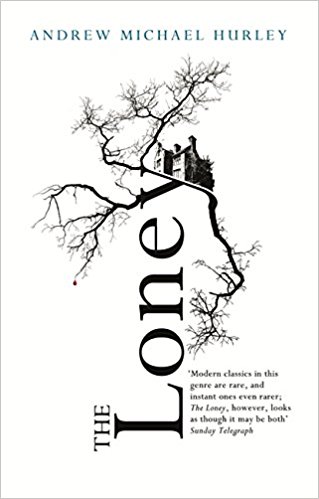
The Loney, by Andrew Michael Hurley

97819473619821
John Murray, 2015
originally published by Tartarus Press, 2014
360 pp

hardcover

"...there was so little of the modern world there that it was difficult not to think of the place being at a sort of standstill ... primed in some way." 


I turned the last page of this novel yesterday evening, and said out loud to absolutely no one "That was a great book."   The big surprise is that it is Hurley's first novel; I say surprise because it is beyond rare that I find a debut so polished and so near-perfect.  The only negative thing I have to say about this book is about its ending, but by then I was already so entrenched in the story and so in love with the writing that  I just did not care.

It was somewhere around page 90 that I noted on my GR status update that what really struck me at the time was how the author set up a number of dualities in this story, and from there they only intensified. Opposing forces are definitely at work throughout this novel,  which is the story related by the narrator about events that happened  thirty years earlier when a small group of Catholic parishioners decided to make a pilgrimage to visit the shrine of St. Anne on the northern Lancashire coast in an area known as the Loney.  The narrator, who we know only as Smith or Tonto, was a teen at the time; he, along with his parents and his brother Andrew, known as Hanny, who had not spoken a word since he was born, make up part of the group. There, Hanny's mother will have him once again drink the holy waters of the shrine; the trip would also serve as a sort of remembrance of the now-deceased Father Wilfred, who would take a group there on retreat at Easter, a tradition "very dear to Wilfred's heart."  Leading the group is Father Bernard, who had been assigned to take Father Wilfred's place.  It turns out though, that Father Bernard's ideas aren't resting well with some of these people, none the least of whom is Hanny's mother, resistant to change, who thinks things ought to be left the way they were.   While Father Wilfred may be dead, he continues to haunt not only this group of people, but the Loney itself as well.     Of course, things don't go as smoothly as planned, not just among the adults, but for the two boys  who become caught up in things well beyond their control and above all, their understanding.

As I said, there are a number of opposites that coexist in this novel, including insiders and outsiders; superstition and traditional practices as opposed to Catholic beliefs; faith and certainty;  change and tradition, and the author uses these to great effect throughout the story, exemplified strongly in the two houses which feature prominently here, The Moorings and Thessaly.

 What Mr. Hurley does best, however,  is to translate the very landscape of the Loney into language so that we can visualize it as  "a dangerous place. A wild and useless length of the English coastline," with tides which could "come in quicker than a horse could run..." isolating the small spit of land known as Coldbarrow by making it an island.  Its marshes seem to be aware of one's presence; they are
" a dark and watchful place that seemed to have become adept at keeping grim secrets; secrets that were half heard in the whispered shibboleths that passed from one bank of dry reeds to the other." 
There are dunes that cast lengthening shadows, there are "sprouts of marram grass" here; the wind has a number of different voices.  The beach during the rain
"turned to brown sludge, and the dunes ruptured and sometimes crumbled altogether, so that the sea and the marsh water united in vast lakes, undulating with the carcasses of uprooted trees and bright red carrageen ripped from the sea bed."
Most of all though, we come to understand it as a place that hides secrets and one that has its own pulse that beats under the surface. 

I could spend days talking about this book because  it is absolutely beautiful in the telling.  There are a number of things that happen here that when put together, combine to create a dark atmosphere that doesn't let up until the last pages.  I'm left with the idea that there are some things for which in the Loney  there are no clear explanations; then again, I think that's part of the point. I loved this book.  Go into it with no expectations, and the book speaks loudly and clearly to you.

highly, very highly, recommended. This is definitely going on my real-world book group's lineup.

Tuesday, December 26, 2017

The Valancourt Book of Victorian Christmas Ghost Stories, Volume Two (ed.) Allen Grove

9781943910885
Valancourt Books, 2017
230 pp

hardcover

"For our own part, we believe in ghosts."
                       -- from "A Real Country Ghost Story," by Albert Smith

On December 22nd, I baked scones, brewed tea, snuggled up in my leather wingback chair and started reading. I'd had this book in my possession for a while, but I'd saved it, having made a plan to finish  the last few stories on December 24th, so that I could try to catch at least a tiny measure of the Christmas Eve ghost story feel. As it turns out, I did finish late on Christmas Eve, and the only thing that could have made my experience any better than it was would have a been a roaring fire with the sound of wood crackling and embers popping as it burns.

part of my British Reading Room (aka the former living room)

All of that was just ambiance though; it's fun to close your eyes and imagine, as editor Allen Grove says in his introduction (quoting from Henry James' The Turn of the Screw),
"a group of men and women sitting 'round the fire, sufficiently breathless' as they share strange tales in an old house on Christmas Eve."
The stories in this book are an excellent sampling of ghostly tales appearing in Victorian periodicals, ranging from some with darkly-comic edges to full-on hauntings to vengeful spirits.  I counted ten separate publications from which these fifteen stories were taken, including Bentley's Miscellany, The London Society Christmas Number, and Belgravia's Christmas Annual, to name only three.  And while that's all part of what makes this book special, the truth is that it can be read and enjoyed any time of the year by anyone who has a deep and abiding fondness for these old tales.  As Grove reveals,
"Ghost stories are meant to surprise and scare us, but at the same time their conventions bring a certain level of pleasure in their familiarity.  The stories here don't disappoint on this front,"
citing "vacant old houses" with cheap rents, "secret rooms and hidden staircases,"...and many other pleasurable chills and thrills.  And for me, there's the added attraction of discovering new stories "by little known or anonymous authors," whose work resonates in  "echoes"  found in  more "popular and influential writers of dark and disturbing tales."  (12,13) 

from The Life Adjunct

The fifteen stories are as follows:

"A Real Country Ghost Story," by Albert Smith
"The Ghost of the Treasure-Chamber," by Emily Arnold
 "Number Two, Melrose Square," by Theo Gift
"The Weird Violin," Anonymous
"Walsham Grange," by E. Morant Cox
"Haunted!" by Coulson Kernahan
"The Steel Mirror," by W.W. Fenn
"White Satin" Anonymous
"Nicodemus," by Alfred Crowquill
"Wolverden Tower," by Grant Allen
"Christmas Eve in Beach House," by Eliza Lynn Linton
"The Necromancer," by Isabella F. Romer
"The Veiled Portrait," by James Grant
"The Ghost Chamber," by Anonymous
"A Terrible Retribution; or, Squire Orton's Ghost," by A.S.

I loved each and every story, and there is not a bad one to be found in the entire book.  As far as personal favorites go, it's very tough to choose. In my top three are ""Wolverden Tower," for several reasons aside from the chills it produced,  "The Ghost of the Treasure-Chamber,"  its "doggerel" verse included (I love clue-like "doggerel" verses in stories), and  "Number Two, Melrose Square,"  which is referred to in the pre-story blurb as "one of the most accomplished and effective tales in this volume."  It is exactly that, and just plain creepy to boot.  Coulson Kernahan's  "Haunted" has that lovely ambiguity I crave, while  "Christmas Eve in Beach House" takes us to a "threatening Christmas Eve on that wild Cornish coast."  But as I said, I loved them all.  

This second volume of Victorian Christmas Ghost Stories is a true treasure, and I just want to say to the Valancourt team how very much I appreciate all of the time and thought that went into the selections found within.  I know that the purpose of publishing books is to sell them, but James and Ryan go well beyond the commercial to bring into our homes books that they love, which is why I'll keep buying them.  Once again, they have outdone themselves.  Highly, highly, highly recommended.  


Thursday, December 21, 2017

and now, one of THE greatest ghost story writers ever -- The Dead of Night: The Ghost Stories of Oliver Onions

9781840226409
Wordsworth Editions, 2010
657 pp

paperback

I feel absolutely  monotonal by reading and posting about all manner of ghost stories, and I'm sorry about that,  but I just can't help myself.  They're like the comfort food of reading for me, and I say the more the merrier (and the older the better).   I finished this collection back at the beginning of the month after starting it towards the first of November, and it actually did take me the entire month to get through it, reading it only late at night.  To be honest, some stories took longer to get through than others because they were just plain tedious, but the joy came in finding the really, really good ones that I'll probably never forget.

Onions is probably best known for his excellent "The Beckoning Fair One," which will live in my head as one of the greatest ghost stories of all time, one that explores the tenuous connection between, as editor David Stuart Davies says in his introduction, "creativity and insanity."    That one I've read several times and I'd read it several times again because it's so good.  It's his lesser-known stories that captured my attention here, and there are twenty-four of them in this collection:

Hey - it's easier than typing them all. Sorry about the blur --
While several of these tales follow on in the same thematic mode as "The Beckoning Fair One," there are many that branch out in other directions, including (but not limited to) more traditional ghostly fare, time slips, reincarnation, murder,  ghosts who enter the present via objects from the past, and strangely enough lycanthropy and a bizarre Kali-like cult.   All are a beautiful blending of the supernatural and the psychological, which is actually why I'm drawn to this author in particular.  Even though I read this sort of thing for fun, I also read in order to extract what I can about different aspects of human nature, and Oliver Onions has this uncanny knack of moving deep into the psyche.

So, let's see... favorites...hmm:
aside from "The Beckoning Fair One," there's "Benlian," "The Honey in the Wall," "The Rosewood Door," which is just bloody creepy when you give pause for thought,  "The Painted Face," "Hic Jacet," which is probably my second favorite after "Beckoning Fair One," and one that  all would-be authors should read, as  it comes down to the question of writing for love or money.  "The Rope in the Rafters" is another one that chilled, as was "The Woman in the Way" and "The Master of the House."  That last one was just downright creepy and considering that I'm not big on the subject matter involved as a general rule,  well, that says a lot.

While the stories are not all what I'd call perfect, The Dead of Night  is a must-have collection worth owning for the home library and definitely a no-miss collection for the avid ghost story reader.  I love Oliver Onions' work, and he should certainly be read by anyone aspiring to write horror.  Not that I fit that bill, but he has a lot to offer anyone who does. 


Thursday, December 14, 2017

from well-known to truly obscure, The Haunters and the Haunted: Ghost Stories and Tales of the Supernatural, (eds) Ernest Rhys and M. Larigot


978152376338965
Crow Press, 2015 
originally published 1921
paperback

The cover of my edition of this book shows the author as "unknown," but a little digging reveals that it was writer (and editor) Ernest Rhys who was responsible for bringing us this volume of ghostly and supernatural tales.  Rhys (1859-1946) according to an article in the Oxford Dictionary of National Biography (ODNB, 24 May 2007) began his writing career in 1886, where in London, he established his "base as the British Museum Room," and became a "familiar figure in literary London."  He had a "passion for eastern mysticism,"  was a friend to Yeats and Madame Blavatsky, and was part of the founding group of the Rhymers' Club.   However, Rhys' claim to fame was not so much his poetry, but more because of his role as editor of Everyman's Library.  The idea had been conceived by Rhys and J.M. Dent with the vision of, as Rhys puts it,
"a large collection of the great books of the world, in a handsome edition that would be affordable by the common man." 
By the time Rhys died, the ODNB article reveals that there were over 983 volumes that had been published for Everyman's Library, and so those of us who have their works in our home libraries now know how it all began.   As far as this book goes, Rhys writes in the introduction that he intended to "widen the area of research, and relate the ghost-story anew to the whole literature of wonder and imagination."    He notes that
"One can take the book as a text-book of the supernatural, or as a story-book of that middle world which has given us the ghosts that Homer and Shakespeared conjured up."
What's interesting here is that the book seems to consist completely of works collected by a M. Larigot, "himself a writer of supernatural tales," as Rhys explains, but I haven't been able to find anything about Larigot anywhere.  Maybe as I get more into French tales I'll come across him, but doing a search brings me back around to this book and Rhys' introduction.  Rhys says that "In this Ghost book," Larigot has "collected a remarkable batch of documents, fictive or real, describing the one human experience that is hardest to make good."  He calls Larigot's collection "varied and artfully chosen," but that's about it except to mention that Larigot had
"in the course of his investigations, during many years, arrived at the conclusion that there is an Art of the Supernatural, apart from the difficult science of psychical research, worth cultivating for its own sake.  So he has gone to Glanvil and Arise Evans and the credulous old books -- to Edgar Poe and Lord Lytton and the modern writers who tell supernatural tales.  He gives us their material insight without positing its unquestionable effect as police-court evidence..."
which, one could take to mean that not only is Larigot an author in his own right, but a researcher into tales of the supernatural, which seems a good guess, since not only does this book present some already well-known stories, but also stories gleaned from Scottish castle lore, Irish legends, various diaries and accounts, as well as stories that go back to Plutarch and Homer.

The Haunters and the Haunted is divided into three distinct sections:  "Ghost Stories From Literary Sources," "Ghost Stories from Local Records, Folk Lore, and Legend," and finally "Omens and Phantasms."    The table of contents can be found here at Project Gutenberg, which contains the footnotes that my edition is missing.   Just an FYI though -- "The Old Nurse's Story" that's mentioned is written by George MacDonald and NOT Elizabeth Gaskell, so don't pass it by thinking you've read it before.  I have quite a few favorites in this section, especially "Teig O'Kane and the Corpse," translated from the Irish by Dr. Douglas Hyde, which is one I hadn't read before.  This story is truly one of the best in the entire book, and focuses on a young man who won't heed his father regarding a marriage, preferring instead to "follow on at his old tricks -- drinking, sporting, and playing cards."  That all changes one night when he meets up with a "band of little people coming toward him, ... carrying something big and heavy with them."  What happens next well and truly makes for great ghostly reading.   In second place is "The Seven Lights," from John Mackay Wilson's Tales of the Borders, which is just eerily and creepily delightful but very sad at the same time.   "The Lianhan Shee" by Will Carleton follows in my list of favorites here, in which a wife realizes that showing charity is good thing, but only to a point.   This one has a most unexpected outcome with a nice twist as well.  One more thing about this section -- Bulwer-Lytton's "The Haunted and the Haunters" appears here, and it's the unabridged version, which tends to become a bit tedious after a while but is still quite good.


from Decoded Past


After finishing the tales in "Ghost Stories from Local Records, Folk Lore and Legends," I decided that it would have been fun to sleep in an old haunted Scottish castle for even one night.  Glamis and Powys castles are represented here, as are various British homes (halls, if you will), and then comes a strange but good one called "Croglin Grange," which isn't at all a ghost story but I won't say what it is exactly so as not to spoil it.  I ended up spending a lot of time researching this particular tale for my interest in the legend itself and how it's been handed down over time.  Don't go looking it up though until you've read the story because you'll wreck it for yourself, and you really, really don't want to do that.

Under "Omens and Phantasms," there's what I would consider a rather obscure ghostly tale called "The Vision of Charles XL of Sweden," which, interestingly enough, (supposedly) comes from an historical document.  This one was just great and the imagery amazing.  There's also a very different version of "The Pied Piper," that sent me looking at all of the various retellings of this one,  a no-miss story called "Anne Walker," with a plot that's been used many times but is still well worth the reading, as is  "The Hand of Glory." My favorite, though is "The Bloody Footstep," another one where giving away the plot would just not be a good idea.

On the whole, this collection is probably most geared toward readers like me who have not only an interest in older ghostly tales, but who also are into the history behind them.  Some of these stories are very short, a paragraph in length, and if you don't read French you'll want to skip the small piece about Joan of Arc, which was left untranslated.  I will say that the best way to read this book is probably the Project Gutenberg version, since my edition has omitted the footnotes which to me are absolutely critical. Then again, I'm a nerd and enjoy knowing where things come from so I can go look them up.   There will be something for everyone here, especially anyone looking for something way, way off the beaten path.

It was a great book to curl up with during late nights of zero sleep, and one I'd recommend but more to nerdish people like myself.


Monday, December 11, 2017

The Twenty Days of Turin, by Giorgio de Maria

9781631492297
W.W. Norton, 2017
originally published as Le venti giornate del Torino, 1977
translated by Ramon Glazov
187 pp

hardcover

"The dark forces that seek to hold us back are far from vanquished."  -- 53

"Take heed! ... The Twenty Days of Turin were the final warning of the LORD!"  --57,58

By the time I'd put this book down, I was actually shaking.  Not so much for the horror elements here, but more because of the feeling that this book, while written in the late 1970s, has a certain timeliness about it that terrifies me, one that is more frightening than the contents of any horror novel.

Our guide through this book of strange events in the city of Turin both past and present is an unnamed man who has decided to write a book about the "Twenty Days of Turin
...neither a war nor a revolution, but as it's claimed, 'a phenomenon of collective psychosis' - with much of that definition implying an epidemic" 
and actually, the word "epidemic"  seems an appropriate description for what follows as the twenty days are recounted through interviews and other media uncovered by our narrator. It was a time of drought, a time when men and women struggled with a strange insomnia that prompted them to "shamble" through the streets and plazas of Turin during the night.  Some witnesses reported strange smells in the air; others were disturbed by unworldly noises, screams that seemed to relay "some kind of message," with "always something gray and metallic deep behind it," ... conveying the "intonation of war cries...virulent and hostile." And then, of course, there were the strange murders that took place during this time, and witnesses who "made certain they didn't see anything."   It was as if the city was in the grip of unknown dark forces unleashed by the cosmos itself, blanketing Turin's citizens in terror to the point where, as our narrator discovers, people are still reluctant to discuss their experiences some ten years later.  And it is to get "behind that silence" that the narrator seeks to understand exactly who it is that is "hiding the mystery of the Twenty Days."

As he proceeds with his investigation, he begins to understand that there are forces at work who do not want him to succeed. The first warning comes after a visit to the remnants of the mysterious  Library, which, according to the narrator, must be part of any picture being painted about "Turin in the time of the Twenty Days."  It had been started with the idea of "encouraging people to be more open with one another," in which people could  collaborate in submitting "documents reflecting the real spirit of the people." They weren't looking for people to contribute works of literature ("there's too much artifice in literature"), but rather "a diary, a memoir, a confession of some problem that really worries you," with the promise that there would be someone who would be interested enough to read what you had to say, and then for a small fee, could get your address and be able to contact you.  Back in the present though, our narrator continues to be plagued by strange occurrences, including a murder, all part of an attempt to get him to back off.

 I see this book in part as an allegory of the fear and upheaval that resulted from Italy's tumultuous "Years of Lead" a time when, as the translator notes in an interview at Weird Fiction Review
"People were scared of being killed as soon as they stepped out of their houses and also scared that the government wouldn't be on their side,"
which also became a "taboo-ish topic to speculate about too loudly."  On the other hand,  I can't get out of my head that since the narrator's real quest is, as he stated,  to discover who (or what)  it is that is "hiding the mystery of the Twenty Days,"  it seems to me that a very big part of this book reveals that those strange dark forces responsible for that dark time haven't disappeared, but are still there, lurking and hiding in the shadows, unseen and unknown, but still in control.

 De Maria used the stuff and the language of horror fiction to tell an horrific story here, and it works, especially upon reaching the ending which seriously chilled me to the bone. One more thing -- there's been a lot said about this novel's prescience in De Maria's early vision of social media, and it is a big part of this story but don't let that be the only thing you get out of it.   There's much, more here -- as just one example, people turning to spirituality (including strange cults) as a sort of bulwark against the darkness,  and the translator in his introduction spends a great amount of time helping the reader to understand how the novel can be viewed as an artistic expression of the turmoil of an Italy in its years of great upheaval.  But skip the intro  until you've finished the novel, so you can experience the chills without any hints first.

 I can see why this book is considered a cult classic, and while it may not be for everyone, I thought it was brilliant.


Sunday, November 26, 2017

Strange Tales from a Chinese Studio, by Pu Songling


It has been a while since I've been here and much has happened in the meantime but life is settling down once again which is a good thing. Whew!

To give this book its due would pretty much need an explanation of its place in classical Chinese literature,  the history of its literary predecessors which hail from from the Six Dynasties period and the Tang Dynasty, along with at least an intro to Chinese religious/superstitious thought, the Imperial examination system, the Imperial bureaucratic/government system and well, the list goes on.   If you're at all interested in an excellent, in-depth study of not only Pu Songling but of Liaozhi tales themselves,  there's a wonderful book by Judith T. Zeitlin called Historian of the Strange: Pu Songling and the Classical Chinese Tale available in paperback that should not be missed.

It is from Zeitlin's translation of Pu Songling's own Preface that we get an inkling of how the author put these tales together:
"I am but the dim flame of the autumn firefly, with which goblins jockeyed for light; a cloud of swirling dust, jeered at by mountain ogres. Though I lack the talent of Gan Bao, I too am fond of  'seeking the spirits'; in disposition I resemble Su Shi, who enjoyed people telling ghost stories.  What I have heard, I committed to paper, and so this collection came about. After some time, like-minded men from the four directions dispatched stories to my by post, and because 'things accrue to those who love them,' what I had amassed grew even more plentiful.  Indeed, within the civilized world, things may be more wondrous than in 'the country of those who crop their hair' before our very eyes are things stranger than in 'the land of flying heads.' " (44)


Pu Songling (1640-1715), according to John Minford (whose translation of some of these strange tales is found in the Penguin edition of Strange Tales from A Chinese Studio), was on his way to "a distinguished career as an official," but sadly, after having passed his first series of exams with flying colors, couldn't quite make it beyond his first degree.  Minford says that from age nineteen to age 72 he was a "perpetual student, locked into the 'examination hell' of the Chinese civil service recruitment system," and served as tutor or private secretary to support his family.  His failure left him with a lot of time on his hands, allowing him to write, (xi-xii)  and so we have this wonderful collection of tales that comprise (again turning to Minford)
"longer stories with complex plots, often involving relationships between men, fox-spirits and ghosts, sometimes interweaving the events of several incarnations. Then there are a large number of medium-length tales dealing with a variety of themes: the foibles of spiritual or alchemical pretension, both Buddhist and Taoist; the workings of illusion and enlightenment; and the ways of human vanity and corruption in general.  These are interspersed with brief accounts of strange phenomena (earthquakes, hail-storms, mirages), of unusual skills (rare sorts of kungfu, mediumistic skills -- genuine or otherwise -- strange performances with animals, obsessions with snakes; descriptions of unusual varieties of bird, fish, turtle and alligator, of magical stones, bags and swords; and tantalizing evocations of the transience of life, of strange tenants and abandoned halls." (xiii-xiv)
I might also add that it also quickly becomes apparent while reading that those involved in the examination system are a central focus in many of these stories, since many of his examiners are not beyond taking bribes, corrupt, and some are downright criminal; most of his "heroes" are plain, ordinary, and very poor scholars who most likely serve as the author's alter ego, if you will.   And since what happens below mirrors what happens above, you find the same sort of thing among the officials who govern hell, which is the location of many of the stories found in this book.


from the Penguin translation, p 7, "An Otherworldly Examination," (my photo).


I did sort of flit between the Penguin and the Tuttle editions while reading this book -- as grateful as I am to Herbert A. Giles for his outstanding scholarship (and for also giving me a great start in trying to understand classical Chinese well over a decade ago), his version of Strange Tales from a Chinese Studio has much less to offer than Minford's.  Minford breathes life into the stories he's translated  while Giles' version ends to be a bit on the dry side;  there are also some big differences in the translations themselves.  I found myself going back to the original Chinese more than once to try to sort things between the two English versions and decided I preferred Minford when all is said and done.  I will also mention that in Zeitlin's book, she takes the reader through a number of these stories, so that you get the feel for what to look for as you read.

I love Chinese classical works and this one with its focus on "strange tales" made me a seriously happy person while reading.  It's not a book you can read in one sitting, and it's certainly not one to speed read because there is so much at work here within each story that needs time and thought to try to suss out what's really happening. 

I leave you with some excellent advice from nineteenth-century commentator Feng Zhenluan who says the following (as quoted in Minford) about reading Strange Tales From A Chinese Studio which I found helpful:

"Read these tales properly, and they will make you strong and brave; read them in the wrong way and they will possess you.  Cling to the details, and they will possess you; grasp the spirit, and you will be strong."


Thursday, November 2, 2017

The Alabaster Hand, by A.N.L. Munby

9781908274120
Sundial Press, 2013
185 pp

hardcover

If I lived in the UK I would be the most loyal customer Sundial Press ever had, especially where their Sundial Supernatural collection is concerned.  Not only that, but I would be able to get my hands on a copy of their publication of Mist and Other Stories by Richmal Crompton, which is only available for purchase in the UK.   Now that's a book I'd give my eye teeth to own, but alas, it is not to be, unless I want to cough up over one hundred dollars for it used and well, ahem. No.

However, I did manage to get a copy from them of ANL Munby's The Alabaster Hand, a collection of fourteen supernatural tales that were, according to the author (as quoted in the introduction by António Monteiro)
"written ... between 1943 and 1945 in a prison-camp just outside the ancient walled town of Eichstätt in Upper Franconia..."
and three of them first appeared in print in "a camp magazine titled Touchstone."  (viii)

For a more in-depth look at the life and career of A.N.L. Munby, you can click here to get to the excellent blog Jot 101, where the blogger has posted a most amazing discovery, that of a "scarce pamphlet" dedicated to Munby himself.

Monteiro also reveals in his introduction that Munby was a fan of the work of M.R. James, referring to him as "a matchless creator of stories of the genre," and while Munby's stories "obey the canons of Jamesian ghost-story writing," there are definitely "clear differences" found in their work.  Monteiro writes that
"The typical features of Jamesian stories are thus relatively easy to bring together and the differences between worthy homages or tributes and mere pastiches depends solely on the artistry and talent of each writer. In that respect, there can be little doubt that the fourteen tales included in A.N.L. Munby's collection The Alabaster Hand belong to the former category."
 Definitely no pastiches here -- there are things in these stories I've not seen before, making them original and extremely readworthy for ghost-story aficionados.  Not just that, but they're all very good, nicely written, and there are a number that were actually chill producing, starting with the opening tale called "Herodes Redivivus."   Just as an aside, I've started to become very picky when it comes to opening gambits in a short-story collection or anthology -- if the first story doesn't quite set the tone and sort of clue me in for what's coming next, well, the editor hasn't really done his or her job in my opinion.  That's not the case here, in this tale of a man who happens upon a rare book that he's seen before, now owned by a fellow club member, Auckland, of "nodding" acquaintance.  As our narrator begins his story, we go back to his schoolboy days in Bristol, where he chanced upon a book shop in a "little court approached through a narrow passage" where he saw the book for the first time under most extraordinary circumstances.  While I won't reveal the contents of this story, let's just say that it was quite the shocker, quite the spine chiller, and well, let's just say that I couldn't wait to get to the rest of them.

While I enjoyed them all, along with "Herodes Redivivus,"  there were a few other standouts that had me on edge, including "The Tudor Chimney," where a project to "restore a derelict house" takes a strange turn; "A Christmas Game," in which a visitor at the holidays provides a strange ending to the family Christmas celebrations; "The White Sack" which is likely based on a Scottish legend of the Sac Bàn , noted in The Transactions of the Gaelic Society of  Inverness, 1897.  A man with a "passion for mountains" who "loves scrambling among large hills"  reveals why even though "mountains exercise strange fascination" within him, they also frighten him.  It all happens in the Black Cuillin, and that's enough of this tale.   [As an aside, this story caused me to immediately go and buy a book called The Lore of Scotland: A Guide to Scottish Legends by Jennifer Westwood and Sophia Kingshill. ]  "The Tregannet Book of Hours" is also excellent, revolving around a curse connected to a certain family and a certain church.

The full table of contents is as follows:

"Herodes Redivivus"
"The Inscription"
"The Alabaster Hand"
"The Topley Place Sale"
"A Tudor Chimney"
"A Christmas Game"
"The White Sack"
"The Four-Poster"
"The Negro's Head"
"The Tregannet Book of Hours"
"An Encounter in the Mist"
"The Lectern"
"Number Seventy-Nine" 
"The Devil's Autograph"


The Black Cuillin in Winter

While there are a number of elements in these tales that readers familiar with the work of M.R. James will certainly recognize, the stories in The Alabaster Hand are not hack copycats in any way shape or form.  These are original works that should be read by anyone who has a deep and abiding passion for older ghostly/supernatural tales, and above all, this book should not be missed by people like myself who absolutely revel in delight at discovering the work of yet another long-forgotten author.


By the way, is there anyone at all in the UK who would take a check to cover the cost of buying and sending me a copy of Sundial's Richmal Crompton collection?????