Friday, February 25, 2022

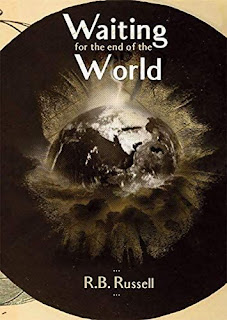
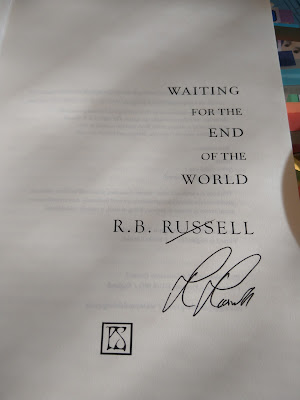
Waiting For the End of the World, by R.B. Russell


978178365958
PS Publishing, 2020
279 pp

hardcover


"It did for those with the eyes to see..."


If your only connection with R.B. Russell is the truly great work he does along with his partner Rosalie Parker in publishing books at  Tartarus Press, you should also be aware that he is also an author and a pretty damn good one.   The last book I read by R.B. Russell was his short-story collection Ghosts, and when I finished that book one of my first thoughts was that I need to read more by this man.  Off to the online realm I went for more, and I picked up two Russell books, Death Makes Strangers of Us All and this one, Waiting for the End of the World.  After reading this book, I enjoyed it so much that this morning I bought his The Stones are Singing.  I mean, I knew after Ghosts that he could do great short stories, but maintaining cohesion and  tension well enough to last the length of  a  novel is another thing altogether.  Some writers just aren't able to bring it, but that's certainly not the case here.  

I will not go too much at all into detail about what happens here, and that is because this is the sort of book where you don't realize until toward the very end that you've been given signs along the way as to what's actually going on.  Even so, I didn't actually understand that until this morning when going through all of the pages I'd tabbed; suddenly all of my synapses were on fire as I made connection after connection.  At that point it became not just a good read, but an eye-opening, crazy good read.  

It all begins as our narrator Elliot Barton is sitting in a train in October of 2006, reflecting on things, including his partner Lana, the joy of sharing life with her at their house on Sapphire Street and his job. On that first page life seems great, and then comes the first clue that there may be some trouble in this paradise.  As he says,
"Above all, I can't believe that what I did so long ago has yet to catch up with me. What I have not told Lana is I live each day as though it is my last of freedom. When the post arrives, the telephone rings, or if there is a knock at the door, I am expecting the worst, even after ... I do the calculation ... eighteen years."

 In what he describes as an "unusually fatalistic mood," he thinks about the "few words" of a  phone message he'd heard after work  and how because of it "the first stone has been loosened from the foundations of our house on Sapphire Street."   Once home, and after a night of strange dreams, the next day Lana's off to her job and Elliot plays the remainder of the message, erasing it afterwards.  It seems that a friend from his school days, Vince Reynolds, wants to talk to him about something that happened in their past.  He continues to avoid Vince on the phone, but eventually speaks to him and learns that Vince is thinking of going to the police to confess and that he would like to get together to talk.  Vince has found religion and wishes to "atone" for his "sin," to "face any punishment;" strangely though, his version of events of that day are quite different than Elliot's.   Elliot, who now has had to tell Lana what it was all about, believes it's the beginning of the end of everything; he doesn't want Vince to do anything and travels to St. Michael's  retreat where Vince and his fellow members of the Children of the Cross are now living, along with none other than a man whom the Children of the Cross believe is Jesus Christ, who has come again "to shepherd his flock."  Elliot's aim: not to have Vince reconsider his plan, but to have him "change his mind and disappear from my life once again."   What Elliot doesn't realize is that his visit to St. Michael's will change everything in ways he could not possibly expect. 


While it may sound like the plot of a crime novel, Waiting for the End of the World is anything but.  Shortly after the beginning of the present timeline, the story begins to move back and forth through  time (and knowing what I know now I'm absolutely fighting with myself to not say anything more about that).  At each move there are added elements of context, suspense and tension that kept me turning pages, yet, as I said in my initial thoughts at goodreads, while reading I kept wondering to myself what all of this was leading to.  Let me just say that there came an OMG moment toward the end where I not only realized what was happening, but also when I realized that everything that had come before has suddenly taken on momentous significance. 

Among other fascinating topics, within Waiting for the End of the World  the reader will encounter themes of religious belief through history, cults and what it is about the need for a Messiah that drives people to  gather around a particular individual to take them through an apocalypse,  the importance of dreams and the idea that one particular event can unknowingly and unwittingly change the course of things.  It's an amazing book, and the writing is utterly fantastic, drawing you in slowly until there comes that above-mentioned moment when everything just explodes.  On top of everything else, I've also made note of all of the book titles that the author included in this one, and I was so pleased to see Machen's Hill of Dreams listed among them; I'm sure that its inclusion as well as that of Rolfe's Hadrian the Seventh (and others) were not simply random choices.   

Very nicely done, and my advice for readers who at some point feel like you're wondering where this story  is headed is to just be patient and enjoy the ride,  but to be sure to pay attention along the way. In this book, things have a habit of turning up again when least expected.   This one I can certainly and very highly recommend.  Like all of my favorite books,  I can honestly and without reservation say that I've never read anything quite like it. 

Thursday, February 3, 2022

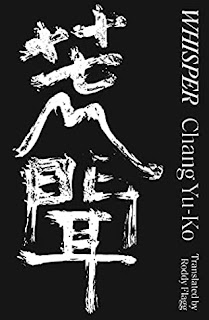
Whisper, by Chang Yu-Ko


9781916277168
Honford Star, 2021
originally published 2018
translated by Roddy Flagg
287 pp

paperback


  I ran across Whisper while browsing through World Literature Today, one of my go-to spots for discovering translated books. Reading through the review by Sean Guynes (where that link will take you), the words  "literary horror fiction," "spooky stuff" and "ghost" were what caught my eye,  and I read no further than the second paragraph because I just knew I had to have this book and I didn't want to know what happened.  

When I started reading it, I couldn't stop, finally finishing at two in the morning but remaining completely wired from what I'd just experienced.  Sleep -- not happening. 

 
Taxi driver Wu Shih-sheng and his wife Kuo Hsiang-ying used to be happy, but after Wu was laid off from his job working for an electronics importer, their lives started taking a downward path.  To make matters worse, when he'd first started the taxi driving, he'd run over someone and the victim's family took him to court where as compensation he was ordered to pay over four million dollars.  Between that and the legal fees, they had to sell their apartment; although Hsiang-ying works more than one job, their reduced circumstances had landed them in a cockroach-infested iron shack;  their daughter left home and they haven't seen her since.   And now, as the novel opens, it seems their situation just might be getting even worse: after getting yelled at by her boss at work one day,  Hsiang-ying ran into a woman in the food court causing the customer's  "bubbling tofu hotpot" to fly, scalding the woman and disfiguring her face.   Hsiang-yang blacked out and was sent to the hospital by her boss, where she could think only about the compensation the other woman's family would demand and the loss of her job.  But as things turn out, these would be the least of her problems. Back home again,  Hsiang-ying hears "an ear-splitting burst of static" just before she hears someone saying something about "a great forest of bamboo" and the name Minako.  She then experiences something completely bizarre before a fall from a window sends her back to the hospital.  

Meanwhile,  Shih-sheng decides to take a break and parks his taxi in a local cabbies' spot.  Next to his car he notices a cab that has been "clearly long closed," and decides to take a look inside.  He discovers a cassette recorder in the glove box and presses play, hearing a man's voice "interrupted by regular crackling sounds" as well as the word Minako.  When he's called to the hospital after Hsiang-ying's fall, she begs him for help -- she's sure that Minako is going to kill her and their daughter.  Surprised at hearing that name, he brushes her off, saying she's mad,  but hearing her say the name Minako takes him by surprise.   Is there some kind of coincidence at work? Later at home as he begins to think about his wife, he begins to realize that "something wasn't right," bringing his thoughts back to the abandoned cab, the cassette tape and Minako.    By now, Hsiang-ying has been moved to the psychiatric ward where her conviction that she's going to be killed grows stronger, to the point where she's "screaming hysterically" and the doctors have to put her in restraints and  sedate her.  But there is no safety for Hsiang-ying here, and her roommate watches in sheer panic as Hsiang-ying fights whatever horrors are assailing her.    

Shih-sheng comes to believe that had he only listened to his wife then things would have been different, so he decides to get to the bottom of things.  Independently, so too does a social worker, Jui-yi who is working with Hsiang-ying's by now terrorized roommate who while in a deep state of shock begins calling out strange words, talking  about ghosts, and making references to a place named Mount Jade.   Indeed, it seems that all roads lead to this place, as by now Shih-sheng has also made a connection to Mount Jade and is determined to destroy the evil that he is sure has its origins there despite a warning to stay away since "the mountain is the gateway of the ghosts."  

Someone reading this post might wonder about how much I've potentially given away here, but don't worry -- we're only up to page 83 by this time and there is much, more that has already happened and which will happen before all is said and done.  The author has created a  truly eerie ghost story that weaves together Taiwanese legend and folklore, the severity of the problems faced by Taiwan's indigenous people, the troubled era of the Japanese occupation, and history that goes back to 1930s Manchuria and the Chinese mainland.   Taken together, all of these elements reveal how, as the dustjacket blurb so accurately states, "a past can still kill."   It also shows how the spirit world is alive,  surviving beneath the trappings of the physical world and that  it is definitely not a force to be messed with, and there is no doubt that he has captured the anxieties of a modern society.  There is much to be said about the author's skill here in using horror and the supernatural to reflect on the modern world -- this is no average ghost story but rather a strong departure into the literary zone. 

 I will say that I wasn't wild about the subplot involving Hsiang-ying's sister and her revenge on her cheating husband.  While it did make for some truly creepy horror moments and shows how natural it might be for people to turn to the occult for assistance, it could have actually been left out and I wouldn't have minded, because for me it was just too much as well as a major distraction in the reading flow and I became impatient to get back to the main story. And quite honestly, I didn't care.     I also thought the ending a bit off, but I won't go into any detail here to explain why -- it should be apparent to anyone who reads this novel.    However, I loved and was completely absorbed in the ghost story itself, as well as in how the past not only reverberates in but also shapes the present in so many unseen ways.  What a mind this author must have, and I will certainly look forward to reading anything more he writes in the future.  My manythanks to the translator, Roddy Flagg, and to Honford Star for making this work available to English-speaking readers.  

recommended, for sure.  

Thursday, January 20, 2022

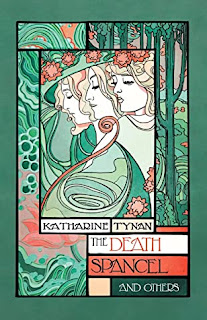
The Death Spancel and Others, by Katharine Tynan

 
9781783807543
Swan River Press, 2020
221 pp

paperback


 "There's few could look on the boorwaugh washa, the death spancel, without terror."  


For me there is no greater comfort than to make a pot of tea, grab my favorite blanket and crawl into my favorite comfy chair with a book of older ghost stories in hand.   Let's just say that it is much more comforting than even my favorite comfort food (a grilled cheese sandwich with some fresh homemade tomato soup  - a childhood holdover), and that the pleasure is augmented when what I'm reading is written by an author whose work I have not previously read.  Imagine my pleasure in finding this book (thanks to one of my like-minded goodreads friends)  -- but I did have to ask myself the following question:  

what the hell is a spancel?

As anyone might do, I googled it and discovered that it's something that "hobbles" or "tethers," with the original usage having to do with cattle.  It's definitely not put to bovine use here though, as I discovered, in not one, but two stories: first, the titular story "The Death Spancel"  and a bit later in the book,  "The Spancel of Death."  In simplest form, it is  skin cut from a corpse from head to heel in one swoop, much like one might do with an apple.  From the second story we learn that the cutting of the skin is done with "ceremonies so awful that it would make this story too ghastly reading to detail them."  In his introduction, Peter Bell notes that it is a "grim artifact of Irish lore;"  William Gregory Wood-martin goes a step further in his description in volume one of his Traces of the Elder Faiths of Ireland: A Handbook of Irish pre-Christian Traditions, calling it a "love charm of most gruesome character."  (Just as an FYI, that link goes to Google Books where you can download the book for free; mine is a paperback copy from Alpha Editions.) In the first story, it "dangles" from the "dusty rafters of Aughagree Chapel," a "devil's charm" of "such power that no man born of woman can resist it, save by the power of the Cross."   This story, which begins with remembrances of a priest fighting "with the demons" over the soul of Mauryheen Holion, has a most gothic atmosphere to it, as evidenced by passages like this one:
"...the servants in Rossatorc Castle said that as the priest lay exhausted from his vain supplications, and the rattle was in Dark Mauryeen's throat, there were cries of mocking laughter in the air above the castle, and a strange screaming and flapping of great wings, like to, but incomparably greater than, the screaming and flapping of the eagle over Slieve League."

The "devil-may-care" Sir Robert Molyneux and the lovely Lady Eva are to be wed in just two weeks' time, but it seems he can't help himself when it comes to the women "of a class below his own."  Even though "the germ of good in him" knows that this is wrong, and even though he  promises himself that he'll never do it again, from the moment he catches "sight of a girl's dark handsome face on the staircase" his fate is sealed. In the other story using this device, "The Spancel of Death," the girl doing the binding is an "Eastern beauty in the wilds of Mayo," Sabina Doheny,  who was once a "lonely, fierce, haunted child" and "pagan at heart" but now  "protegĂ©e"  and maid of the daughter of the local Marquis.  Lady Kathaleen's fiancĂ© is Sir Harry Massey, and once again, as in the case of  Sir Robert Molyneux, once Sabina's eyes lit upon his face, her "heart had awakened with a madness and a violence beyond expressing."  Given that Sabina had once lived in a hut with Mag Holon, the local witch, she knows exactly where to go and what to ask for.  Be warned, old Mag reminds her,  "There's few could look on the boorwaugh washa, the death spancel, without terror."  

While those two stories alone were well worth the price of this book, there are plenty of other topnotch tales included here.  I have to say that I have read more than a few volumes of ghostly/strange tales, some of which are so predictable that they're hardly worth reading, but that is not the case here. Take for example   "A Sentence of Death," which I thought was going to be a sort of rehash of Benson's "The Bus Conductor" from 1906, when something similar happens and a driver offers the main character "Room for one more, madame." But I was pleasantly surprised with what Tynan did with this story, since (as described in the introduction, which should be left until last), the focus was much more on the poor woman as she undergoes a great internal turmoil. It seems that while "Life at the Manor House flowed by in its old, delightful way," Marion Desborough finds no joy either in her upcoming wedding, nor in life itself, as her memory of an event takes a toll on her mental health and she waits for her death which she believes has been sent by portent.  Her loved ones try to convince her it was all a dream, but, well, Marion seems to know better.  And then there's "The Dream House," in which Reggie Champneys is cut off without a penny because of his marriage to a dancehall girl and even worse, Champneys, the family home he loves,  goes to another relative.  His wife, Kitty, is told about the "Champneys ghost," but this is no ordinary haunted house story whatsoever.  

Two stories sort of jumped out in the "most disturbing" category,  "A Night in a Cathedral" and "The Picture on the Wall."  In the first a young officer becomes "obsessed" with a young woman who lives with her father near his regiment's barracks to the point that he follows her every evening as she enters a "gothic" cathedral for Evensong. He does this for months on end, hiding in the shadows to prevent being observed.  One night, not feeling well while "inhaling one knew not what foul vapours" he faints, only to find himself completely alone, locked inside the the cathedral, and realizes he must stay there until the morning, in the dark with no light. It's then that he notices the waters rising over the floors ...  "The Picture on the Wall" begins as a young woman refuses to give the man who loves her a specific wedding date, for reasons she will not reveal.  Eventually though she takes him home to meet her father, who not only seems hostile towards him but also puts him in a certain room of the house for his stay.  This is another one where I thought I could guess the ending, but I was (happy to be) very, very mistaken.    

There are still another half dozen or so stories remaining in this volume , along with a number of poems; the final section of the book includes other short writings, including a "weird tale," by the author, a "chat" with Tynan, and a brief anecdote about fantasy author Lord Dunsany.  All in all it's a fine and engrossing collection; and while not unexpectedly some stories worked better for me than others, it was still a great pleasure to read and to lose myself in this author's strange tales.  Leave it until the end, but do not miss the great introduction by Peter Bell.  I'll happily recommend this book to others who enjoy finding new (old) authors, women writers whose work has sadly sank into obscurity,  and to those readers who are fans of older Irish fiction and folklore as well. And it's from Swan River Press, which has provided me with hours and hours of great reading time over the last few years, so you know it's going to be good.  


Wednesday, December 29, 2021

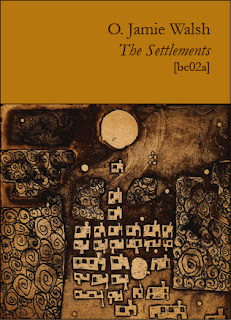
another outstanding book from Broodcomb: The Settlements, by O. Jamie Walsh


9781999629816
Broodcomb Press, 2018
236 pp

paperback


The Settlements  is set in an area known as "The Peninsula," which, according to Broodcomb's webpage, "abounds in strange tales." It is  a place where "the settlers have found harmony," providing "tales both eerie and shocking" which also explore the "fantastic/everyday meaning of what it means to be human," and I can't begin to express how very happy I was to  be back there again.  One more thing: while the back-flap blurb notes that this book is "plotless and meandering,"  don't believe it.  


The narrator of this book is an omissioner, whose function is to "offer an ear," to serve as "a valve for the bleeding of grief or worry," in short, to be available for anyone in the Settlements who needs to have someone to talk to.  Each settlement is different, depending on the "world focus" its population espouses, and the omissioner must be able to adapt himself/herself to all of them.   For example, the settlement of Emotion 
"is a place of whiny indulgence, populated by the emotionally incontinent, the adolescent or the theatrical...The inhabitants are interested in how feelings live, how humans live within them and what emotions feel like to be inside"
 while the settlement of Fear (one of two the omissioner dreads visiting),  "focuses on visitors" and  which on entering, 
"the day darkens, which is less accident of mind or weather but achieved by light-inhibiting screens across which shapes can be projected to become shadows in the shape of raptors or devils when they touch the ground."

The narrator moves through the Settlements, going where needed and describing the places as well as the myriad issues faced by those who need him while also offering his observations on other matters both external and internal, including bits of  "mind-chatter."  That alone would make for great reading on its own, but of course, there's much, much more, with plot threads that appear and reappear, ultimately forming connections.  There's a certain Dr. Krab who has spent time exploring various patterns that lead to a startling conclusion, also channeling strange thoughts,  a murder, a strange "fox boy" with orange fur, a book entitled A History of Dice and Counter Games detailing  some of the strangest  (and macabre) games such as the deadly "Six Gates of the City" and "The Uncertain and the The Beguiled,"  as well as a rather sinister and creepy golf game.  And then there's a chapter from a new Judge Dee book, which, as an aside, I found absolutely brilliant since I  love van Gulik's Judge Dee novels. What is the significance of the number 63?   And just who is the strange and sinister woman who, impossibly, hasn't aged in twenty years but seems to be everywhere?   I haven't even mentioned the dead girl preserved in the "huge specimen jar..."  

Plotless and meandering? No way.   The Settlements is carefully and cleverly constructed, falling more on the surreal side than probably any of the Broodcomb novels that have come before, while taking a look at what it means to be human, to feel, and to make connections.     And speaking of those books that have come before, anyone who's read them will quickly notice the intertextual connections made here, especially in the case of The Night of Turns, which, in reality, I'm actually glad I read before this one.  Don't worry -- having knowledge of what happens in any of the other Broodcomb titles isn't a necessity for reading The Settlements.  

As was the case with Night of Turns, I found myself completely caught up in the strangeness and the lives of these people as well as the quirky happenings, and The Settlements also affected me on an emotional level.  I was beyond sad when this book was over, a little choked up, and left in a sort of daze just going over it again in my head once away from it.     Once again readers are warned that "This might not be for you," but by this point I know better.  

Absolutely stunning and superb.  


Monday, December 27, 2021

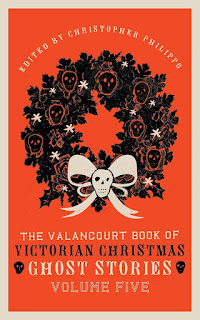
The Valancourt Book of Victorian Christmas Stories, Volume Five (ed.) Christopher Philippo


9781954321540
Valancourt Books, 2021
257 pp

hardcover

"The Christmas Party that has just listened to a ghost story would rather go on all night, drinking in fresh horrors, than separate to their cold and gloomy chambers." 


I would happily reinstate this Victorian Christmas tradition if I thought that anyone in my family would love it as much as I do, but I'm quite content to settle for just reading these old ghost stories each year on my own.  After all, as we're told in this book, 

"The telling of ghost-stories, no less than the eating of turkey and plum pudding, is inseparably connected with Christmas in the popular idea!"

 For the last five years, at least, it's just not been Christmas anymore without taking my copy of the latest of edition of Valancourt's Victorian Christmas Ghost Stories off of its shelf, and as long as they keep publishing them, I'll keep buying them.   While it's true that I have a deep fondness for ghost stories in general, what I really love about these anthologies is that I always find a few stories by authors previously unknown to me.   This year that list is nice and long -- leaving out the poems, and the one story attributed to Anonymous,  out of the remaining sixteen tales editor Christopher Philippo has selected for inclusion, there are a whopping ten (with one of these having two stories here) who are brand new to me.   That's always a bonus.   

One of those ten is Mabel Collins, whose short bio blurb reveals that she had "learned of Helena Blavatsky's occult Theosophy religion in 1881," meeting her in 1884.  In 1885, she had published a book she'd begun the year before, The Light on the Path, claiming that it had been "dictated to her by some mystic source".  A little digging reveals that this "mystic source" was the Master Hilarion, who had himself "received it from his own teacher, the Great One who among Theosophical students is sometimes called 'The Venetian.' "  Philippo notes that The Light on the Path had been "written in an astral cipher, and can therefore only be deciphered by one who reads astrally."  It's easy to see some of her beliefs embedded in her story included in this volume,  "A Tale of Mystery," in which a young man becomes beyond infatuated with a woman, leaving his friend in despair because he is absolutely certain that this woman wants to lead said young man "to his destruction."  Evidently his "suffering" has been transmitted far and wide across the spiritual plane, as he receives some help with his problem from a strange and completely unexpected source.   Another  story by a previously-unknown-to-me author is "The Siren," by Thomas Grindley, whose pen name for this piece was Magister Monensis.  Subtitled "An Adventure in Manxland," offering the clue that the location for this tale is the Isle of Man.  It seems that just before Christmas, a man who lived with his wife a few miles south of the town of Ramsey had received a telegram causing him to leave home to be with his parents due to an accident suffered by his father.  On the return journey,  along the way he finds himself in a "miserable position" in the middle of a violent storm complete with fog, and is forced to stop in the village of Old Laxley with five or six miles of "exposed road" still to travel in the darkness.  Because of an "overpowering longing to get home,"   he leaves his exhausted horse with an innkeeper and sets off on foot, with only a lantern to light his way.   During a short rest break, his attention is "suddenly arrested" by a faint sound, much like a "woman in deep distress," and he goes in search of its source.   I'll say no more, but thinking the title is a dead giveaway, I thought I'd figured out what would happen next.  I was so wrong.  

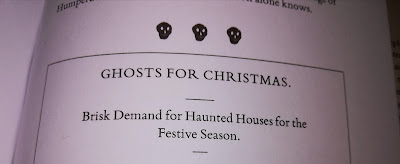
Every so often you run across fun little things the editor has unearthed in his research, for example, this article from the December 5th, 1907 edition of The Daily Mirror


informing readers that a "prominent West End real estate agent" has a "list of ancient houses which are claimed to be visited with apparitions" on hand for "many Americans and a few Englishmen" whose "beau ideal" is "spending Christmas in an old house which has the reputation of being haunted"  or 


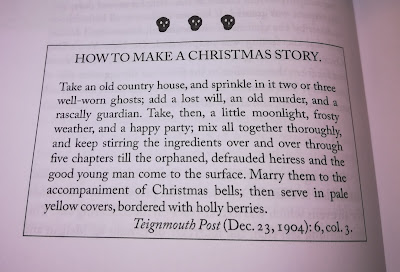
this recipe for "how to make a Christmas story."  I love this stuff.  


For the sake of brevity, and although I didn't encounter a story I didn't like,  I'll offer just one more example, this time from someone whose work I know -- Barry Pain's "The Undying Thing,"  a story which, as the editor quotes one contemporary reviewer,  "no one should tackle after eating a plum pudding."   This story moves across generations, starting with a murder, a remarriage, a child, and a curse on the family lineage.  The sixth baronet of the Vanquerest family, Sir Edric,  "a fine young fellow and popular in the village," does his best to stop the village gossip about a certain spot called Hal's Planting, "said to be haunted by something that will not die" by sleeping there, but to no avail; evidently an ages-old curse and a legend are hot topics of conversation at the Stag.  One day, while the current Sir Edric is away from home, his friend gets word of a corpse found at Hal's Planting, and even worse, in sorting through some papers he discovers a parchment having to do with "the devil's wolves" and something far worse, far more malevolent.  Shivers.

I wish I had time to talk about each and every story in this book, but suffice it to say I had a great time reading all of them.  Once again Christopher Philippo has done an excellent job not only finding the material but also in writing his brief introductions to each and every story.  I will also say that while it's a fun book to read over the holidays, it would be a fine read at any time of the year for those people who, like me, love these older ghostly tales.  

Now I'm already looking forward to volume six ... 

Saturday, December 25, 2021

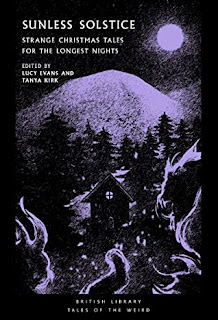
Sunless Solstice: Strange Christmas Tales for the Longest Nights (eds.) Lucy Evans and Tanya Kirk


 9780712354103
British Library, 2021
288 pp

paperback

"Night, and especially Christmas night, is the best time to listen to a ghost story.  Throw on the logs! Draw the curtains! Move your chairs nearer the fire and hearken!"  


For me it's more a case of brewing some cardamom chai tea (with milk, of course), grabbing my favorite blanket, curling up in a cozy chair and opening a book, but I'd say the Victorians (in this case Frederick Manley) had it right:  who wouldn't love to sit in the darkness with only a roaring fire for light and listen to a ghostly tale or two?   

While there are only three stories from Victorian times in this anthology, they are three really good ones.  Frederick Manley's  "The Ghost at the Crossroads: An Irish Christmas Night Story" (1893)  kicks off this anthology, finding a Christmas party in full swing at the "snug home" of the Sweenys in Derry Goland as the winds are howling outside.  Just as it's time for the dancing to begin, with "the fun ... at its height," the revelry is interrupted by "the banshee's cry."  It's not really a banshee, of course, but a young man with a story about a strange card game with a "thing in black."  Definitely the  perfect opener for what's to come, and the weirdness doesn't end there.  Continuing on with the Victorians,  there's Lettice Galbraith's "The Blue Room" (1897) which I've read elsewhere but still love,  and last but not least, a story by American writer Elia Wilkinson Peattie,  "On the Northern Ice" from 1898.   Ralph Hagadorn is on his way to stand as groomsman to his best friend, getting a late start due to a delay caused by business.  Skating across the Sault Ste. Marie region in the dead of night where "in those latitudes men see curious things when the hoar frost is on the earth," he suddenly realizes that not only is he not alone, but that the mysterious "white skater" is leading him away from his intended path.  More than hints of the strange in this story, and we're not just talking about ghosts. 


Of the next two stories, written in the 1920s,  E. Temple Thurston's "Ganthony's Wife" (1926) is completely new to me, while I'd previously read WJ Wintle's  "The Black Cat" from its original source, Ghost Gleams: Tales of the Uncanny (1921), republished by Sundial Press in 2019.     Thurston's story, while beginning with the lament that "The custom of telling stories round the fire on Christmas is dying out," focuses on a ghost story told sitting "round a blazing wood fire" at a house party.  The teller of the tale swears it's true, and that it's definitely not for children.  Trust me, it isn't.  

The 1930s are represented here with Hugh Walpole's 1933 story from The Strand, "Mr. Huffam" which quite honestly I didn't care for and Margery Lawrence's "The Man Who Came Back" from 1935, which I very much enjoyed.   I'm a true fangirl of any story with a sĂ©ance at its heart; add in a medium's warning, a reluctant spirit guide and some "decidedly non-festive revelations," and well, you have a topnotch story here.  I love Lawrence's work; in her lifetime she was, as the editors reveal, a "committed spiritualist" and member of The Ghost Club;  sadly she's somewhat underappreciated today, which is a true shame. 


from abebooks 


Bypassing the 1940s,  "The Third Shadow" by H. Russell Wakefield was  first published in Weird Tales in November 1950.  To digress a moment, to my great delight because I'm a huge fan of the goat-footed god, the cover of that edition (above) features a Pan-like figure  playing his pipe and cavorting in a forest, cloven hooves and all, with what looks to be a mountain range in the background.  That would make sense as "The Third Shadow" is a tale centered around amateur mountain climbers.  Told to an anonymous narrator by Sir Andrew Poursuivant as they sail to New York on the Queen Elizabeth, it is the story of a man named Brown, "a master in all departments, finished cragsman and just as expert on snow and ice."  It seems that Brown, in one of his reckless streaks, proposed to and married a woman named Hecate, who "made his life hell,"  and who was "a good deal heavier" than her husband.  Two years after their marriage, Brown took Hecate to the Mer de Glâce glacier for a morning of training, during which her rope broke, sending her falling into a crevasse.  Although he swears he'll never climb again,  Sir Andrew reluctantly talks Brown into a trip up the Dent du GĂ©ant,  "a needle, some thirteen thousand feet high."  It is a climb Sir Andrew says he will never make again because of what happened that June day.   Following Wakefield is Daphne Du Maurier's "The Apple Tree" (1952) which I've read more than a few times, and then there's a bizarre and rather creepy story by Muriel Spark called "The Leaf-Sweeper" (1956) about a young man who wants to abolish Christmas and whose anti-Yule rantings land him in a mental asylum.   But wait. There's more -- but I will say nothing about what happens next.  Great story, actually, and a personal favorite. 

Robert Aickman's "The Visiting Star" first published in 1966 (in Powers of Darkness: Macabre Stories) tops my list of favorites here.  It  is not the weirdest story I've ever read by this author (whose often-cryptic work I absolutely love) but strange it is all the same, employing here, as he often does, bits of the mythological, the psychological and just plain weirdness to tell the story of Arabella Rokeby, an actress who is set to make a return to the stage in a play she'd starred in years earlier in London, now being produced in an "unused and forgotten" theatre in some out of the way town.  When "the great actress" arrives accompanied by her strange companion named Myrrha, Colvin (an expert on lead and plumbago mining),  expecting an aging woman, is somewhat surprised by her youthful looks, but that's not the only strangeness to be found in this most excellent tale, a truly great choice by the editors for inclusion.  

The closing story in Sunless Solstice is from 1974 by James Turner, from his collection of stories called Staircase to the Sea : Fourteen Ghost Stories. I've looked for this book everywhere and sadly, I can't find a copy anywhere. In  "A Fall of Snow" Nicky, a boy from Cornwall, is staying at his uncle's farm in East Anglia  over the Christmas holidays while his parents are in New York; the arrival of snow both awes and terrifies him.  Why this is so I will not say, but a toboggan ride with his cousin heralds the unexpected and the strange.  

 As is the case with the other books in the British Library Tales of the Weird series, it's a true delight reading the work of past masters of the strange.  The editors of Sunless Solstice  have certainly done their research in putting together this book, leaving their readers with enough scary chills and weirdness to take them through the Christmas holidays, but as always, you don't need to limit yourself to the season to find joy in the reading.    Very nicely done, and of course, definitely recommended.    

Friday, December 17, 2021

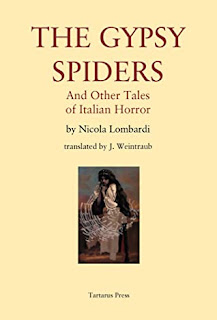
arachnophobes beware (part 3): The Gypsy Spiders and Other Tales of Italian Horror, by Nicola Lombardi

 
9781912586325
Tartarus Press, 2021
240 pp
translated by J. Weintraub

hardcover

Last year I read the first volume of The Valancourt Book of World Horror, and in their introduction the editors posed the following question to their readers:

"What if there were a whole world of great horror fiction out there you didn't know anything about, written by authors in distant lands and in foreign languages, outstanding horror stories you had no access to, written in languages you couldn't read..."?

It's a very good question; as those editors also stated, "... there's a much larger body of world horror fiction out there than any of us would suspect."    At the end of my post about that book, I noted that it is a true pity that "so much great writing is out there that remains unavailable to an English-language readership."   Valancourt, of course, has a second volume of world horror on the horizon, but I'm beyond delighted that  Tartarus has also opened the window onto that "whole great world of great horror fiction" with its publication this year of Nicola Lombardi's The Gypsy Spiders and Other Italian Horrors.  To Tartarus and to translator J. Weintraub, a huge round of applause for making this book happen.   

As Weintraub notes in the introduction to this volume, Lombardi grew up in an area of Italy the author once described in an interview as "a stewpot boiling over with folkloristic legend and dark tales of crime, filling the imagination with nightmares. "  It was also a place where "so very many ghosts" wandered "between fogs and immense desolate spaces, between woods and abandoned farmhouses." A fan of writers such as Lovecraft, Poe, Blackwood,  Bradbury, Fritz Leiber and Dino Buzzati (one of my favorite Italian authors) in his younger days, influenced as well by the stories told to him by his grandparents," Lombardi started publishing his own work in the late 80s.  

 In 2013 The Gypsy Spiders won "one of Italy's most prestigious awards for horror fiction," the Premio Polidori.  Originally published in 2010, this story (which is actually novel length) begins in  late summer of 1943, the year that an armistice with the Allies had been declared by the Italian government, a move which turned their former German allies into their enemy.  Michele, an Italian soldier now in a hospital in Albania after being wounded, decides it's time to leave the front and go home to his family.   On his return he discovers that his younger brother Marco has completely vanished, his family left suffering from the loss.  As we're told,
"He had lived next to death for months, side-by-side with it, and now that he had managed to escape and find shelter in, for him, the safest and most beloved place on earth, he realised that the horror had only preceded him there, to welcome him home."

But what he hasn't realized is that the true horror is only beginning.  

 In "Alina's Ring,"  a wounded soldier wakes up to discover himself in a farmhouse, being taken care of by a young woman named Alina.  He notices that "there was something not quite right" in her eyes; and that she "was determined to unburden herself of the thoughts that were cascading through her mind."  As they talk, he's looking for a "way out" -- and about this story I will say no more.   "Sand Castles" finds an elderly man returning to his beloved Villa Dora which he'd been away from since 1945, at age nine.    As Italy was "being rebuilt," his family took him to Bologna, where he'd rebuilt his own life right on through to retirement.  Now in his mind, it is time to go back to the Villa Dora, to give "destiny the chance to complete the plan designed for him."  When he finally arrives, he hears his old childhood pals "calling out his name..."   Weintraub notes that in these stories, it's "the actuality of the war and its aftermath that lead to madness, obsession, and significant 'collateral damage'," and in these three stories, all of  these elements scream loudly from the page.  

Six incredibly dark stories remain in this volume, nearly all of which are gut-level disturbing and much darker than I normally tend to go in the realm horror fiction, but god help me nothing short of a bomb blast in my living room would have made me put the book down while reading them.    I'll mention two here.  First, "Professor Aligi's Puppets," in which a young boy's fascination with puppet theatre takes a turn into nightmare territory, and "Striges," my favorite story in the book, which thoroughly chilled me to my bones.  In that one, a man looks  back in time to recall something he'd witnessed in his childhood that left a "kind of knotting" in his stomach (a similar reaction to my own with each step of this story, by the way) when he thought about his friend Francesco,  the "prisoner of a situation so horrible its true nature could hardly be fully understood."  As kids, Francesco and his friends were fascinated with spiritualism, flying saucers, divination and "on and on," fueling their imaginations with comic books, television, horror novels,  movies etc.  The trouble begins when Francesco reveals to his buddies that his mom is writing a "study on witches," and would be going on a trip throughout Europe.  As the narrator recalls, the boys got a bit of a charge over that, knowing that "whatever she might bring home would launch us further off the face of the earth," before offering his observations in hindsight that "she would be bringing us the burial, once and for all, of our childhood, and much worse." 

These are stories which demand more than just a quick read through, and which also need to be pondered on many levels.  While they are extremely disturbing, these stories reveal a major depth of insight into human nature on the author's part, as through his writing he makes very clear that, as noted in the introduction,  the source of evil can often be seen to stem from the "individual and collective hearts of men and women."  He doesn't have to resort to old, well-worn and tired tropes for cheap thrills here that quite honestly turn me off --  Lombardi offers his readers an eerie but sophisticated blending of the "uncanny and otherworldly" that slowly seeps not only into the lives of his characters, but under the skin of his readers at the same time. 

Absolutely brilliant and very, very highly recommended.  And Tartarus people: please consider more translated works in the future ... they would be very much appreciated.