Showing posts with label Broodcomb Press. Show all posts

Sunday, October 15, 2023

Nocebo, by R. Ostermeier


9781739733940
Broodcomb, 2023
281 pp

hardcover

First things first:  a mega thank you to Jamie Walsh -- you know why. 

I had actually started this post Tuesday of this past week, and I had meant to finish it long before today,  but I've had a weird week of waking up at 4:30 in the morning and have subsequently been  living in a haze from the lack of sleep.  Today's the first day of clarity since.  

 The latest volume published by the phenomenon that is Broodcomb Books is Nocebo, a collection of stories that I've been raving about to anyone who will listen.  Once again we find ourself back at the Peninsula, not surprising since Broodcomb Press is, as noted on its website, the "House publisher " for the region.  First time visitors should know that the Peninsula,  according to a quote from the author's Therapeutic Tales,  is  a place that is "welcoming to the unusual."  

Three new stories grace this book along with a fourth, "Upmorchard," which was published in 2021 as a limited-run hardcover  book.  The publisher made it very clear at the time that Upmorchard was "never to be reprinted as a standalone volume," so anyone who missed it at the time has a second chance now. I urge you to take it.   You can read my post about it if you'd like, but the bottom line is that it was such a disturbing story that I had to stop reading for a couple of days after finishing it because I needed a mental reset.  It still bothered me this time around with the second reading, especially in the context of what comes before it. 


photo from Ancient Yew Group


In "Winn's Clock," which opens this volume, there is a particular moment in which the narrator finds himself in conversation with a green-eyed girl, and wonders if  his participation in that discussion, "having grown up on the peninsula, with its long history of strange tales..."  might " close a door" between the fields he knew and the fields he "knew not -- vanishing behind me so I'd never be able to return."   I tabbed this particular passage when I'd gone back to reread this story after finishing the book because it hit me at the time that in its own way,  it characterizes what happens throughout all of the stories in Nocebo. 

Although I can't really reveal too much about this or any other story here since these tales (as are all written by this author)  are experienced, rather than just read,  I can offer a slight peek into the three that are new as of this reading.   "Winn's Clock" is  a prized possession in the narrator's otherwise poor household, belonging to his grandfather Winn, who had "been largely itinerant for much of his life, spending time on the seas and for long periods travelling with the caravans."  People used to say about Winn that "He wanders" which as the narrator notes, "had a financial effect on us."  It was only the occasional "windfall" that would save the family, but like the clock, the origin of the money was a mystery to the boy until he was later enlightened by his uncle.   The clock itself was a unique piece, with "no winder or hole where a winding key might be inserted," and with steel "seemingly without join or access" that was always "bright as if new-worked." The only problem with the clock was in the wood, which "suffered from woodworm," yet was never destroyed.  Winn worked at the problem but could never fully solve it, as new tunnels would appear in different parts of the wood after one part had been fixed.  An offhand remark from the boy's mother leads to an act of love and kindness on his part that will change everything for this family, with long-lasting effects.     "Moving the Yew" is my favorite, actually remaining in my head for a full two days after reading it and preventing me for the duration from  moving on to the third story.  Members of The Yew Society, "whose remit was the preservation of yews on the peninsula," have taken on the project of moving a certain yew tree near Buddyn, due to a change in the course of the river.   The narrator, R. Ostermeier, on a break from his counseling duties, is asked to join his friend and the others in the group as they move the tree "the old way," with the only modern equipment a backhoe.  Doing it this way was the idea of the project manager, Rebecca Birdwhistell, as "she was insistent on traditional methods." The project gets underway and the yew is uprooted, but something is left behind in the earth, "right in the centre of the tree."  As the narrator notes, "Only then did the implications come clear. Birdwhistell had said the yew might be over a thousand years old, perhaps older still."  But there is much more to come for these people, and the implications will be become even clearer as the object is opened and its contents revealed.  The story takes  place over several days as the tree is moved; in time even small things will come to take on the greatest significance for a few members of the group, as "the whole area of land came to life. Or took hold of people."   Even more significant is the epigraph by Rainer Maria Rilke that precedes this story:
"... Life that is not concerned with us celebrates its festivals without seeing us, and we look on with a certain embarrassment, like chance guests who speak another language."
 Trust me here, it's absolutely killing me to say nothing about this incredible story, which like "Winn's Clock," has deep connections to history, nature and ritual.  The final story is "Mommick," about which writer and real-time reviewer Des Lewis says "... we have a dark masterpiece on our hands."  I have to wholeheartedly agree (and in a Facebook-post conversation with him I did agree)  with his assessment -- I have never nor do I believe I will ever again read something quite like this one.  If the first two stories left me feeling especially unsettled and uneasy, "Mommick" took me completely over the edge, making me feel that there must be some way beyond ordinary verbiage to express what this story did to me.  This story outdarks both of its predecessors, and as deeply as "Upmorchard" affected me, "Mommick" is even more frightening in its implications.  At this juncture I will offer readers the same warning that comes with all of the Broodcomb books  -- "it might not be for you." The narrator of this story is Bartoš Gerard, named after his grandfather, a photographer who had a love for "single subject focus."  His work found its way into books he'd put together, one of which, Murder Ballads, was a favorite of the narrator's as a boy.  In this book, he set models, dressed in "ordinary street clothes," into tableaux depicting various murder scenes, "some unwisely or unfortunately close to notorious crimes of the  time."  His grandfather's book, Scarecrows, on the other hand,  "terrified" him, filled with photos of "a succession of sinister figures in stark black-and-white, few what might be called regular."  As he notes, "To a child, those photographs were dream poison."   While in his twenties, a small publisher put together a bibliography of his grandfather's books, and the narrator discovered a book he'd known nothing about, a volume called 6:20.   It kept with his grandfather's "single subject focus" approach, but the photos were not his work, and he was the subject -- "naked and grotesque."   He has no idea where the photos originated, he doesn't remember having the photos taken, and they were not the object of blackmail.  His friend had collected each one as they arrived in the mail.   Starting with the photos themselves, his grandson decides that he needs to find out what he can about this "episode" that had changed his grandfather's life, setting off on a quest to discover what he can.  This is where it all turns very weird, and that is all I'm going to say about this one.   

The dustjacket notes that "Winn's Clock" and "Mommick" draw from deep wells of rural disquiet," and that's an understatement, especially with "Mommick."  The ending of "Winn's Clock" left my jaw on the floor, I'm sure, and with "Mommick," despite the darkness, it is on many levels a most poignant and very human story. It completely scared the holy bejeezus out of me while simultaneously hitting me very hard on a gut, psychological level.   "Moving the Yew" hit some deep level of resonance within, largely due to my own interests in myth, folklore and ritual, as well the author's focus on the connections between humans and the natural landscape through time.   When I closed the book after finishing it, I said to my husband that this may be the best Broodcomb book yet, but as he replied back,  "you say that about each one."   This time I'm positive.  Beyond positive.  Well beyond positive.  

So highly recommended that it's off the charts highly recommended, and anyone who has become a fan of Broodcomb and the Peninsula should definitely not miss Nocebo.  It will also appeal to readers of the strange and the weird, and quite honestly, I don't know how the author continues to produce such great, intelligent work but please, keep it coming.  

Saturday, April 30, 2022

Delivery Artefacts, by Jude Golby and Another


9781999629885
Broodcomb, 2021
216 pp

hardcover (#21)


It's been a while since my last visit to the Peninsula,  and I am happy to be back.  I still have one Broodcomb book left to read (The Revenants) and one to anticipate, Therapeutic Tales, which also marks the return of R. Ostermeier.   Another edition of  Therapeutic Tales is also forthcoming from Zagava this summer,  in what looks to be a gorgeous lettered edition limited to twenty-four copies  (my apologies if it's sold out by the time you click on that  link to preorder it).  

Somewhere between Ockmarsh and Petersdock stands a group of old farm buildings that have been converted into a research facility, where a certain Dr. Hoskin and her team are involved in a study into preservation of the mind "beyond the death of the body."   One of the minds under study there belongs to John Moonfield, "the first of the legacy minds," which are those "that are, or were, at the forefront of their fields," and "whose death puts a brake on human progress."   While the body may be dead, these are minds that are still able to "contribute" long after death.   The short explanation of how this happens is that after a particular chemical allows 
"every meat part of the brain, in a global, door-jamb rattling bang, splitting all the hinges when each synapse and connection slammed open," 

the mind's contents are stored in a substance called "chain-fluid" which afterwards are drawn out, and 

"everything in a human brain, the mind, the knowledge, the personality, the memories and the essence... was decanted into a jar entire."  

After that, it could be months of waiting to see if delivery is complete.   Literature teacher Jude Golby has been approached by Hoskin to come to the facility, where his task would to be "test" Moonfield, so that the scientists would be able to gauge whether or not " what has been delivered is -- in his thinking essences, the same man" whom Golby knew while Moonfield was alive.   This is a critical step in Hoskin's work -- in some cases, the process was never completed -- but if Jude can talk to Moonfield (via another process I will leave for the reader to discover)  and verify that it is the same person he'd known, then Moonfield's "reasoning and work" can  be gathered and put into "publishable shape."   Moonfield's mind is not the only one at the facility; some are "partial," some which were complete but have gone silent and another whose memories are recalled to another member of the team.   During one particular conversation with Moonfield, Jude notices that a few words did not come through as speech, and when he asks Hoskin about a particular phrase Moonfield used that could only be heard on the recording of the conversation, he learns that as the minds are delivered, "something else comes through. Artefacts." It happens soon after they return:
" They speak of places they never knew in life as existing structures within their visual understanding. But nothing can be in that chain-fluid that wasn't in their original brains. Nothing should be strange or unrecognised to them. But they speak of distant buildings, and when we drilled down into it, they all see the same structures. And they're drawn to them."
As time passes, the minds "lose focus" as they become more drawn to these structures.  Jude suggests that they send Moonfield to his structure to explore, but the scientists have already done that once with a mind that "never came back."  Jude, however, is determined to "know how they see" and to "know how these otherwheres are the same and how they're different.  He is given three days.  As the dustjacket blurb notes, the "report that unfolds is an unsettling addition to the Broodcomb Press family,"  and trust me on this -- unsettling is a mild word in this case.  

There are all manner of issues explored in Delivery Artefacts; chief among them all is (as also stated on the dustjacket), "what it means to be a human being," but there's also a focus on the ethical questions that science can often raise, the nature of memory and an exploration into the mystery of the human brain. I was also happily surprised to see G.R. Levy's The Gate of Horn mentioned at the end of the book -- one of my university required reads that has made it through every move we've ever made.  

While Delivery Artefacts is very different from the other Broodcomb books I've read, it is still edgy, compelling, deeply philosophical and in my case completely unputdownable.   There is nothing quite like the Broodcomb experience; as someone who has read pretty much everything from this unique publisher, I should know. 

very highly recommended


Wednesday, December 29, 2021

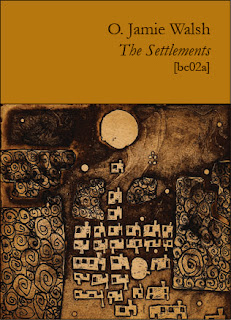
another outstanding book from Broodcomb: The Settlements, by O. Jamie Walsh


9781999629816
Broodcomb Press, 2018
236 pp

paperback


The Settlements  is set in an area known as "The Peninsula," which, according to Broodcomb's webpage, "abounds in strange tales." It is  a place where "the settlers have found harmony," providing "tales both eerie and shocking" which also explore the "fantastic/everyday meaning of what it means to be human," and I can't begin to express how very happy I was to  be back there again.  One more thing: while the back-flap blurb notes that this book is "plotless and meandering,"  don't believe it.  


The narrator of this book is an omissioner, whose function is to "offer an ear," to serve as "a valve for the bleeding of grief or worry," in short, to be available for anyone in the Settlements who needs to have someone to talk to.  Each settlement is different, depending on the "world focus" its population espouses, and the omissioner must be able to adapt himself/herself to all of them.   For example, the settlement of Emotion 
"is a place of whiny indulgence, populated by the emotionally incontinent, the adolescent or the theatrical...The inhabitants are interested in how feelings live, how humans live within them and what emotions feel like to be inside"
 while the settlement of Fear (one of two the omissioner dreads visiting),  "focuses on visitors" and  which on entering, 
"the day darkens, which is less accident of mind or weather but achieved by light-inhibiting screens across which shapes can be projected to become shadows in the shape of raptors or devils when they touch the ground."

The narrator moves through the Settlements, going where needed and describing the places as well as the myriad issues faced by those who need him while also offering his observations on other matters both external and internal, including bits of  "mind-chatter."  That alone would make for great reading on its own, but of course, there's much, much more, with plot threads that appear and reappear, ultimately forming connections.  There's a certain Dr. Krab who has spent time exploring various patterns that lead to a startling conclusion, also channeling strange thoughts,  a murder, a strange "fox boy" with orange fur, a book entitled A History of Dice and Counter Games detailing  some of the strangest  (and macabre) games such as the deadly "Six Gates of the City" and "The Uncertain and the The Beguiled,"  as well as a rather sinister and creepy golf game.  And then there's a chapter from a new Judge Dee book, which, as an aside, I found absolutely brilliant since I  love van Gulik's Judge Dee novels. What is the significance of the number 63?   And just who is the strange and sinister woman who, impossibly, hasn't aged in twenty years but seems to be everywhere?   I haven't even mentioned the dead girl preserved in the "huge specimen jar..."  

Plotless and meandering? No way.   The Settlements is carefully and cleverly constructed, falling more on the surreal side than probably any of the Broodcomb novels that have come before, while taking a look at what it means to be human, to feel, and to make connections.     And speaking of those books that have come before, anyone who's read them will quickly notice the intertextual connections made here, especially in the case of The Night of Turns, which, in reality, I'm actually glad I read before this one.  Don't worry -- having knowledge of what happens in any of the other Broodcomb titles isn't a necessity for reading The Settlements.  

As was the case with Night of Turns, I found myself completely caught up in the strangeness and the lives of these people as well as the quirky happenings, and The Settlements also affected me on an emotional level.  I was beyond sad when this book was over, a little choked up, and left in a sort of daze just going over it again in my head once away from it.     Once again readers are warned that "This might not be for you," but by this point I know better.  

Absolutely stunning and superb.  


Saturday, October 23, 2021

The Night of Turns, by Edita Bikker*


978199629847
Broodcomb Press, 2021
184 pp

paperback


 Another stunning and truly sublime book from Broodcomb, The Night of Turns is unlike anything I've read before.  It's very likely that I'll never read anything like it again, so I feel extremely fortunate to have a copy.  As it stands, Upmorchard (which I read earlier), has sold out completely, so yes indeed I feel lucky that I bought my books when I did.  


The blurb states that 
"The Night of Turns" is a narrative of folk horror, a record of the author's experiences in a land where theatre is used as a weapon, and lives are forfeit in a sinister game of spiritual roulette. "  

And, as the usual Broodcomb warning states, 

"It might not be for you."


Oh, but it most certainly was for me, from page one on as Edita, who narrates this story, crosses "the border" from the settlements into another place altogether via a tunnel.  She encounters a man who asks her the name of her caravan, and discovering she is alone, tells her that she needs "to belong somewhere."  As she makes her way through a number of wagons on the path, she decides to go with the Caravan of Burnt Women, where "no one's turned away." She is welcomed by these travellers, from whom she learns that the number of hours they walk each day is determined by "the game."  It seems that "everyone engages with the game," with the travellers each taking their turn at different intervals, the game never stopping.    The caravans never stop either, traveling a defined circuit with designated resting points along the way.   While each of the caravans is different from the other, they all fall under the aegis of a strange entity called The Beekeeper.


just one of many game boards from the novel


When the caravan comes to the end of its determined hourly travels, if there happens to be another Caravan at the same stopping place, then a "Night of Turns" is called for, in which members of each of the two regales the other with bizarre entertainments.  These are far from relaxing hours of funtime or escape; they are, in fact, deadly serious, nightmarish with purpose.  

As Edita becomes more entrenched with the Caravan of Burnt Women,  she observes, questions and falls into daily life  with other members of this group, but it becomes  clear after a while that her travels with the caravan have ultimately become parts of her own inner journey.   

The above is just an uber-brief synopsis, because a) I could never do full justice to this novel and b) if I say much more it will detract from potential readers' enjoyment of  this book and that would be a crime. It is also difficult to pigeonhole this book --  "folk horror" just isn't enough of a label to categorize it.   In The Night of Turns, the author has created an intense and completely-actualized world that incorporates among other things mythology, esoteric knowledge, magic and the fantastic; at the same time, he keeps the reader drawn into and completely engaged with the story with his strong, realistic  characterization.  There are several places where the author introduces somewhat puzzling utterances and  events that seem to come out of nowhere, only to be taken up later on where the context is more fully understood, creating a richness of depth to the narrative  as it continues to expand.  There is also an ongoing sense of foreboding and downright nightmare as you make your way through this novel, with a sense of unseen horrors and the uncanny always nearby,  leading to much page turning and a tension that takes root in the mind and body and won't let go until the end.  

This is my third foray into the phenomenon that is Broodcomb Press, and jeezus H., if these three books are representative of the future output of this publisher, I'll be one of their best customers as long as they keep producing.    I most strongly recommend this novel -- as I said, it is like nothing that's come before.  And that's a very good thing. 


*and Jamie Walsh

Saturday, October 2, 2021

Upmorchard, by R. Ostermeier


9781999629854
Broodcomb Press, 2021
83 pp

hardcover
(#62/100)


"...and the devil will appear."


There was absolutely no question about reading this book once I'd finished A Trick of the Shadow -- at this point now I'd read anything written by R. Ostermeier because that first book was so damn good. Upmorchard, while much shorter, has much more of an intense nightmarish quality to it that continued to haunt me long after it was all over.   

As this story opens, Watts Barlik, who goes by Barley, is taking some time off before moving on to his first research post, doing a walking tour of the coast of the Peninsula.  He's not one for a set itinerary; as we learn about Barley, 
"Folk ritual, crow roads and the quiet little places where there is more to be heard than the sea were always going to lead him astray."

After a week he's stopped at a B&B next to train station, and the old steam engine currently sitting on the tracks catches his attention.  With the intention of taking "an evening ride up the coast" he boards the train, which the only other passenger tells him is heading for Linnett. He also learns about a dig on a "spit island" called Gloy Ness, from which a number of artifacts ("the Gloy stones") were removed because of the island's geographical impermanence.  Barley finds a room in Linnett, and then decides to travel the roughly three miles to Upmorchard, "a tiny fishing cove with a natural harbour" where the stones are now housed.  It isn't long until he is invited to view the stones and he meets two academic researchers who are focused on trying to decipher the strange symbols on these "gargantuan stones." As Barley looks at the stones, he is positive that together they made up "an enormous text," which Arthur, one of the researchers, has already figured out.  He also claims to have translated some of the text, and Barley is curious as to how, since neither Arthur nor his colleague Delia have neither a key nor any kind of  Rosetta stone as a guide.  His curiousity and his need to know get the better of him, until he too falls under the stones' spell.   To say more would be absolutely criminal, but I will say that what Barley encounters while trying to solve this textual mystery is well beyond disturbing, moving into the zone of abject horror.

Upmorchard, as the dustjacket blurb notes, "returns to the peninsula's history," with Watts Barlik's story, but it also captures an even more sinister and horrific history that goes back to antiquity.  It may be short in length but do not let that fool you.  It is a gifted, talented writer who can do so much in such a short space and Ostermeier is a master.    Not only is this story atmospheric from the beginning, the sense of place is so well established that it's as if you're right there along with these people, smelling the sea breeze on a dark night.    Suspense and tension grow slowly before the story turns so dark that I had to put this book down more than once to regroup mentally before picking it up again.  Like much of my favorite weird fiction, there are no ready-made answers here; like much of my favorite weird fiction, the story played out over and over again in my head long after the last page was turned.  

While Upmorchard is definitely not meant for the faint of heart or for those readers who must have everything spelled out, it is a book I can more than recommend to other lovers of the strange.  Sadly, I don't see any more of R. Ostermeier's work listed at Broodcomb, but hopefully this author will return with more at some point.  


Friday, October 1, 2021

A Trick of the Shadow, by R. Ostermeier


9781999629823
Broodcomb Press, 2020
193 pp

paperback (#163/200)


Thanks to some of my like-minded goodreads friends, I discovered Broodcomb Press last month, and after seeing the rave ratings for R. Ostermeier's A Trick of the Shadow,  I picked up a copy.  As soon as I'd finished that one, I went back and picked up three more books and just this morning added a fourth.  I'm not generally a bulk buyer like that, but after reading this book and the author's Upmorchard, I knew I had to have more.  All of the stories in A Trick of the Shadow take place at a location known only as "The Peninsula," which in the first tale, "The Tantony Pig," is described as "a place that put the notion of ordinariness in doubt."  As I read through the rest of the tales in this volume, that particular description became somewhat of an understatement, as what goes on in this place often defies any attempt at rational explanation.  As the dustjacket blurb notes, this collection of stories 
"draws predominantly on the region's folklore and history, yet also includes first-hand accounts of contemporary disquiet."

In short, it's my kind of book.  

 " A Tantony Pig" dives right into weirdsville with a story that Ostermeier notes was inspired by Machen's short story "The Ritual,"  which the author says was "filtered through watching the version in Julian Butler and Mark Goodall's Holy Terrors."  [As an aside,  I immediately looked for and found a copy of Holy Terrors on ebay and am eagerly awaiting its arrival in just four days if all goes well.]  The narrator of this story had been to the Peninsula earlier while "researching the links between psychogeography and conversion disorders in closed communities;" he's back now after his supervisor, a certain Professor Barlik became concerned for his student's mental health.  [As another aside, Barlik ("Barley")  will feature prominently in Ostermeier's next book, Upmorchard, but more on that in my next post.]  Barlik tells him of a "coven of boys" in the small coastal village of Annesdock who at "certain times of the year" play a game at dusk "for occult reasons" and then "disperse," vanishing "into the mist" if anyone comes near.  As the narrator will later say, this village "spooked" him, having experienced "an event ordinary and known" which turned sinister when the shadows lengthened."  Debt to Machen acknowledged, "A Tantony Pig" is the perfect appetite whetter for the rest of the stories in this collection.  It also spooked me to no end.  In "Finery" a "seller-of-woven things"  who is also a fortune-teller and a clothes maker has a following of women who buy her dresses.  Instead of choosing a dress, "the dress found you."  How this is so I will not say.  " Object" is another excursion into creepytown as a young man is given an opportunity to review "amateur or touring theatre" for the local newspaper.  One particular play, A Circus Mirror,"  performed by an out-of-town troupe at the local theatre, stays on his mind well after the performance, and comes back to haunt him after he receives a strange gift as a thank you.   "The Bearing" has much more of a folk-horror feel, centering on a ritual to celebrate the founding of the village of Tinton.  There are two stories about that: the first, the official version in which the owners of the tin mines in the area brought in the money to build the cottages to house the workers that came looking for work, and second, the local folklore which tells of the first cottages having been built after "seven coffins were dragged during the night over the moor by seven mysterious black goats." At dawn the goats laid down between the "two sunken tors," six dying and the seventh killed for its meat.   At present the ritual is carried out by selected townspeople rather than goats.  And that's all I will say about this story, except that this one chilled me to the bone.  


from Pinterest

I've skipped around here as far as the actual table of contents goes, because there are three particular eerie stories that are linked to one particular location near Cubton, the Mosk House, so named because of the scientist who had once lived there, a Doctor Ernst Moskovitch, whose "work with minds and the reputedly brutal operations he used to perform: operations denounced as occult." Each occurs during a different time period; the first of these is "The Chair." When a family (Paul, Mari and eleven year-old daughter Ingrit) buys this house that had "once belonged to a scientist," Paul discovers that a chair, "a creature of metal, leather, with brass lengths like gilt bones strengthening the arms," he had seen when they'd first viewed the house is still there.  He is fascinated by the chair, which as he discovers serves as the mechanism for opening a secret room, small enough that only a child might access it, furnished only with a bed, with walls filled with strange writings.  Trying to figure out what the room was used for becomes sort of an obsession with Paul, and Ingrit is more than happy to help him.  In "The Intruder" Wolfgang Eck wants to do something about all of the extra fat he's put on, and opts for the "less dangerous version" of bariatric surgery, the gastric band. Before he can do so, however, he must attend a series of ten counseling sessions which explored other options such as nutrition and "healthy eating."   At some point he overhears a conversation about "the organic method," but is told that it's still in "trial phase so access is limited." Eventually he is accepted for the surgery, but given what happens afterward, he probably should have opted for the healthy eating.   The last story set in Mosk House is the novella-length "Bird-hags," which the author warns "might not be for you."  Looking back in time, as a child Owain Ockmarsh suffered through terrible night terrors, and was fortunate enough to obtain a temporary place at Mosk House where he was under the care of Doctor Moskovitch himself.  If he was found "suitable," Owain would have an operation that would permanently cure him of his sleep disorder; first though, his sleep would be monitored and recorded; hypnosis would allow his dreams to "breathe."  And again, not another word on this one except that while it was truly beyond disturbing, it was most definitely for me. 

Considering I had absolutely no idea that either this book or this publisher even existed, I feel incredibly lucky to have discovered both.  A Trick of the Shadow is for me the new standard of "weird," meaning that with this book the bar has certainly been raised in terms of any modern weird fiction I will read in the future.   I would read a story and then just sit and think about it for a very long time; I had to switch from reading this in late-night quiet to brightest day because all of the thinking was keeping me awake.  It just wouldn't let go.   The influences of other writers can certainly be felt in this volume,  but this is truly an original collection that once read, will never be forgotten.  An amazing effort, and a book I more than highly recommend.   I loved it.