Showing posts with label dark fiction. Show all posts

Tuesday, September 24, 2024

Malpertuis, by Jean Ray


9781939063702
Wakefield Press, 2021
originally published 1943
translated by Iain White
246 pp

paperback

Sometimes you just find that book that you know is not only unlike anything you've ever read but also makes you wonder just how in the hell you're going to find aything that ever tops it.   This past summer I had the great fortune to have read all four volumes of Belgian author Jean Ray's short-story collections published by Wakefield:  Whisky Tales, Cruise of Shadows: Haunted Stories of Land and Sea, Circles of Dread and The Great Nocturnal, and fell in love almost immediately into the first of these, but it is Malpertuis that's really won my soul as far as Ray's work goes.  

This post will not be a long one since the secret of what lies at the very core of the mystery of the house named Malpertuis should remain exactly that until discovered by the reader.    Divided into two main parts, the story begins with a short introduction written by a thief who had discovered pages of "yellowing, scribbled papers" in a pewter tube while pilfering a monastery.  As he sets out to "sift, to classify, to eliminate" the "work of colossal size,"  he also happened upon a "little notebook, in a neat scholarly hand,  bringing "the number of collaborators to four"  people responsible for the account as a whole. In putting it all together,  now, as he says, this thief-slash editor is "obliged" to add his name 
 "to the role of those Scribes who, without their knowledge (or almost without it),  have given Malpertuis a place in the history of human terror." 
After a brief introductory chapter detailing a shipwreck, the story begins in earnest with the narrative that "constitutes the kernel of the story, around which "the appalling destiny of Jean-Jacques Grandsire that the whole horror of Malpertuis revolves."   And now we're off and into Malpertuis itself, where Jean-Jacques' Uncle Cassave is quite literally on his deathbed with his family all around.  He is obviously a man of great wealth, but his family will not inherit any of it unless they all come to live in the house until their own deaths, and to sweeten the deal they will receive annual allowances.  They may not make any changes to Malpertuis, and there are a few other conditions as well, including that the last surviving inhabitant in the house will acquire Cassave's entire fortune.  

Notably, while this is Jean-Jacques' account, when the name of that house first arises, he becomes anxious:
"Malpertuis! For the first time the name has flowed in a turbid ink from my terrified pen! That house, placed by the most terrible of wills like a full stop at the end of so many human destinies -- I still thrust aside its image! I recoil, I procrastinate rather than bring it to the forefront of my memory!"
He continues:
"What is more, pressed no doubt by the brevity of their earthly term, human beings are less patient than the house; things remain after them, things -- like the stones of which accursed dwellings are made. Human beings are animated by the feverish haste of sleep tumbling through abbatoir gates -- they will not rest until they have taken their place under the great candlesnuffer that is Malpertuis."
There is obviously something terribly wrong about this house, but I had absolutely no clue as to just how wrong things were going to become.  After being plagued by bizarre visions, strange sounds and other occurrences, Jean-Jacques at one point comes to believe he's caught up in a "dream, a nightmare," begging "For the love of God, let me wake up!"  But this is no dream.    While it may sound as if this is prime haunted-house story material, perfect for relaxing curled up in your easy chair while reading,  for me that was definitely not the case -- it is so much more, well beyond your standard fare, with one character describing Malpertuis  as a "kind of 'fold in space...' " and an "abominable point of contact."  

As is the case with his short stories, Jean Ray writes here constructing layers upon interconnecting  layers as he gets closer to the heart of the tale of Malpertuis.   The result is an atmosphere of lingering dread, bleakness and full-on uncanny created by a blending of elements of the mystical, the mythical and the Gothic, leaving the reader with the feeling that perhaps you ought to mentally hold on to a ball of string or lay breadcrumbs as you navigate the labyrinth that is both this house and this story.   I realize that it may not be for everyone -- it does take a lot of patience and time spent thinking through this puzzle of a book and although I thought I'd sussed it a couple of times, what happens here went well beyond anything I could have possibly imagined.  The Wakefield edition has an excellent editor's afterword by Scott Nicolay that by all means should be left until after completing the novel unless, of course, you want to wreck things.  Malpertuis is a wild ride of a novel that I can most heartily recommend to readers of the strange.   I was completely entranced, off in another world altogether as I read it.   

Sunday, June 23, 2024

Ringstones and Other Curious Tales, by Sarban


9781905784356
Tartarus Press, 2024 (first Tartarus edition 2000)
originally published 1951
289 pp

hardcover

I hadn't actually planned on reading this book this summer, but I had recently finished reading Circles of Stone: Weird Tales of Pagan Sites and Ancient Rites (ed. Katy Soar) as part of my ongoing reading of the British Library Tales of the Weird series and as it happens, that book began with an extract from Ringstones.   I realized that unlike the other authors whose stories were included there, I'd never read anything by Sarban, so I bought this volume from Tartarus Press and immediately on finishing it, wondered out loud how the hell I had not read him before.   I had already purchased the Tartarus edition of The Doll Maker and Other Tales of the Uncanny (2022) but once again, meeting the same fate as many books I buy, it had arrived, was shelved and other books came along that left it just sitting there -- as it turns out, a hugely serious, serious mistake.  Let me just say that after finishing Ringstones, the very first thing I did was to pick up The Doll Maker and devour it, after which I immediately ordered Sarban's The Sound of His Horn and Other Stories, which arrived earlier this week. 


First edition, 1951.  From ABAA


I won't offer much in the way of author biography of here -- that is best discovered by reading Mark Valentine's excellent Time a Falconer: A Study of Sarban  which I also bought directly after finishing Ringstones. It was originally  published by Tartarus in 2010, although I picked up the paperback issue from 2023.    John William Wall spent his working life in the British diplomatic service, and it was early in 1948 on a visit to England when he gave his future wife Eleanor two stories he'd written earlier in 1947 while working in Casablanca,   "A Christmas Story" and "Ringstones." She found a publisher, Peter Davies, and to make a long story short, eventually Wall added three more stories, "Capra," "The Khan," and "Calmahain," and his first book was published in March of 1951 under the name Sarban.  According to Mark Valentine, Sarban wrote to Mike Ashley that he had "had a liking" when he was young "for stories of fantasy and the supernatural -- H.G. Wells, and Walter de la Mare, for example," which had "prompted" him to "choose that vein" when attempting "something of my own (57)".  Trust me here, he succeeded. 

The best way to describe this book and its contents is to quote a small portion of the dustjacket blurb, which originally came from one of the book's "original reviewers" who said that these stories 
"have a curiously-imparted quality of strangeness; the feeling of having strayed over the border of experience into a world where other dimensions operate." 

 Like the very best examples of the weird tale, Sarban's work tends to begin in normal circumstances while slowly but surely taking the reader across that border into unexpected and disturbing territory.  

 The opening tale in this collection, "A Christmas Story,carries more than a tinge of melancholy,  but signals to the reader that he or she is about to delve into the realm of the strange.  It begins on a "hot, damp Christmas Eve" in Jeddah as a group of British diplomats dress up and make the customary "round of calls" which includes a stop at the home of Alexander Adreievitch Masseyev, a Russian exile who now works for the Arabian Air Force.  A bottle of Zubrovka labeled with a picture of the "European bison which seems to be the trade mark" sparks Masseyev's bizarre story about an experience he had in 1917 while a sea-plane pilot aboard a ship heading to Archangel. He and his friend were assigned the task of flying the plane to drop a message to a station where the ship was supposed to have made a call and could not due to dangerous ice conditions.  Of course, things go awry, the plane goes down, and the two decide to walk through the marshes of the "immense, sad taiga" to civilization, no easy feat as winter is closing in.   Luckily, they come upon a group of Samoyed hunters whom they believe will lead to them "to the nearest Christian men," but they encounter something entirely unexpected.  As Masseyev notes, "Yes, there are rare things in Russia," and of all people, he ought to know.   About "Capra" which I also quite enjoyed, it's best to say as little as possible, except perhaps that it's not too far a distance from the modern world of the 1920s to the realm of the old gods, especially when one is in Greece.  Set in England during World War II, in "Calmahain" two young teenaged children of the Maple family, Martin and Ruth,  whose lives are tightly restricted by the adults in their home and who are told repeatedly to stay in their own garden find a refuge in a game they play called "Journeys."  It means leaving their yard, but as neither is likely to tell on the other, the game is on.  They set a time limit that takes advantage of Mrs. Maple's "elastic after-breakfast hour with a detective novel," and each goes his/her own way.  The idea is that when they next meet, they will describe the fantastical journey each has made, and the journey becomes a fantasy tale to share with the other in great detail.  At the end of this particular adventure, Martin relates his travels but it's Ruth's story that takes center stage here, with Martin praising hers as "the best you've ever told."  He adds that he doesn't know how she made it all up, and her reply is that she didn't "make it all up."  Absolutely excellent story, one you may want to read a second time once you've finished it.   Correction -- you should read it again.   Of all of the stories in this book, it is "Ringstones" that clearly wins the prize for most disconcerting, and it happens to also be my favorite. Steeped in antiquity, in mythology and an added darker layer of subjugation and dominance (which seems to be part of Sarban's repertoire, as I noticed in The Doll Maker, but more on that book another time)  it  most strongly continues the thread of straying "over the border of experience" into another world altogether. Two friends, Piers and the narrator, have a conversation about Piers' good school friend Daphne Hazel, who has taken a summer job as a tutor/au pair taking care of "some foreign kids," specifically a teenaged boy and two younger girls.   Their discussion includes commentary on Daphne's sanity, with Piers mentioning the fact that she wouldn't be likely to "have come under influences that would encourage the germination of elvish fancies and eerie illusions" at the school she is attending, and that  he would be "much more likely to spin fairy tales for the fun of them than she is; and yet."   Piers asks his friend to read the contents of an exercise book that Daphne had written and sent to him, and it's only the next morning when the two friends talk about it that the significance of the state Daphne's mental health becomes clear.   At first it begins as a relatively benign story detailing her arrival at Ringstones Hall in Northumberland,  meeting the children Nuaman, Marvan and Ianthe and well as some of the outdoor games they play while her employer spends time on his research.  Soon, however, what sounds almost idyllic slowly turns dark and menacing as Daphne discovers that there's much more to this boy than she could possibly realize, and that she may "never come to the end of Ringstones." I'm being purposely vague here because you really must read this story to feel its full impact, and nothing I say can even come close. 

While I enjoyed some of the stories in this volume more than others,  what travels through all of them is the author's imagination and striking prose style that slowly and unexpectedly moves the reader into darker realms.  He raises the storytelling bar as he adds in elements of mythologies and the natural world that complement each other as well as the characters who populate his stories, all the while building in layers of the mysterious and the strange to create different worlds where, as he notes in "Ringstones," "some queer feet have danced."  This creative blending that marks his work as truly something of his own makes for compelling, unforgettable and unputdownable reading that stuck with me long after the last page had been turned.  

Beyond highly recommended -- truly a collection I will never forget.  

Tuesday, June 4, 2024

Through the Night Like a Snake: Latin American Horror Stories

 
9781949641578
Two Lines Press / Calico
215 pp


paperback

I think I'm finally back from my long hiatus caused by the when-it-rains-it-pours syndrome that seems to plague my house every so often and just knocks me mentally on my can.  I've declared June a drama-free,  stress-free month here so it may actually last a while.  

I don't remember where I first heard about this book but I was so excited for its release that I preordered it back in December of 2023.   Through the Night Like a Snake is volume of ten dark and beyond-edgy stories written by "an ensemble cast of contemporary Latin American writers,"  with each translator's name featured prominently at the beginning of each new tale.  It is also the ninth in the  Calico series of books published by Two Lines Press, which as posted at the blog at the Center for Translation, is 
"dedicated to capturing vanguard works of translated literature -- curated around a particular theme, region, language, historical moment or style ..." 
As also stated on that blog post, the series is an opportunity to learn from translators "what's being left unread by English readers," which is the bottom-line draw for me.  

 In the editor's introduction to this volume (not included in the finished product but so generously provided by Kelsey at Two Lines Press via PDF),  Sarah Coolidge refers to a subgenre called  "narrativa de lo inusual," a phrase coined by literature professor Carmen Alemany Bay. I'd come across this term last year while reading Mariana Enriquez's Our Share of Night, while looking up different articles about the author.   Alemany Bay is quoted by Benjamin Russell in his 2022 article in the New York Times entitled "Women, Horror and Fantasy Capture Everyday Struggle," saying that  the "depictions of normal life" offered by these writers  "aren't intended to heighten the effect of the fantastic or supernatural; instead the unreal is used to sharpen readers' view of what's true." The style reminds me somewhat of reading  Bora Chung's Cursed Bunny, where she also used the strange to bring real-world horrors more clearly into focus.  

 I'll offer just a few examples of what's in this book, beginning with the first story.  I've always believed that an anthology should start with an offering that points to what a reader can expect from the rest, and if the idea here is to examine modern anxieties of the realities of life in different parts of Latin America, then  "Bone Animals" by Tomas Downey (translated by Sarah Moses) definitely succeeds.  After reading that one, I couldn't wait to get on with the rest.  In this story, a family has been "moving from village to village" over several months, "unable to find shelter or work," and they've just been asked to leave the school where they've been sleeping. Luckily, they are told about a shack that doesn't belong to anyone -- a "single room, just a roof over our heads, really."   They survive by living off the nearby land, and soon discover  a "small, carved animal, almost hidden ..." at first a bobcat, then a piranha, which "could have only been carved by an impossibly skilled hand."   They are cleaned, collected and displayed in a corner, and soon multiply with more discoveries.  However, as the collection begins to grow, things begin to take a dark, thoroughly unexpected and frightening turn.  "The House of Compassion" by Camila Sosa Villada, translated by Kit Maude, also starts on a normal note, but then takes off in a direction that I guarantee nobody will expect.    I was so in awe of this the author's writing that I immediately bought two of her books, I'm a Fool to Want You and Bad Girls, also translated by Kit Maude.     Flor de Ceibo (named after the national flower of Argentina) is a travesti sex worker in a rural area on the Córdoba Pampas, where the highway is plagued by a large number of car crashes; as we're told, "the side of the road is littered in crosses." After getting caught robbing her clients one day, they come after her, and during a chase through a cornfield, she collapses.  The next thing she knows, she is waking up at the convent of the Sisters of Compassion, where the nuns are taking care of her  and also a number of dogs -- evidently the convent doubles as a sort of dog sanctuary.  When she's feeling better and is ready to leave, the  dog Nené has asked the nuns to keep her there is not allowed to go.  Believe it or not, it gets weirder and more mystical/horrific from there.   I had to read this story twice and it still kept me awake after finishing it, and it turned out to be my favorite.    "Rabbits" by Anotonio Diaz Oliva (ADO -- translated by Lisa Dillman) is another fine tale, set in a commune/cult in Chile during the time of the Pinochet government.  A former member looks back to his experiences there,  a place of "old fogeys willing to sacrifice anything, even their families, to avoid confronting what was happening on the outside ..."  while slowly revealing the truth of what happened on the inside.   A story by Mariana Enriquez is also included here with her "That Summer in the Dark," translated by Megan McDowell.   In this story, as in Our Share of Night, Argentina's past is part of the contemporary moment.    It is the summer of 1989 in the Buenos Aires neighborhood of Las Torres, a time of rolling blackouts due to a lack of funding. As the narrator notes, it was also a time of "energy crisis, hyperinflation, carry trade, due obedience, pink plague ... and there was no future."   It was during that hot summer that she and her friend "got obsessed with serial killers" bemoaning the fact that Argentina hasn't had any.  It's only when a murder hits close to home that she feels things shift, with "the crime" that "did us all good."   

Considering that there are only ten stories in this book, these authors manage to cover a wide scope of issues that range from the political to the personal, engaging with issues that are not only relevant within geographical boundaries, but which also, in some cases, take on universal importance, especially for women. At the same time, the actual horror content is solid enough to please readers of more sophisticated work in the genre, so it's a win-win all around.  

Most definitely and very highly recommended.  I loved it. 


Monday, July 3, 2023

The Sea Change & Other Stories, by Helen Grant


 978095665877
Swan River Press, 2013
144 pp

hardcover

We've just returned from a three-day early start to the  4th of July weekend,  staying in a place with neither internet nor television, which equates to many happy long and guilt-free reading hours.  I really haven't felt like reading much this year because it seems like in my house, when it rains it pours, and it's been doing so since the end of January with the latest event  the loss of my sweet little dog of thirteen years.  With The Sea Change & Other Stories, I couldn't have chosen a better book to get myself back into my reading groove.  I picked it up and did not put it down until the very last page.  

Out of the seven phenomenal stories in this collection, there are two that I found to be absolutely striking:  "Alberic de Mauléon" and my bottom-line favorite,  "The Calvary at Banská Bystrica."    The first, as the author says in the "Story Notes" section of the book, was her entry for a story competition in M.R. James Ghosts and Scholars Newsletter.  The challenge was to "write a prequel or sequel to an MRJ story." I unfortunately don't have a copy of the first volume of The Ghosts and Scholars Book of Shadows (Sarob, 2012) where this story was published along with those of the eleven other contest winners, but you can find a list of them here.  By the way, and I mean this quite seriously, if anyone has a copy of that volume to sell, please let me know. I've been looking for a while.  "Alberic de Mauléon" is on the prequel side of the fence, in this case, to James'  "Canon Alberic's Scrap-book."  Highly original and very nicely done,  I won't say more about it, except to say that the creep factor from the original is definitely here as well.    Two friends talking together begins "The Calvary at Banská Bystrica," as the narrator details his search for his missing brother last seen in Slovakia.   The brother, Robert Montague , had been "travelling around the Continent" until any word from him just stopped.   The last time the narrator had heard from him was in the spring via "some letters and a card" from Banská Bystrica.  Although they were not very close, the narrator reveals that his brother had written to tell him he was going to be married to a girl who had "some sort of job relating to tourism in the town."   That was pretty much it for communications between the two, but when no one else had heard from him by that summer,  the narrator decides that he needs to go look for him at the last place he'd mentioned.  I will keep mum on the action here, but the rest of the story is a stunning and absolutely chilling account of what happens as he begins his search. 


the Calvary at Banska Bystrica from The Slovak Spectator


As for the five remaining stories in The Sea Change, there is another tale based on a story by M.R. James, one that he had left unfinished -- "The Game of Bear."  Without moving into the pastiche arena, the author does a great job with her completed version of that story, which starts out over the Christmas holidays with the elderly narrator explaining why the game of Bear the children in the house are playing at the time sets his nerves on edge.   I won't go into details here, but "The Game of Bear"  has all of the elements one expects to find in an M.R. James story, most especially a foray into the dark arts and something unseen that has entered into a house.    Moving on,  it came as no surprise to me that Lovecraft popped right into my head while reading the title story, "The Sea Change."  Two divers' discovery of a previously-unknown shipwreck turns to a consuming obsession for one of them and outright horror for the other.   They both go down to explore, and while one of the two men immediately senses something not right about it, the other is fascinated. Somehow he manages to stretch out his dive times to clearly-impossible intervals, and there will be a cost.   While there are no clear answers to the "why" and the "how" of it all, there is certainly plenty of horror in terms of what is left unseen and unknown.    "Grauer Hans" opens this collection, reminding readers that old folk beliefs exist for good reason, here serving as a sort of shield against something that lures young children to be let into the house at night.  God forbid the old wisdom is forgotten ...  "Self Catering" adds a needed touch of comic relief to this book.   A man by the name of Larkin whose colleague Watson has a personality that rubs him completely the wrong way finds himself backed "into a corner" about booking a weekend holiday.  He searches for something different, and after some unsatisfying offers, happens upon a travel agency run by a certain Cornelius von Teufel, who offers him an incredible experience.  With that name, Larkin should have been clued in a bit more.  Finally, in "Nathair Dhubh, "on a bright, clear day two young men decide to tackle the difficult and challenging peak of Nathair Dhubh (which translates to black snake)  in Scotland.  While roped together, a mist arises that separates the two, "a real pea-souper" that causes one of them to lose sight of the other.  Now in his eighties and looking back on the incident, one of the pair reveals why that was his last attempt. 


from Sea Museum

  Without the story notes (which you should definitely save until the end) and the acknowledgments, the reader is left with 136 pages in which the author delivers these seven brilliant and uncanny stories, no small feat in such a short amount of space.  It is a gifted writer who can pull this off, but there's more.  As the author writes at the Scottish Book Trust website, she often includes "elements of folklore, snippets of real history and atmospheric real life locations" in her work. She's done this in The Sea Change & Other Stories to great effect, imbuing her tales with a sense of place that amplifies the eerie  atmosphere and growing sense of dread she builds slowly in each story.  

I've never been disappointed with an offering from Swan River Press, and this book is no exception.  I definitely and very highly recommend it to readers of the strange and the weird.  

Wednesday, November 30, 2022

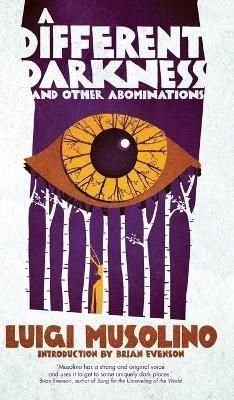
A Different Darkness and Other Abominations, by Luigi Musolino


9781954321731
Valancourt Books, 2022
translated by James D. Jenkins
316 pp

hardcover

I am a passionate advocate of translated fiction and I am loving this latest wave of translated horror collections from Valancourt.  First they wowed me with their two world horror anthologies, and then it was the off-the-charts excellent  The Black Maybe, by Hungarian author Attila Veres.  My latest Valancourt read is from Italy, A Different Darkness, by Luigi Musolino, and it is dark with a capital D.   After having finished both books now,  if this is the direction weird fiction is heading, I'm all for it.  Keep it coming. 


 In the translator's note, James Jenkins (co-founder of Valancourt) says that he and Musolino jointly selected the stories to appear in A Different Darkness.  Some of these are from  Musolino's two-volume collection Oscure Regioni (Dark Regions), which we're told number twenty stories, "one from each of Italy's regions, each inspired by local folklore from that region."  A few were also selected from some of the author's other works as well, and together these tales were chosen "to represent the best of his work over his career, which so far spans about ten years."  They did a great job in the choosing  -- the horrors begin immediately and do not let up, keeping the reader in a squirmworthy state throughout.  Musolino is a master of the existential dread and the gloom that pervades all of these stories,  many involving  strange creatures that make themselves known now and then, but at the heart of it all, human nature is also scrutinized in these tales as the author zeroes in on human psyches that have somehow become (as he describes in the titular story of this collection)  "derailed from the tracks of normality." 


Since this is another book that a reader will experience,  I will very briefly list only a few of my favorites without going into any sort of detail so as not to spoil things for potential readers.  In order of appearance  "Black Hills of Torment" comes first on the favorites list, in which it is clear from the outset that something has gone horribly wrong in the small town of Orlasco. Money "doesn't matter one damn bit any more," a certain song plays over and over"  as a "neverending dirge" and has done so for a year, people are out of food and living on mice, leaving town is impossible and everyone finds themselves living in a "nonsensical seclusion."  As the narrator notes, "We have become a town of shadows. A non-place."   I won't say how things have come down to this point but it makes sense that Brian Evenson  likens this one  in his intro to a certain story by Jerome Bixby. In this case however, there are twists that makes it even darker.  This tale is bleakness and sheer hopelessness personified.      "Pupils" is outstanding, and in its own unsettling way,  revisits the Pied Piper legend.  In Italian it's  Il Pifferaio Magico, but here it's actually The Lord of Dust, who had "always lived in Idrasca, since before the town existed or had a name." He is  a "specter of the lost future," and took up residence in the book storeroom of the local elementary school. His task, as he sees it, is to "open their eyes, to make them become like him, to share what he knows" to stave off his loneliness.  Children love fairy tales, right?  The Lord of Dust decides that he will write his own ("fairy tales, as everyone knows, are terrible"), and after a year he finishes his book, invites the children to come to him "one by one" at some point in their day, and begins reading "to open their eyes."   Let the horrors commence.  Good god. This is probably the most pessimistic story in this book, but in its own way the bottom line is beyond realistic, which is pretty damn scary.    Finally, the spectacular titular story "A Different Darkness" is an utter mind bender, beginning with a visit to an empty apartment by the police.  At first it was a child who went missing, but police are now wondering where her missing parents have gone.  What they do find is an apartment filled with bizarre paintings that were "abstract, focused on a single subject,"  representing "an obsession, a disease, the product of a mind derailed from the tracks of normality."  

It seems that in these stories  Musolino has discovered a number of cracks hidden in the mundane world into which, often without notice, his characters fall, slowly making their way into a completely different and certainly unexpected darker reality if not directly into the abyss.    I will be honest and say that there were a couple of stories that were just too dark or gross for my taste that I didn't care for,  but it is most certainly a book that no reader of  intelligent horror fiction or weird tales should miss.  

 Brian Evenson hits the nail on the head about this book, when he says in his introduction that 
"Musolino is expert at making us feel the void yawning below us, waiting to swallow both us and his characters up ..."
which is a perfect description that encompasses each and every story in this volume from page one on.

Very highly recommended.  

Tuesday, March 15, 2022

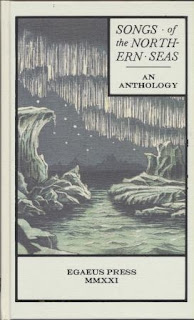
Songs of the Northern Seas, by Mark Beech (ed.)


9781838396039
Egaeus Press, 2021
203 pp

hardcover


"this ice entombed wilderness has been driving people to the edge of madness for hundreds of years."
       from "In Orbis Alius", by Colin Fisher


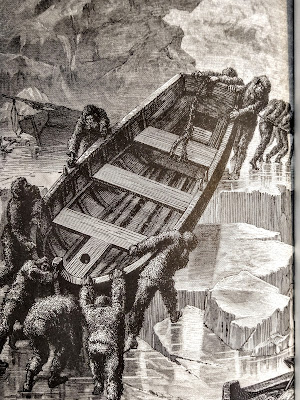
I happen to be a huge, huge fan of fiction set in the earth's polar regions, largely because I happen to be a huge, huge fan of nonfiction about polar exploration.  That's been the case since like fourth grade, and unlike other interests that have come and gone in the meantime, that one is still going strong.  Naturally,  once I saw that Egaeus was publishing this book of strange tales set in the Arctic, it was a no-brainer -- this book had my name on it.  Not only did I get my fill of  Arctic weirdness, but the drawings inside that illustrate this anthology are also awesome.   I am one of those strange people who will pore over a drawing like this one for a long time, trying to take in all of the detail. 


from page 202


Opening the book just past the table of contents there first thing you see is a brief note:

"Herein are thirteen tales cast up in northern latitudes, hooked on the cardinal points of traitorous compasses. They are dark, strange, uncategorisable pieces, diverse in tone and theme, though each uniquely shaped by similarly restless Arctic tides, cold winds, and ancient ice-flows,"
 and then it's on to the strangeness.

While everyone's mileage will of course vary, I did have more than a few favorites in this volume,  beginning with  "The Ghosts of the Great Northern Sea,"  by  Leena Likitalo.  As should happen in any anthology, this first story sets the tone for the rest of what's to come.  A young woman named Soila finds herself strangely drawn to a stranger who has just arrived in her small village having traveled some two hundred miles on skates across the ice.  She's not sure why until she learns about the provenance of the sweater he's wearing; wanting to settle certain questions in her mind, she decides she'll go back with him when he leaves.  As they make their way across the ice, what happens on their journey will later become a "tale, and then a tall tale repeated around the fires when the wind howled outside," involving ghosts, murder, and above all, an unearthly justice.  This story is so well done that I could completely picture it in my head.  The next story, which is just as creepy as the first, is relayed via two sets of  journal entries from 1926.  In "The Tupilaq," by Stephen J. Clark, missionaries have arrived at Coral Harbour in Nunavut to "save these people from their primitive ways," and more importantly, "to make every conceivable effort" to convert the shaman, which would help in convincing the local population to "abandon their superstitions and embrace Christ as their saviour."   However, the shaman, Iksivalaq,  has been warned by the spirits that his rival  Kulaserk knows of this plan, and that there are dire consequences in store should the missionaries succeed.  All I will say about this one is that perhaps the missionaries shouldn't have been so quick to write off "pagan superstition."   Number three is  "In Orbis Alius" by Colin Fisher, in which Robson, an archaeologist working Viking settlements in southern Greenland, hears of the incredible discovery of an intact Viking ship on the northwest coast.  By the time he actually arrives at Qaanaaaq station (formerly known as Thule) he discovers that two anthropologists Martin and Angela O'Brien,  had been investigating, making three trips to the ship before Angela, for some inexplicable reason, "destroyed the site and the ship with it."   Martin is nowhere to be found.  When Robson begins listening to Angela tell her story, he believes she's become "unbalanced," especially when she starts talking about "Orbius Alius," which can mean "other Earth," "different place" or in Celtic lore, "Otherworld."   While she won't really talk about what happened to her at the ship site, she has kept a record which Robson reads, a thoroughly fantastical but also thoroughly frightening account.  In the meantime, strange things have started happening at the station that can't be written off as simple "mass hallucinations;" nor is it the case of being there in "this ice entombed wilderness" which has been "driving people to the edge of madness for hundreds of years."  


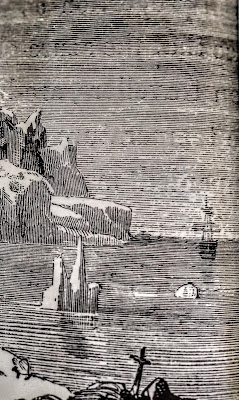
another fine drawing  ... 
"

After the tension of the first eight stories,  it was great to read Rhys Hughes' "Ice Flows in Eden," which not only brought my  pulse down but also made me laugh out loud.  It all begins when an iceberg finds its way into the waters off Goa, and the two people who first spot it decide they need to take it back to the Arctic Circle where it belongs.  Too much more would spoil the story, but it's a delightfully good one, perfectly placed in this book, allowing for breathing room after what had come before. The last two tales on  my favorites list begin with Jonathan Wood's "The Salon in the Woods," a tale of the "meeting of literary and spiritual minds" of two people (later joined by a third), who have isolated themselves from the rest of humanity in Russia looking to "write and compose and to unveil the Mysteries," to "construct that which will emerge out of nature..."  I would absolutely love to read more by this author, whose prose is absolutely gorgeous.  And finally, there's  Alison Littlewood's "The Light You Can Hear,"  in which a couple arrive at the Icehotel in Jukkasjärvi, Sweden, a  Sámi word for "meeting place by the river."  The couple are there "to escape, to be somewhere else, something else, if only for a time."    They are given room 215, the plaque outside of which reveals its name:  "The Light You Can Hear."  Inside there's a sort of "static crackle" as part of the ambience of "sounds from the Arctic landscape," which gives way to a 
"soft, whistling, not quite like music, and something else: an almost unnoticeable breathy undercurrent, reminiscent of a voice." 

It is the sound of the Northern Lights, according to the Sámi people, "the light you can hear;" they also believe that the Northern Lights are souls" that "bring the dead closer to us."  But it's a trip to the nearby river that changes everything for this couple.  This story may be short, but the writing is absolutely beautiful, capturing not only the place but also a keen and intense sense of loss. 

I absolutely love the way in which these authors and some of those I didn't mention due to time considerations have  incorporated local, indigenous lore and belief (real or imagined, I can't say for sure) into their work; as just two examples, Chris Kelso in his story "Blood-Sea"  and  the authors of "Oil," Sean and Rachel Qitsualik-Tinsley,  do a great job in that regard.   On the collection as a whole, well,  you can't love all of them, but that doesn't mean that the stories I didn't mention weren't also worth reading.    The Arctic has always seemed to me a mystical, eerie place, and each and every author in this book in his, her, or their own way somehow managed to capture that sense of otherworldliness in their work, as well as the effects of this place on the human psyche.  

recommended.  

Friday, February 25, 2022

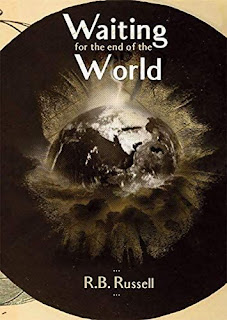
Waiting For the End of the World, by R.B. Russell


978178365958
PS Publishing, 2020
279 pp

hardcover


"It did for those with the eyes to see..."


If your only connection with R.B. Russell is the truly great work he does along with his partner Rosalie Parker in publishing books at  Tartarus Press, you should also be aware that he is also an author and a pretty damn good one.   The last book I read by R.B. Russell was his short-story collection Ghosts, and when I finished that book one of my first thoughts was that I need to read more by this man.  Off to the online realm I went for more, and I picked up two Russell books, Death Makes Strangers of Us All and this one, Waiting for the End of the World.  After reading this book, I enjoyed it so much that this morning I bought his The Stones are Singing.  I mean, I knew after Ghosts that he could do great short stories, but maintaining cohesion and  tension well enough to last the length of  a  novel is another thing altogether.  Some writers just aren't able to bring it, but that's certainly not the case here.  

I will not go too much at all into detail about what happens here, and that is because this is the sort of book where you don't realize until toward the very end that you've been given signs along the way as to what's actually going on.  Even so, I didn't actually understand that until this morning when going through all of the pages I'd tabbed; suddenly all of my synapses were on fire as I made connection after connection.  At that point it became not just a good read, but an eye-opening, crazy good read.  

It all begins as our narrator Elliot Barton is sitting in a train in October of 2006, reflecting on things, including his partner Lana, the joy of sharing life with her at their house on Sapphire Street and his job. On that first page life seems great, and then comes the first clue that there may be some trouble in this paradise.  As he says,
"Above all, I can't believe that what I did so long ago has yet to catch up with me. What I have not told Lana is I live each day as though it is my last of freedom. When the post arrives, the telephone rings, or if there is a knock at the door, I am expecting the worst, even after ... I do the calculation ... eighteen years."

 In what he describes as an "unusually fatalistic mood," he thinks about the "few words" of a  phone message he'd heard after work  and how because of it "the first stone has been loosened from the foundations of our house on Sapphire Street."   Once home, and after a night of strange dreams, the next day Lana's off to her job and Elliot plays the remainder of the message, erasing it afterwards.  It seems that a friend from his school days, Vince Reynolds, wants to talk to him about something that happened in their past.  He continues to avoid Vince on the phone, but eventually speaks to him and learns that Vince is thinking of going to the police to confess and that he would like to get together to talk.  Vince has found religion and wishes to "atone" for his "sin," to "face any punishment;" strangely though, his version of events of that day are quite different than Elliot's.   Elliot, who now has had to tell Lana what it was all about, believes it's the beginning of the end of everything; he doesn't want Vince to do anything and travels to St. Michael's  retreat where Vince and his fellow members of the Children of the Cross are now living, along with none other than a man whom the Children of the Cross believe is Jesus Christ, who has come again "to shepherd his flock."  Elliot's aim: not to have Vince reconsider his plan, but to have him "change his mind and disappear from my life once again."   What Elliot doesn't realize is that his visit to St. Michael's will change everything in ways he could not possibly expect. 


While it may sound like the plot of a crime novel, Waiting for the End of the World is anything but.  Shortly after the beginning of the present timeline, the story begins to move back and forth through  time (and knowing what I know now I'm absolutely fighting with myself to not say anything more about that).  At each move there are added elements of context, suspense and tension that kept me turning pages, yet, as I said in my initial thoughts at goodreads, while reading I kept wondering to myself what all of this was leading to.  Let me just say that there came an OMG moment toward the end where I not only realized what was happening, but also when I realized that everything that had come before has suddenly taken on momentous significance. 

Among other fascinating topics, within Waiting for the End of the World  the reader will encounter themes of religious belief through history, cults and what it is about the need for a Messiah that drives people to  gather around a particular individual to take them through an apocalypse,  the importance of dreams and the idea that one particular event can unknowingly and unwittingly change the course of things.  It's an amazing book, and the writing is utterly fantastic, drawing you in slowly until there comes that above-mentioned moment when everything just explodes.  On top of everything else, I've also made note of all of the book titles that the author included in this one, and I was so pleased to see Machen's Hill of Dreams listed among them; I'm sure that its inclusion as well as that of Rolfe's Hadrian the Seventh (and others) were not simply random choices.   

Very nicely done, and my advice for readers who at some point feel like you're wondering where this story  is headed is to just be patient and enjoy the ride,  but to be sure to pay attention along the way. In this book, things have a habit of turning up again when least expected.   This one I can certainly and very highly recommend.  Like all of my favorite books,  I can honestly and without reservation say that I've never read anything quite like it. 

Friday, December 17, 2021

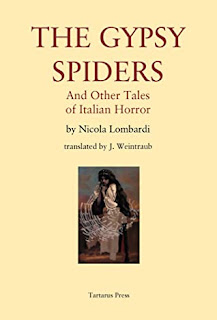
arachnophobes beware (part 3): The Gypsy Spiders and Other Tales of Italian Horror, by Nicola Lombardi

 
9781912586325
Tartarus Press, 2021
240 pp
translated by J. Weintraub

hardcover

Last year I read the first volume of The Valancourt Book of World Horror, and in their introduction the editors posed the following question to their readers:

"What if there were a whole world of great horror fiction out there you didn't know anything about, written by authors in distant lands and in foreign languages, outstanding horror stories you had no access to, written in languages you couldn't read..."?

It's a very good question; as those editors also stated, "... there's a much larger body of world horror fiction out there than any of us would suspect."    At the end of my post about that book, I noted that it is a true pity that "so much great writing is out there that remains unavailable to an English-language readership."   Valancourt, of course, has a second volume of world horror on the horizon, but I'm beyond delighted that  Tartarus has also opened the window onto that "whole great world of great horror fiction" with its publication this year of Nicola Lombardi's The Gypsy Spiders and Other Italian Horrors.  To Tartarus and to translator J. Weintraub, a huge round of applause for making this book happen.   

As Weintraub notes in the introduction to this volume, Lombardi grew up in an area of Italy the author once described in an interview as "a stewpot boiling over with folkloristic legend and dark tales of crime, filling the imagination with nightmares. "  It was also a place where "so very many ghosts" wandered "between fogs and immense desolate spaces, between woods and abandoned farmhouses." A fan of writers such as Lovecraft, Poe, Blackwood,  Bradbury, Fritz Leiber and Dino Buzzati (one of my favorite Italian authors) in his younger days, influenced as well by the stories told to him by his grandparents," Lombardi started publishing his own work in the late 80s.  

 In 2013 The Gypsy Spiders won "one of Italy's most prestigious awards for horror fiction," the Premio Polidori.  Originally published in 2010, this story (which is actually novel length) begins in  late summer of 1943, the year that an armistice with the Allies had been declared by the Italian government, a move which turned their former German allies into their enemy.  Michele, an Italian soldier now in a hospital in Albania after being wounded, decides it's time to leave the front and go home to his family.   On his return he discovers that his younger brother Marco has completely vanished, his family left suffering from the loss.  As we're told,
"He had lived next to death for months, side-by-side with it, and now that he had managed to escape and find shelter in, for him, the safest and most beloved place on earth, he realised that the horror had only preceded him there, to welcome him home."

But what he hasn't realized is that the true horror is only beginning.  

 In "Alina's Ring,"  a wounded soldier wakes up to discover himself in a farmhouse, being taken care of by a young woman named Alina.  He notices that "there was something not quite right" in her eyes; and that she "was determined to unburden herself of the thoughts that were cascading through her mind."  As they talk, he's looking for a "way out" -- and about this story I will say no more.   "Sand Castles" finds an elderly man returning to his beloved Villa Dora which he'd been away from since 1945, at age nine.    As Italy was "being rebuilt," his family took him to Bologna, where he'd rebuilt his own life right on through to retirement.  Now in his mind, it is time to go back to the Villa Dora, to give "destiny the chance to complete the plan designed for him."  When he finally arrives, he hears his old childhood pals "calling out his name..."   Weintraub notes that in these stories, it's "the actuality of the war and its aftermath that lead to madness, obsession, and significant 'collateral damage'," and in these three stories, all of  these elements scream loudly from the page.  

Six incredibly dark stories remain in this volume, nearly all of which are gut-level disturbing and much darker than I normally tend to go in the realm horror fiction, but god help me nothing short of a bomb blast in my living room would have made me put the book down while reading them.    I'll mention two here.  First, "Professor Aligi's Puppets," in which a young boy's fascination with puppet theatre takes a turn into nightmare territory, and "Striges," my favorite story in the book, which thoroughly chilled me to my bones.  In that one, a man looks  back in time to recall something he'd witnessed in his childhood that left a "kind of knotting" in his stomach (a similar reaction to my own with each step of this story, by the way) when he thought about his friend Francesco,  the "prisoner of a situation so horrible its true nature could hardly be fully understood."  As kids, Francesco and his friends were fascinated with spiritualism, flying saucers, divination and "on and on," fueling their imaginations with comic books, television, horror novels,  movies etc.  The trouble begins when Francesco reveals to his buddies that his mom is writing a "study on witches," and would be going on a trip throughout Europe.  As the narrator recalls, the boys got a bit of a charge over that, knowing that "whatever she might bring home would launch us further off the face of the earth," before offering his observations in hindsight that "she would be bringing us the burial, once and for all, of our childhood, and much worse." 

These are stories which demand more than just a quick read through, and which also need to be pondered on many levels.  While they are extremely disturbing, these stories reveal a major depth of insight into human nature on the author's part, as through his writing he makes very clear that, as noted in the introduction,  the source of evil can often be seen to stem from the "individual and collective hearts of men and women."  He doesn't have to resort to old, well-worn and tired tropes for cheap thrills here that quite honestly turn me off --  Lombardi offers his readers an eerie but sophisticated blending of the "uncanny and otherworldly" that slowly seeps not only into the lives of his characters, but under the skin of his readers at the same time. 

Absolutely brilliant and very, very highly recommended.  And Tartarus people: please consider more translated works in the future ... they would be very much appreciated.  

Saturday, December 5, 2020

hopefully, the first of many: The Valancourt Book of World Horror Stories, Vol. 1 (ed.) James D. Jenkins and Ryan Cagle

"there's something universal about the telling and reading of a good, creepy tale."


Here's the question asked by the editors:

"What if there were a whole world of great horror fiction out there you didn't know anything about, written by authors by distant lands and in foreign languages, outstanding horror stories you had no access to, written in languages you couldn't read? For an avid horror fan, what could be more horrifying than that?"

Luckily for readers like me who have experienced this dilemma, there's Valancourt's new Valancourt Book of World Horror Stories.  This book is like a key that unlocks a door to a room which once opened, yields a library of previously-unknown treasures gathered from around the globe.  


978194805638
Valancourt Books, 2020
432 pp, hardcover (#163)


As the editors note in their introduction, 
"if one takes the trouble to look hard enough, there's a much larger body of world horror fiction out there than any of us would suspect ... it often involves deep digging and venturing into uncharted waters."

The "deep digging and venturing into uncharted waters" is what the people at Valancourt do best, no matter what they publish, so I knew before I even ordered this book that I would not be disappointed.  I wasn't.  

Before you even get to the main event, Valancourt has included an aerial view of sorts with a look at which countries are represented and a little blurb about each story (not that this photo is particularly legible but you get the drift):


Of course, as in any anthology, it's impossible not to latch on to favorites even though all of the stories found in this volume are topnotch.  These are mine, in order of appearance.   "Uironda" by Luigi Musolino (from Turin) opens this book, in which a truck driver, as the brief description on the world map above states, takes an "exit to terror on the highway to Hell," and his "umpteenth work trip" assumes "the features of a nightmare." From Hungary comes "The Time Remaining" by Attila Veres.  The narrator of this story needs to "recount everything ... up to the point when I lost control."  It all begins when a plush toy named Vili begins to be sick, with a prognosis of death looming.  I swear that when I first started reading this one I nearly passed it by but it just kept getting better (and creepier) with every paragraph.  It was poignant, until the turn to  absolutely frightening.     "The Angle of Horror," by Spanish writer Cristina Cubas Fernández is another of my top picks, one of the most eerie tales in this book.  Some time ago, after reading her collection of stories called Nona's Room, I entered her name into my imaginary top tier of writers of the weird and the strange, so I was beyond happy to see her represented here. The editors quote Terrence Rafferty from his New York Times review of Nona's Room as saying about her that she is "most interested in the ambiguities and the periodic disturbances that plague the imagination," and that in her work, "The threat of madness is never too far away, a dark cloud hovering."   In "Angle of Horror," a young man returns home from being abroad and locks himself away in his room.  The explanation of why that he gives to his sister seems unbelievable to her, until it isn't.  As much as I loved that one, my very favorite story comes from Bernardo Esquinca (Mexico) called "Señor Ligotti," an eerie, menacing tale in which Esteban, a writer of thriller novels who is also about to become a father,  accepts a strange but intriguing proposition from an elderly man, Señor Ligotti.  The señor offers to sell him his beautiful home for whatever money he has on hand;  Esteban's wife isn't sure about the deal, telling her husband that the old man might be "the tip of the iceberg of something we can't even imagine."  Of course he fails to heed her advice, and soon comes to regret the deal.  I enjoyed this one so much that I've preordered Esquinca's El libro de los dioses, the book  from which this story comes.   "Si non oscillas, noli tintinnare..."  I dreaded each mention of those words, getting the shivers even now as I wrote them.    From the Netherlands it's "The Bones in Her Eyes" by Christien Boomsma which moves well beyond the point of disturbing to downright horrific as a young woman feels terrible about hitting a cat with her car, returns the cat to its elderly owner,  then goes to check on it the next day.  It's the ending of this one that will leave you with nightmares... I couldn't stop thinking about it for a long, long time.  

Really, there isn't a bad story to be found in this book, and the beauty of this volume is in the diversity of points of view and storytelling, while encompassing ideas and themes that everyone everywhere will recognize.   The full table of contents can be found at Valancourt Books' website, where there is also a blurb from Ann VanderMeer which explains one of the many reasons this particular volume is so important, so groundbreaking and so incredibly meaningful.  As she notes, 
"While the language of horror is universal, its means of expression necessarily varies from culture to culture... "

and the stories in this book come from "voices and perspectives we have lived too long without." 

 I agree wholeheartedly, and it's a shame that more of the work of these authors has yet to be translated into English.   The editors ask and answer the question of why this is so in their introduction,  but at the same time it is just a bit frustrating to know that so much great writing is out there that remains unavailable to an English-language readership.  Hopefully some day this will change, but for now at least we have this first volume as an introduction.

Very well done, and very highly recommended. Now awaiting a Volume Two. 

Tuesday, October 6, 2020

And My Head Exploded: Tales of Desire, Delirium and Decadence from Fin-de-Siecle Prague (ed.) Michael Tate


9780993446719
Jantar Publishing, 2018
translated by Geoffrey Chew
204 pp

hardcover

"... liberation is to be found solely when reality is abandoned and when everything that has constricted us hitherto is left behind." 
                     -- Jiří Karásek ze Lvovic,  "The Legend of Simon Magus." 


Some time back I read and loved Jiří Karásek ze Lvovic's A Gothic Soul (Twisted Spoon Press, 2016; originally published in 1900) and searching for more of his work online, I came across And My Head Exploded, which contains one story by this author.   Buy button clicked. 

The truth is that I know little to nothing about Czech decadence or Czech fiction in general.  The introduction by Professor Peter Zusi  helped a bit, as he explained that  "the international reputation of Czech literature stands under the shadow" of "the best known and most influential work of Czech modernist literature," The Adventures of the Good Soldier Švejk (1923) by Jaroslav Hašek, as well as the work produced by writers of " 'dissidence' against the Communist regime in the second half of the twentieth century."   The stories in  And My Head Exploded  are representative of "another" Czech literature which has been "remarkably absent from the consciousness of English-language readers of Central European literature" ranging in date from 1892 to 1917.   He refers to it as ambiguous, unsettling, and "at times ... more grotesque," descriptors that are very much reflective of the work found in this volume, which is imbued with shades of gothic, horror, and the weird as well.  

I've always felt that the opening story in any anthology or collection should not only whet the appetite for what will follow, but also offer the reader an idea of what to expect thematically. The first story,  Julius Zeyer's "Inultus: A Prague Legend" (1892) meets both of those criteria.  This story  is a blending of art, aestheticism, myth, death and a femme fatale sort of figure, along with an added religious/nationalistic dimension that enhances this tale of "bloodthirsty madness."  It begins with a chance meeting between a poor poet and a sculptress who is trying to create a sculpture of Christ; eventually and reluctantly he agrees to serve as  her model.  His face, though "beautiful and melancholy" isn't quite enough for her as she desires something more.   Zeyer also has another story in this book, "El Cristo de la Luz: A Toledo Legend" the story of  a zealous, would-be murderer who has a rather unexpected mystical union with Christ. After reading these two, which are part of a tryptich called Tři legendy o krucifixu (1895),  I decided I would really like to read more of Zeyer but there seems to be little of his work published in English, and a book I would like to have about him, Julius Zeyer: The Path To Decadence by Robert Pynsent,  is long out of print with used copies selling in the three figures.  Yikes. 

Following Zeyer are two stories by Bozena Benešová, another writer who is woefully untranslated as well as the sole woman writer represented here.   The "Biographical Notes" section  describes her prose as 

"anti-sentimental and psychological, dealing with women's issues, typically from the point of view of a marginalized female protagonist"

all of which are reflected in her "Tale for All Souls' Day" (1902) and "In the Twilight" (1900).  The first  takes place over five days in October and is related through the point of view of a woman in mourning.  She has four months left to go until the end of her "imprisonment"  so that she can go "out into the world, for the sun, for life, for love."  After all, social convention requires that the "year of mourning must run up to its last minutes."  It is from this story that the book's title is derived, as she recounts the crumbling of her brain, her  steps toward regrowing , and the moment when, as she says, "straight away my head exploded."  More overtly  critical in nature, her second story finds a woman "wholly overcome with pain and sorrow ... so long suppressed" finding herself letting it all "burst out in full force."  


Judith in the Tent of Holofernes,
by Johann Liss.  From The National Gallery

My hands-down favorite in this volume is "Cortigiana" by Miloš Marten.  Here, as in Zeyer's work, art and death come together in the story of Isotta, a beautiful scholar of Plotinus from childhood and now a courtesan in plague-ridden Florence.  She has discovered a way of "taking her revenge from life for its fradulence," and after one such moment, decides to "pursue the caustic fire that was penetrating her," taking her cue from the story of Sardanapalus in one final, fatal act of revelry. I couldn't help but think of Poe as reading this one, but there's more than a touch of the vampiric as well.  


The Death of Sardanapalus
from Wikipedia 

Two stories by Arthur Breisky are up next, "Prose Poem, After Felicien Rops, Mors Syphilitica," and "Confession of a Graphomaniac" (1909).  Translator Geoffrey Chew notes that Breisky "appended" both of these tales to his translation of The Suicide Club by Robert Louis Stevenson, adding a fake "translator's note" to the first.  In "Prose Poem" the Knight of Death pays a visit to a man stricken with syphillis in order to propose a deal.  The second story  is far darker, involving a narcissistic narrator relating a tale of incest, love, madness, betrayal and a mother who could be a stand in for Salome. I'll admit to having a good laugh at the end of   Jiří Karásek ze Lvovic's "The Legend of Simon Magus" (1911), about which I'll say nothing here.  

The two stories closing out this anthology, "My Travelling Companion" (1912) by František Gellner and Richard Weiner's 1917 story "The Empty Chair: An Analysis of an Unwritten Tale" are very different in tone from those that have come before.  The first involves a man with a passion for travelling who takes on a companion "renowned for his ill-bred behaviour"  as he makes his way to Bavaria and the "Alpine countries." I had to give some extra thought to Weiner's masterful and very well-crafted tale, in which a writer has come up with a title for his work, "The Empty Chair," but the "story has never actually been written."  He plans to lay out the circumstances for why this is so, but something happens as he explains what he considers to be his failure. Watch carefully what happens as he does this.   I'd love to share more, but that would ruin an otherwise excellent story. 

For someone like me unable to read the works of these writers in their native language, the publication of And My Head Exploded is a hugely-welcome addition to my reading repertoire. There's just something exciting  about knowing that there are all of these yet untapped, untranslated works out there waiting to be read and appreciated, especially  more Czech fiction in the vein of  Professor Zusi's  "another literature," and I'm sure this book represented only a small sampling.  I will say that as I looked up these authors online, it started to become important to me to know more about the times in which these stories were written  to provide some sort of context (for example, women's writing/women's issues  of the time) which is omitted here, but that's about the only complaint I can muster.  

Very highly recommended and oh, what a pleasure to read! 

Friday, May 29, 2020

Terror Tales of Cornwall (ed.) Paul Finch

9781845831219
Telos, 2017
274 pp

paperback

Last week I was completely down with a fever that wouldn't quit. I grabbed a random handful of books off the shelves, grabbed a hot cup of  tea and went to bed.  Not feeling in the mood to prioritize,  Terror Tales of Cornwall was on the top of the stack so it was also the first read.

I'm no stranger to Finch's Terror Tales anthologies and have almost all of them on my shelves.  They all share the insertion of brief snippets of local lore, history, people etc. between each story, while the stories themselves are geographically centered within a particular region.  This time around it's all about Cornwall,
"which would not be Cornwall without its multiplicity of spooky tales, its thousands of ghost stories, its legends of monsters, faeries, demons, witches, smugglers and mermaids" 
 and to that list I'll add Daphne du Maurier, whose life and work does get a few mentions here.

There is a good mix here of horror, weird, and the strange.  Six of these stories I loved, as they are each brilliant examples of weird fiction,  two made me laugh almost out loud, two reflect current social anxieties, and the remainder I'll file  under NPT -- not particularly terrifying, but okay.


The standouts for me (and this in order of appearance)  begin with "In the Light of St Ives," by Ray Cluley.   There is something quite special about the quality of light in St. Ives, which was ideal for Claire the artist, until she tried to burn down her house and paint herself black after noticing the colors that "seep into everything."  This one absolutely chilled, and the ambiguity here keeps the tension high as the story itself merges into surreal territory.   Very nicely done.  In "Trouble at Botathan," by Reggie Oliver,  one character notes, "... all this has happened before," and in this place, indeed it has.  "Botathan Place" is the home of the Bligh family.  The last of the line, a mathematics Don at St. Saviours, died in 1973 and left the remote house to his college. Now at "The Place" a hand-picked group of young men,  a college Dean and the chaplain of St. Saviour's are having a sort of summer retreat when one student has a strange experience in the wood that turns him in into "a different person."   Sad but strange, and oh so good.  Mark Valentine's "The Uncertainty of All Earthly Things" reveals that "here there are secrets" as a museum curator and his artist friend are allowed a glimpse just over the thin boundary between the "Sancreed we see" and the "Sancreed Beyond."  "His Fire Was Kindled" by Kate Farrell is yet another fine piece of  unsettling weirdness, as commercialism and the spiritual butt heads  in Penharrack.  A representative of  luxury housing developers seriously underestimates the staying power of a local vicar who doesn't care if a new development is a done deal -- the church has been there since the thirteenth century and the vicar aims to keep it there.    "Four Windows and a Doorby DP Watt is quite possibly the most eerie and chilling story in this collection, in which a glimpse at a strange house during a boat ride begins a terrible odyssey for a family vacationing in Cornwall.  Read it twice -- the impact is staggering.  Last but by no means least comes Mark Samuels' "Moon Blood-Red, Tide Turning."  which unsettled me to my core.  A man travels to an amphitheatre carved into a cliff to watch his friend perform in a play that is "all very ritualistic. But definitely cutting-edge and experimental." As it just so happens, the play runs during a lunar eclipse, after which the viewer leaves while the play goes on.   Twenty years later it seems that although the venue's changed, the show goes on.  I have to confess that I had to look up "Dr. Prozess," resulting in the purchase of a used copy of The Prozess Manifestations. If this story (which is in that book) is any judge, I'll soon be immersed in intense weirdness. 


Botathen House, from Haunted Britain

Both "Mebyon versus Suna" by John Whitbourn and "The Old Traditions Are Best" by editor Paul Finch combine a bit of horror with a comic touch.  In the first, a dyed-in-the-wool Cornishman whose wife refuses  to share his "born-again nationalism" just can't shut up about it when his wife gets a promotion and he finds himself living in Exeter.  His neighbor is tolerant as can be until one day when he's not.   Finch's entry is steeped in Padstow local traditions but young Scott, a  tough guy from Manchester whose probation officer  had brought him down on holiday, openly scoffs at them, much to his detriment.

Although they come at the end of this volume, there are two tales which reflect current social concerns and speak mainly in metaphor: "The Memory of Stone," by Sarah Singleton, and "Losing Its Identity" by Thana Niveau.   Singleton's story is focused on Michael, whose obsession with one woman decimates his family. Alone in an old cottage on the Cornish shore, he receives strange nightly visits from a group of children who leave messages in the form of white stones until one day when they arrive in person.   Niveau exams senility and climate change in her story, set in a future where Cornwall is on the verge of being swallowed by the sea. A sad and poignant tale, to be sure.

The remainder fit more along the edge of traditional horror, and in most cases reflect the idea that the legendary, mythical creatures of Cornwall may be more real than one might believe.   "We Who Sing Beneath the Ground" by Mark Morris which opens the collection,  begins when a rather shy child brings something strange to show and tell day at school.  The next day he doesn't return, and his teacher goes to find out why.  In "The Unseen" by Paul Edwards, an unemployed man watches a dvd from a local shop and becomes fascinated.  Going online to see if anyone else has seen it, wondering if there's an uncut version, he is told that there is a more complete version, and also learns that it's the film itself which will seek out "worthy" watchers.  In Jacqueline Simpson's "Dragon Path" a young man skilled in Druidic arts learns the hard way that  power does not equate to wisdom.  A dirty, dated and hardly-thriving amusement arcade filled with "nightmarish nostalgia" is the location for Steve Jordan's "Claws."  It's also a place where very strange things are happening and the boss thinks the employees are out to get him, but boy is he wrong. Adrian Cole's "A Beast By Any Other Name" begins as a murder mystery, morphing slowly into something not completely of this world.   It's also the most original within this group of stories, and if you ask me, very nicely done. Finally, "Shelter from the Storm," by Ian Hunter finds three friends on a routine "practice walk" before tackling a bigger, 150-mile hike.  Hoping to find their way to Port Isaac, their walk becomes anything but routine when they discover they're lost and the weather turns terrible.  They find what one of them believes is "salvation" when they come across the ruins of an old church, yet fail to heed the warning left there and, as kids often do in these sorts of things,  start messing around with things that are best left alone.

Depending on personal tastes, of course, mileage may vary, not uncommon in any anthology. I trend much more toward the weird, and my selection of favorite stories here reflect my preference, but really there's something here for everyone.  I have enjoyed the series so far, and look forward to reading more in the future.