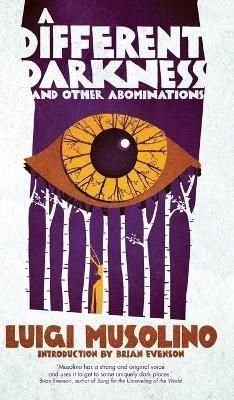
Valancourt Books, 2022
translated by James D. Jenkins
316 pp
hardcover
I am a passionate advocate of translated fiction and I am loving this latest wave of translated horror collections from Valancourt. First they wowed me with their two world horror anthologies, and then it was the off-the-charts excellent The Black Maybe, by Hungarian author Attila Veres. My latest Valancourt read is from Italy, A Different Darkness, by Luigi Musolino, and it is dark with a capital D. After having finished both books now, if this is the direction weird fiction is heading, I'm all for it. Keep it coming.
In the translator's note, James Jenkins (co-founder of Valancourt) says that he and Musolino jointly selected the stories to appear in A Different Darkness. Some of these are from Musolino's two-volume collection Oscure Regioni (Dark Regions), which we're told number twenty stories, "one from each of Italy's regions, each inspired by local folklore from that region." A few were also selected from some of the author's other works as well, and together these tales were chosen "to represent the best of his work over his career, which so far spans about ten years." They did a great job in the choosing -- the horrors begin immediately and do not let up, keeping the reader in a squirmworthy state throughout. Musolino is a master of the existential dread and the gloom that pervades all of these stories, many involving strange creatures that make themselves known now and then, but at the heart of it all, human nature is also scrutinized in these tales as the author zeroes in on human psyches that have somehow become (as he describes in the titular story of this collection) "derailed from the tracks of normality."
Since this is another book that a reader will experience, I will very briefly list only a few of my favorites without going into any sort of detail so as not to spoil things for potential readers. In order of appearance "Black Hills of Torment" comes first on the favorites list, in which it is clear from the outset that something has gone horribly wrong in the small town of Orlasco. Money "doesn't matter one damn bit any more," a certain song plays over and over" as a "neverending dirge" and has done so for a year, people are out of food and living on mice, leaving town is impossible and everyone finds themselves living in a "nonsensical seclusion." As the narrator notes, "We have become a town of shadows. A non-place." I won't say how things have come down to this point but it makes sense that Brian Evenson likens this one in his intro to a certain story by Jerome Bixby. In this case however, there are twists that makes it even darker. This tale is bleakness and sheer hopelessness personified. "Pupils" is outstanding, and in its own unsettling way, revisits the Pied Piper legend. In Italian it's Il Pifferaio Magico, but here it's actually The Lord of Dust, who had "always lived in Idrasca, since before the town existed or had a name." He is a "specter of the lost future," and took up residence in the book storeroom of the local elementary school. His task, as he sees it, is to "open their eyes, to make them become like him, to share what he knows" to stave off his loneliness. Children love fairy tales, right? The Lord of Dust decides that he will write his own ("fairy tales, as everyone knows, are terrible"), and after a year he finishes his book, invites the children to come to him "one by one" at some point in their day, and begins reading "to open their eyes." Let the horrors commence. Good god. This is probably the most pessimistic story in this book, but in its own way the bottom line is beyond realistic, which is pretty damn scary. Finally, the spectacular titular story "A Different Darkness" is an utter mind bender, beginning with a visit to an empty apartment by the police. At first it was a child who went missing, but police are now wondering where her missing parents have gone. What they do find is an apartment filled with bizarre paintings that were "abstract, focused on a single subject," representing "an obsession, a disease, the product of a mind derailed from the tracks of normality."
It seems that in these stories Musolino has discovered a number of cracks hidden in the mundane world into which, often without notice, his characters fall, slowly making their way into a completely different and certainly unexpected darker reality if not directly into the abyss. I will be honest and say that there were a couple of stories that were just too dark or gross for my taste that I didn't care for, but it is most certainly a book that no reader of intelligent horror fiction or weird tales should miss.
Brian Evenson hits the nail on the head about this book, when he says in his introduction that
"Musolino is expert at making us feel the void yawning below us, waiting to swallow both us and his characters up ..."
which is a perfect description that encompasses each and every story in this volume from page one on.
Very highly recommended.