Showing posts with label British Library. Show all posts

Wednesday, December 24, 2025

Illusions of Presence: Lost Christmas Ghost Stories (ed. Johnny Mains)


 " ... an empty house is an admirable field for the operations of the imagination ..."
-- from "The Haunted Vicarage," by Emeric Hulme-Beaman


9780712355933
British Library, 2025
244 pp

hardcover

Ever since Valancourt Books put out its first book of Victorian Christmas Ghost Stories, reading ghostly tales for the holidays has become a personal tradition.  Now, just in the nick of time—Saint or Old, your choice—for this  2025 Christmas season, I dove into the latest entry in the British Library’s Gilded Nightmares series, Illusions of Presence: Lost Christmas Ghost Stories, edited by Johnny Mains. Known for his knack for unearthing wonderfully obscure tales, Mains pulls from a wide range of old, forgotten sources here, and the result is pure reading pleasure. Rather than sticking to the familiar seasonal standbys (near and dear to my heart though they may be), this collection offers stories reprinted here for the first time, steeped in that irresistible combination of Christmas warmth and the quiet, uncanny sense of dread that I so enjoy. 

Before I get going here with my purely reader's thoughts, if you would care more for a professional review, there's one here by Tim Prasil, who also knows his way around obscure stories and ghostly tales. 

Every story in the collection comes with a short but highly-informative introduction to its author, complete with  context about where and how the tale first appeared.  This volume definitely passes my does-the-first-story-convey-the-tone-of-what's-to-come test, with "In Deadly Peril: A Strange Christmas Story of Mining Life," by John Pendleton (1853 - 1914).   From 1887, it's a fine opener -- dark, eerie, and claustrophobic all at once—offering an immediate plunge into the anthology’s unsettling atmosphere. A dramatist in search of a “strong situation” for his new play, ventures into a coal mine on Christmas Eve. He’s warned he’s chosen a “strange day” for such an expedition and told it’s “not too late to turn back.” Christmas Eve, it seems, is unlucky in this pit—but he laughs it off as mere “nonsense.” Yet as the mine’s shadows deepen and the cold seeps in, it becomes clear that some warnings are best heeded…  

From there,  we move indoors for the most part, inside of houses that have seen too much and where the past lingers in the corners but has a way of making itself known.   "The Ghost at the Red Farm" by Mabel Collins (1892)  first sends us into haunted house mode.   Young Lucy Fielding has grown up motherless at the Red Farm, sheltered from almost all human contact—especially men. So when her father suddenly asks her to prepare a room for an older male visitor, the request unsettles her in a way she can’t quite name. Her unease deepens as the guest stays longer than expected, and she notices the subtle shift in her father—his usual good nature replaced by a “manifestly uneasy” tension.  Despite the unease, Lucy finds herself drawn to him, caught in a mix of fear and “awestruck admiration.” Then comes the chilling proposal: he asks her to marry him. But her father’s warning, spoken on his deathbed, hangs over the tale like a dark shadow, and to quote something I recently heard on British TV, Bloody Norah!    The ending of this story is evidently unending, when all is said and done.  Just plain creepy this one,  as is The Haunted Vicarage (1903) by Emeric Hulme-Beaman (1864–1937).  The vicar at Walford  invites his old friend Marsden to visit his home. When the conversation turns to the house being less than ideal for a bride—despite its “recommendations for domestic comfort”—Marsden is initially taken aback.  That was, of course, before he witnessed firsthand (and not forewarned!) the eerie happenings that have troubled the vicar since his arrival.  


from Love to Know


Further hauntings plague the inhabitants of various houses in "Nights of Terror" (1913) by E.J. Thomas, "The Ghost of Moor Hall" (1925) by M.E. Murray and then there's "The Malignant Thing: A Christmas Eve Ghost Story" (1928) by Vincent Cornier which begins with three men sitting by a blazing fire discussing the "pet spook" that lives in the host's (Summerson's) house.   One of the men, Petersham, declares that he only requires “one proof” of the house being haunted, promising a donation to a charity of the host’s choice if it can be shown. Meanwhile, the third, a professor, pleads—“for the sake of two souls”—that their host refuse the offer altogether. It seems that whatever has been lingering unseen yet present in the house has caused an entire wing to be closed, and that this "malignant thing ... a thing of Hell, a demon, a spectre, a shadow..." has been terrorizing people for well over two hundred years.  But a bet is a bet.  Then it's the eerieThe Spectre Bridegroom by Mrs. Gordon Smythies (1884), followed by Bessie May Tobin-Montague’s A Christmas Ghost Story (1901), set during a Christmas hunting party at an inherited country house complete with gargoyles and a bordering Black Swamp. Everything begins pleasantly enough—fires lit, guests assembled—until the hostess starts seeing and feeling things no one else can. Naturally, whispers follow, and both her guests and her husband begin to wonder whether the problem lies with the house…or with her mind. I found this one especially well done, its slightly off-kilter events setting it a bit apart from the rest of the collection.  Even darker is The Lady of the Mistletoe: A Christmas Ghost Story by Mary Hall (1902), told from the retrospective point of view of Tom Derston as he recalls a fateful Christmas house party hosted by himself and his wife, Ellice. Their country home—Derston Hall—once belonged to an elderly relative whose presence still seems to cling to the place. One thing missing from the holiday decorations is mistletoe, which (and I won't divulge why) they were told was a good thing.  Unfortunately, an invited guest is unable to attend and instead sends along “a mass” of the stuff. That gift is the beginning of a strange unraveling.   Rich in atmosphere, heavy with supernatural menace, and just a little unhinged, this tale was so much fun to read.  May Wynne's "The Ghost of Cheldon Court:  A Christmas Ghost Story," from 1924, starts two days before Christmas, and gambling man Jack's wife Mollie makes him swear that he'll be back to spend time with her and their children on Christmas Eve.   Jack has resolved to leave by eleven that night, but best laid plans and all that.  While he and the men he is with are trying to figure out something fun to do, one of them comes up with the idea of spending a night at Cheldon Court.   As one of Jack's cronies says, he'll "lay a thousand to eight against any man spending the night tonight in that haunted room."  Despite the horrific things he's told about people who've done it before, Jack decides he'll take the bet.  


Leaving the haunted houses behind, we have five more tales that move outside home and hearth.   "The Child Who Had Everything But: A Christmas Ghost Story" by John Kendrick Bangs (1911) is a very different sort of ghostly tale, very likely the most poignant of this anthology, "The Ghost of Appledore Pool or The Iron Chest at the Barnstaple Bar," by JYT (1893) is a fine yarn that begins with two siblings asking their grandmother to tell them a story -- "a real good one, a thorough Christmas story..." Evidently, grandma is a terrific storyteller, because one of the children hasn't been able to forget last's year's ghostly tale.  They ask for a "real true one," as well as a ghost story, so she obliges with a tale unsettling enough to satisfy them as well as anyone reading this little piece.  Storms, shipwrecks, a lighthouse and of course, ghosts -- who needs any more than that?  "That Terrible Dentist" (1880)  by an anonymous writer is downright demonic in its own way (hint hint), and while offsetting that experience, more than a bit of tongue-in-cheek humor finds its way into "Claus and Defect by William J. Koen (1927).   

Bringing the anthology to a chilling close is “The Shadows of Evil or The Fatal Dream,” another anonymously published tale from 1871—and easily one of my absolute favorites here. Once again, a grandmother is pressed into service at Christmas to provide a ghostly diversion, and the story she chooses is one that held a “great fascination” for her when she was a girl. It comes from a diary written by her father’s aunt, who, in turn, heard it from one of the very people involved. Certain it won’t “trouble the heads” of her grandchildren, she reads it to them, but it turns out to be one of the most disturbing pieces in the entire book, troubling my own head for a while.   I can’t help wishing I knew the identity of this anonymous author; I’d hunt down everything they ever wrote without hesitation. This story is truly that good.

While not everyone will love every story, for me the editor's selection of stories for this Christmas ghost-story volume is spot on, and I can only begin to imagine the time and care that went into tracking them down.  While they are perfectly suited to the season, they are also first-rate ghost stories that would feel entirely at home in any anthology of ghostly tales from yesteryear.  So, if you didn't manage to read this one over the holidays, don't fret-- these stories will rattle your nerves and raise your hackles at any time of year.  Very, very highly recommended, especially for those readers who delight in older, darker pleasures.

I loved this book. Absolutely. 

Wednesday, December 20, 2023

Haunters at the Hearth: Eerie Tales for Christmas Nights (ed.) Tanya Kirk

 
9780712354271
British Library, 2022
305 pp

paperback


It's been a while since I've been here -- vacation and then a subsequent case of covid have sucked up my time pretty much since Thanksgiving and I'm just now feeling up to posting again.  I couldn't let the year go by without reading at least one volume of Christmas ghost stories, which, ever since Valancourt launched its first book of Victorian Christmas Ghost Stories  has become a tradition I've followed as the holiday approaches.   Sadly, they haven't published  one in a while, but luckily for me, the British Library Tales of the Weird came up with Haunters at the Hearth: Eerie Tales for Christmas Nights, edited by Tanya Kirk.  These stories are not limited to the Victorian era; in this volume there are actually only two in that particuar category, with the entries spanning a whopping 110- year range from 1864 to 1974.   In my very humble reader's opinion, this is one of the best Christmas anthologies the British Library has to offer.


There are a few stories in this book I'd encountered before -- "The Phantom Coach," by Amelia B. Edwards (1864), "Bone to His Bone," by E.G. Swain (1912)  "The Cheery Soul," by Elizabeth Bowen (1942) and Celia Fremlin's "Don't Tell Cissie" from 1974.   As for the highlights here, the most unexpected story and hands-down winner of my own award for most disturbing comes from American writer Mildred Clingerman (1918-1997), an author whose name I'd not heard before.  "The Wild Wood" (1957),  which I had to read twice because I couldn't believe wtf I'd just read, is worth the entire price of this book and inspired me to buy a collection of this author's work called The Clingerman Files, so be prepared for a post about that one in the near future.   Tanya Kirk notes in the brief introduction to this story that "The domestic horror of a seemingly wholesome 1950s scene can be likened to the work of Clingerman's contemporary, Shirley Jackson," but if you ask me, "The Wild Wood" is creepier than anything Jackson ever wrote in her short stories.   Pardon the overused cliché here, but it is like reading Shirley Jackson on steroids ... jeez! It all begins when Margaret Abbott, a mom of two small children, decided that her young family needed to establish its own Christmas traditions, starting with buying a tree.  By the time the kids had become teens, the tradition of buying the tree at Cravolini's which had started when her daughter was just four had "achieved sancrosanctity" over the years, but it is a family custom that Margaret does not look forward to at all.  While "Wild Wood" begins on the mundane side, once the family walks into Cravolini's the first time, things start to take a strange turn as Margaret gets a serious case of déjà vu, knowing "this has happened before." To say any more would be absolutely criminal, but let me just say that it's been a while since a story has punched me in the gut like this one did.  


from Cincinatti Enquirer


Another story that stands out comes from D.H. Lawrence.  "The Last Laugh," first appearing  in 1925 could be an entry in my entirely mythical complete book of Pan-related stories, even though his appearance is  not specifically stated here.  A bowler-hatted man with a faun-like face and a young, "nymphlike" deaf woman leave a house just as the midnight bell is striking, making their way through the snowy streets of Hampstead.  The man hears someone laughing, "the most extraordinary laughter" he'd ever heard; not long after she sees someone she describes only as "him" in the same holly bushes where the laughter had originated.  Strange, inexplicable occurrences follow. Obviously there's more happening here under the weird bits in this tale, but all signs definitely point to the return of the goat-footed god.   And speaking of weird, Eleanor Smith's story "Whittington's Cat" certainly fits that bill.  A young man named Martin is writing a book called Pantomime Through the Ages, although he knows absolutely nothing about the subject.  His interest was sparked after a visit to a curiosity shop where he'd picked up "a series of spangled prints representing characters from popular pantomimes."  Since then he'd developed  "pantomime mania," spending each and every night watching Dick Whittington (which is evidently still going strong) at the Burford Hippodrome.  Martin's life takes a strange detour after one particular performance when it's his turn to be the victim of Dick Whittington's Cat as it did its regular  thing, climbing up to a stage box where "it was wont to engage one or other of the spectators in badinage, much to the delight of the entire audience."    "Whittington's Cat" appears in Smith's collection of stories Satan's Circus, which I will now be pulling from its shelf after reading this tale, which beyond its weirdness is also laced with more than a bit of humor.   Perhaps the most Christmas-y of all of these stories is "Christmas Honeymoon" by Howard Spring (1939), which follows the strange adventure of a couple who have chosen to hike in Cornwall for their honeymoon.  I really can't say too much about this one without giving away too much, but clearly the term "Christmas miracle" applies.    The rest of these tales are also very good, perfect for Yuletide.  You can find the entire table of contents here


from The Newark Advertiser


There is not a bad story in this anthology, ranging from ghosts, possessions, hauntings and dark humor to  other strangeness, so really, there is something for everyone to be found here.  The book joins my highly-revered, personal collection of British Library Tales of the Weird volumes, to which I've just


today added two more books (well, pre-ordered them anyway).   I can't speak highly enough of Haunters at the Hearth, and once again Tanya Kirk has done a great job selecting terrific stories for the holiday season.  Very highly recommended. 


Friday, October 6, 2023

Polar Horrors: Strange Tales from the World's Ends (ed.) John Miller


9780712354424
British Library, 2022
340 pp

paperback

It's time for another book in the British Library Tales of the Weird series.   This time we're off to the remoteness of the Arctic and the Antarctic with Polar Horrors: Strange Tales From the World's Ends.  My geek self has a particular fascination with the history of polar exploration, which after a while led to a particular fascination with fiction set in these locations as well, so this book is tailor made.   With the exception of one story from 2019 that editor John Miller has chosen to include here, the remainder of the stories range from the 1830s through the 1940s, with the earliest in the section entitled  "North," reflecting, as Miller notes in his introduction, the "earlier arrival of the Arctic than the Antarctic into European and American writing."  

 Surprisingly, there were only two stories that I'd read before, leaving nine here that are new to me.  The first of these is Sir Arthur Conan Doyle's well-known "Captain of the Pole Star," followed by Harriet Prescott Spofford's "The Moonstone Mass," in which a young man decides to attempt the Northwest Passage.  About that one, all I will say is that anyone should think twice before setting sail on a ship named Albatross, especially when heading into unknown territory.  My favorite stories (in order of appearance) begin with  "Skule Skerry" by John Buchan (1928), from his The Runagates Club, which I own but haven't yet read.   An island at  "61° latitude in the west of the Orkneys" is where this story is situated.  The narrator of this story is an ornithologist, Anthony Hurrell,  one of a group of men at a gentlemen's club in London who regale each other with their stories.   He had gone to the Norland Islands one year for the spring migration of certain birds, but unlike other people who "do the same," he had in mind something quite different.  Taking his cue from prior research he'd done and using the Icelandic Saga of Earl Skuli as a guide, he'd  found  a reference to a certain "Isle of the Birds," which was located "near Halsmarness ... on the west side of the Island of Una."  Further research nets a mention of "Insula Avivum... quae est ultima insula et proximao, Abysso," by a "chronicler of the place."  Intrigued, he made his way to Una, and finds exactly the place that had "been selected for attention by the saga-man," Skule Skerry.  He is told that it has an "ill name" --  that "Naebody gangs there," and that "the place wasna canny." While highly atmospheric, it's really all about the journey in this one.  Next on the list and deserving of top honors is the incredibly unsettling "The Third Interne" by Idwal Jones (1938), which appeared in Weird Tales in January of that year, listed as "A brief tale of a surgical horror in the Asiatic wastes of northern Russia."   As Miller notes about this tale, the setting "outside the established limits of civilisation" is perfect for the secretly- unfolding of "darker enterprises." In this story, a group of three science "internes" who had studied under Pavlov set their sights on working with "a far greater scientific man than he,"  a certain Dr. Melchior Pashev, "a brilliant worker in neurology."  Dr. Pashev, as "the third interne" relates, had once cut off a dog's head and managed to keep it alive for three years. It had "functioned beautifully," barking, drinking water, blinking its eyes "in affection," just like a normal dog despite the lack of a body. The three worked hard and saved the money they made in their jobs and finally borrowed enough to get them to Yarmolinsk, where Pashev was busy with his work.  Welcomed warmly, after a while their devotion grows to the point where it knows no bounds.  And that's about all I will say about this one, except that the ending turns things back on the reader, where he or she must judge between two alternatives.   This is one of the strangest and most eerie mad scientist stories I've ever encountered, and not only gave me the shivers but made me feel queasy.   Also deserving of high marks is  John Martin Leahy's "In Amundsen's Tent" from 1928, a story of an horrific series of events left behind in an account "set down" by Robert Drumgold, a member of the Sutherland expedition aiming to be the first to the south pole at the same time that Scott and Amundsen were vying for the same honor.  It begins with a question that asks
"What was it, that thing (if thing it was) which came to him, the sole survivor of the party which had reached the Southerrn Pole, thrust itself into the tent, and issuing, left but the severed head of Drumgold there?" 
Having discovered and read the journal left behind by Drumgold, the narrator of this story and his comrades had decided to suppress the parts that dealt with "the horror in Amundsen's tent," so as not to "cast doubt upon the real achievements of the Sutherland expedition."   But he's decided that it is now time to release it to the world, and thus his story of horror begins.  Don't be surprised if you find something familiar in this one.  


Three more stories of note,  presented here in no particular order,  deserve a mention.    Although modern (2019),  Aviaq Johnson's  " Iwsinaqtutalik Pictuc: The Haunted Blizzard" is a reminder that there is more than a measure of truth in indigenous legends, which in this case, have seemed to have been forgotten by all except children and elders, with disastrous consequences. I am always  happy to see indigenous literature in any volume, so cheers to the editor.   "A Secret of the South Pole" by Hamilton Drummond (1901) begins with a visit to a former sea captain during a downpour.  The captain loved to tell stories, and on this day, what he's about to say has to do with a strange artifact he calls "the gem of my whole kit."  If any one could tell him what it is, he has offered to give that person "the whole shanty." All he knows about it is that it's "a bit o' the South Pole" and launches into a story about how it came to be in his possession. Once upon a time he  and two fellow sailors were stuck out in the ocean  in an open boat, when they encountered a derelict ship and decided to go on board.  As he tells his attentive audience, "what came after was queer, mighty queer, that I'll admit."  No Flying Dutchman lore here, just weirdness.   Mordred Weir's "Bride of the Antarctic" (1939) centers on an "ill-fated expedition" headed by "Mad Bill Howell," who had forced his wife against her will to go with him to the coast of Victoria Land.  Legend has it that Howell was a cruel man, and during his expedition all perished during the long Antarctic night except Howell and the cook, who were both saved when the ship came to pick them up.  Now another expedition has come to the same place, where strange happenings begin just as the winter darkness falls.  


And now the difficult part, where I'm left with three stories that I just did not care for, but your mileage may, of course, vary.   To be fair, they all certainly fit the bill of "Strange Tales," they are set at one of the "World's Ends," and the main characters of these stories did technically experience some sort of polar horror, each in his or her own way.  Therefore, the editor did his job.  But  as a reader of the weird and the strange, these three just left me cold and unfazed.   In my way of thinking, the opening story of an anthology should set the tone for what's to come, making  me excited about getting to the rest.  Unfortunately, that didn't happen here.  "The Surpassing Adventures of Allan Gordon" by James Hogg started out well, but its novella length and a polar bear with the name of Nancy saving the main character's skin time after time just didn't do it for me.  Quite honestly, this isn't the story I would have led with.    "Creatures of the Night" by Sophie Wenzel Ellis and Malcolm M. Ferguson's "The Polar Vortex" are, like "The Third Interne," tales which concern themselves with rather outré science for the time, but while Jones' story had the power to seriously disturb, these two were lacking in that department.   


from my own designated British reading room


That's the thing about anthologies, though -- they truly are a mixed bag so you don't know what you're going to get.  The eight stories I did enjoy were still well worth the price of the book, so I can't complain too much.   And then there's this:  I've read and loved two other anthologies in this series edited by John Miller (Tales of the Tatttoed: An Anthology of Ink and Weird Woods: Tales From the Haunted Forests of Britain)  so if I wasn't exactly enamored with three stories  in this book, he's still provided me with hours and hours of solid reading entertainment, as has the series as a whole.  

Recommended. 


Monday, August 28, 2023

Holy Ghosts: Classic Tales of the Ecclesiastical Uncanny (ed.) Fiona Snailham


"The past seems so close here..."


9780712354134
British Library, 2023
279 pp

paperback

I have a serious addiction to the British Library Tales of the Weird series, so much so that I tend to preorder the books often months ahead of  their scheduled release.  I actually just got one in yesterday's mail, The Uncanny Gastronomic (ed. Zara-Louise Stubbs),  which I will likely set aside to read in October when I do a month of spooky reads.   The other book I'm looking forward to landing at my doorstep soon  is The Lure of Atlantis (ed. Michael Wheatley) which sounds like good, pulpy fun and which will likely also be saved for October.   December brings Circles of Stone: Weird Tales of Pagan Sites and Ancient Rituals (ed.) Kathryn Soar. As long as the British Library continues to publish these books, I will continue to buy them. * 

Today's post  is about Holy Ghosts: Classic Tales of the Ecclesiastical Uncanny, edited by Fiona Snailham, which I finished a couple of weeks ago or so.  The title alone should offer enough of a clue about what you're about to read, but to clarify, the editor spells it out in her introduction, saying that this book

"presents a collection of stories published between 1851 and 1935. The tales offer accounts of holy places filled with horror and believers tormented by terrifying ghosts."  

 The introduction, course, reveals other considerations and various themes to take into account while reading these stories, but I will leave these for prospective readers to discover.  

I've had the pleasure to have previously read six of the eleven tales presented in this book.  Even before opening this anthology and perusing the contents, I just knew M.R. James would be among the authors and I was correct.  The James selection was "The Stalls of Barchester Cathedral," a perfect pick for this volume, and a story that never fails to chill me to my bones.  By the way, back in 1971, this story was dramatized as "The Stalls of Barchester,"  the first of the BBC's A Ghost Story for Christmas annual series, and, of course, I had to watch it again. Cue serious spine hackles.  I have it on dvd, but it is available on youtube as well.    "The Poor Clare" by Elizabeth Gaskell and E. Nesbit's "Man-Size in Marble" are also found among the previous-reads.  Nesbit's story has been anthologized so often that although I love it, it's just a bit on the disappointing side to see it here yet again, while "The Poor Clare" runs to novella length at 70 pages,  sort of interrupting the flow of the book as a whole.  Rounding out the remaining three are Le Fanu's "The Sexton's Adventure," an awesome little tale which is one of his Chapelizod stories, "The Face of the Monk," by Robert Hichens [sidebar:  I read this story first in The Zinzolin Book of Occult Fiction (Snuggly Books, 2022;  ed. Brendan Connell) and I really need to read it again] and "The Duchess at Prayer" by Edith Wharton, which is quite good but sadly, I saw the ending of this one coming. 


the Barchester Stall cat carving, from Cathode Ray Tube


From  Mrs. Henry Wood comes my first unread story, "The Parson's Oath" (1855), a tale that involves two young people in the village of Littleford.  Vicar  John Lewis and school teacher  Regina Winter discover they have feelings for each other.  The problem is a certain Brassy Brown, who has designs on Regina and has "sworn" to marry her, and will keep his promise "by fair means or foul."   She wants nothing to do with him and just knows that "he will kill me, some of these days," and jokingly makes the vicar swear an oath to give her a "Christian burial" if that should happen. The vicar believes it's a joke, at least at first ...  I knew where this was headed as well,  and the same happened with "A Story Told in a Church," by Ada Buisson.  This story was first published in 1867 in Mary E. Braddon's  Belgravia Annual for Christmas, and would be a good choice for modern anthologies of Victorian Christmas Stories.   It's Christmas Eve and it seems that a governess, Miss Montem,  and a few young girls in her care have been the victim of "dreadful boys" who have locked them inside of a church while they'd been "decking" the place "with holly-wreaths and shining laurel."  Night is on its way, and while rescue is certainly at hand, Miss Montem is "deadly pale" and  ill at ease.  When prompted to tell a story, she takes the girls back ten years to when she and her fellow schoolgirls were "obliged" to remain at school over Christmas.  The schoolmistress, not wishing for anyone to feel disappointed, arranges a small party with a few local village families.   Miss Montem remembers that that  Christmas Eve began "joyously," and she'd "never since" laughed "with such freehearted joy."  The night takes a very dark turn, however, with the arrival of the fiancé of one of two cousins, who decides to invite himself to the party and proceeds to be less attentive to his betrothed than to her cousin.   "In the Confessional," by Amelia B. Edwards (1871) is a much stronger story, which begins as a man who prefers to amble in less tourist-oriented places finds himself in Rheinfelden, an "old walled town" where the inhabitants are preparing for a fair.  Trying to find an inn, he comes to a "little solitary church" where he stops for a while.  It is near the altar that he sees a plaque commemorating a certain priest by the name of Chessez and finds himself captivated by its final line --  "He lived a saint; he died a martyr."   On the way out of the church, he decides to take a look at the confessional, opening the door.  To his surprise he encounters a priest within with "fixed attitude and stony face," with "terrible" glaring eyes, saying absolutely nothing.  The encounter disturbs our narrator to the point where he decides he must discover something of this man's life.  What he finds is murder, madness and of course, a ghost. 


from Wikipedia


Rounding out the final two, sadly I actually didn't care for "An Evicted Spirit" by Marguerite Merington, but choosing to save John Wyndham's (yes, that John Wyndham) "The Cathedral Crypt" to finish off Holy Ghosts was brilliant;  at only seven-and-a-half pages, it packs a powerful punch that really highlights the notion that (as expressed in the introduction) "holy settings" are not always places of sanctuary.  Married for only three weeks, Clarissa and Raymond are in Spain and come upon a medieval cathedral.  Clarissa finds it frightening, unlike Raymond, who wants to go inside and take a look around.  Putting aside her fears, she accompanies her husband inside but still has "an overwhelming desire to get back to the familiarities of noises and people."  Unfortunately, by the time it's time to leave, they find themselves stuck inside with no way out. That is all I'll say, except for this: Clarissa is sadly on the money when she notes that "the past seems so close here ... Somehow it hasn't been allowed to fade into dead history."

I love the concept behind this book, as well as the majority of the editor's choices for inclusion.  There is something here for everyone in the range of uncanny tales presented, including the weird, the strange and the ghostly.  Do not miss the introduction; I didn't go into it as much in this post as I would have liked to for time reasons, but really, it's best discovered on one's own.  The first story definitely whets the appetite for more and sets the tone of what's coming next, and the book as a whole was certainly most difficult to put down.   I've sung the praises of this series so often that all I have left to say is that this volume is a no-miss, especially for regular fans of these books published by the British Library and for  aficionados of older ghost stories.  It's an anthology I can most certainly and without hesitation highly recommend.  


**********


*If you're in the US and you want paper copies of these books but don't want to wait for them to be published here, Blackwell's is a good place to pick them up.  Like the now defunct  😢 Book Depository, shipping to the US is free.  

Friday, October 28, 2022

Spectral Sounds: Unquiet Tales of Acoustic Weird (ed.) Manon Burz-Labrande


9787012354172
British Library, 2022
308 pp

paperback

In this anthology, as the editor of this volume says in her introduction,  "unexplained noises take centre stage."  I would think that at least once in someone's life, he/she/they would have experienced strange aural phenomena -- I know I have.  When I was about seven, we had a heater in our house that made strange noises now and then which reminded me of footsteps and I would just lay there at night in bed frozen to my core from fear.  I've been awakened at night more than once by someone distinctly calling my name,  bolting straight up in bed, only to find my sweet spouse still snoring away.  I could list others, but let  me just say that compared with what happens in these stories, my experiences are minor.  


Burz-Labrande divides this book into four thematic sections.  The first is  " 'I Heard a Noise, Sure Enough' : Living with Audible Presences"  and you  have to love an editor who starts her book with a selection from Florence Marryat (1833-1899), whose short stories, novellas and novels have given me hours of entertainment, especially her bizarre The Strange Transformation of Hannah Stubbs (1896) and The Blood of the Vampire (1897),  republished in 2009 by Valancourt.  I love her weird stuff so much that I bought the two-volume set of work from Leonaur, The Collected Supernatural and Weird Fiction of Florence Marryat, and I always rejoice when I find a collection of ghostly tales and find one of her stories in the contents.  Getting back to Spectral Sounds,  the Marryat piece included here is  "The Invisible Tenants of Rushmere" which made its debut in her The Ghost of Charlotte Cray and Other Stories published in 1883.  A London doctor who believes he's on the edge of a breakdown and is looking for a few months of "complete quiet," finds a house "on the banks of the Wye, Monmouthshire" that promises "excellent fishing," rounds," and a nominal rent.  It is, he thinks, "the very thing we want," and the family soon takes up residence in the place.  It is a bit on the isolated side, and this worries his wife, but as time goes on there are more pressing matters to deal with as the family begins to experience some strange but unseen phenomena.  In conversation with the landlord of a nearby pub, the doctor learns that  "No one who lives at Rushmere lives there alone," but the doctor refuses to listen to "any such folly."  As always, he probably should have taken the word of someone who knows.  It is a fine opener, the perfect haunted house story to read at night by booklight during a noisy thunderstorm, which is how I did it.   Also included in this section is B.M. Croker's "The First Comer"   and The Day of My Death" by Elizabeth Stuart Phelps, which unlike the previous two, takes place in America. 


from Sublime Horror

The second section, " 'I Had Heard The Words With Painful Distinctness': Perceiving Ghostly Voices"  begins with  "The Spirit's Whisper," by an unknown author but often attributed to Le Fanu.  You can be the judge as to whether or not it reads like a Le Fanu story.   My favorite in this section is "A Case of Eavesdropping" by Algernon Blackwood, which first appeared in his The Empty House and Other Ghost Stories from 1906.  Shorthouse,  down on his luck, left high and dry "in an American city" talks his way into a week's trial writing for a newspaper.   Forced by circumstance to live in a rooming house, he keeps irregular hours, thereby never meeting the "old gent" on the same floor.  Although "it seemed a very quiet house," well.... The remaining stories in this section are "A Speakin' Ghost" by Annie Trumbull Slosson, "The Whispering Wall" by H.D. Everett and "No Living Voice," by Thomas Street Millington. 


from Wikipedia


The work of four very well known authors makes up section three, " 'I Jumped Awake to the Furious Ringing of My Bell' : Sonorous Objects and Haunting Technology."  Edith Wharton's "The Lady Maid Bell" is first up before  Barry Pain's very short "The Case of Vincent Pyrwhit;"  Rosa Mulholland follows  with one of my all-time favorite tales "The Haunted Organist of Hurly Burly" and H.D. Everett's "Over The Wires" rounds out this part.   "The Lady Maid Bell" (1902) wins for most atmospheric, as a young woman who's come to the end of her money after a bout of typhoid takes a job  at a country house on the Hudson.  She is warned before taking the job that it is "not a cheerful place,"  with the mistress of the house alone for most of the time after losing her two children and having a husband who is rarely there. When he is there, she is told, "you've only to keep out of his way."  Although the job suits her, even as isolated as she is there, she does wonder why her employer, Mrs. Brympton, doesn't use the bell to summon her but sends a maid to fetch her instead.  Let's just say she will definitely find out why in the course of things, but not before she is witness to some rather extraordinary phenomena.  


from Litbug


And last, but by no means least, two stories bring us to the end of this volume in the final section, "Sounds and Silence: Acoustic Weird Beyond the Ghostly."  The first is a tale by Edgar Allen Poe, "Siope"  which I have to admit that I'd never read before; the book ends with  "The House of Sounds," by M,P. Shiel, which the editor refers to as "a masterpiece of the acoustic weird."  I wholeheartedly concur.   On an isolated island off the Norwegian coast, the narrator of this story has been called to the home of his friend.  The noise of the waves is not only constant, but along with the fierce howling of the gales tends to drown out other sounds so that the conversation between the two has to be conducted largely via written notes.  While I won't go into any detail here (if ever a story needed experiencing this is it)  think family curse, a strange machine, altered states of consciousness and time ticking down toward a very palpable doom.  The editor mentions its comparison to Poe's "Fall of the House of Usher," but this story goes well beyond Poe into something entirely its own.  It is truly one of those tales that once read, will never be forgotten. 

I love these spooky tales from yesteryear and I really enjoy the British Library Tales of the Weird Series, offering readers the opportunity to find authors and their works which they may not know, as well as incorporating more famous (and often anthologized) strange tales into the mix.  Not all of these stories floated my boat but the ones that did provided several hours of enjoyment, chills up the spine and often left me thinking about them well into the night.  I definitely recommend this volume as well as the complete series of books from the British Library.   And since it's October, these stories are more than perfect for Halloween, but they can be enjoyed any time of year.  I am truly in my element here, happy as a clam and wanting the show to go on long after the book is finished and the booklight goes off. 


Thursday, October 20, 2022

The Horned God: Weird Tales of the Great God Pan (ed.) Michael Wheatley


9780712354967
British Library, 2022
312 pp

paperback

Some time ago I read Paul Robichaud's nonfiction work called Pan: The Great God's Modern Return and at the time I noted that someone would really be doing a favor for readers like me if they'd collect and compile every known story written about the great god Pan and then publish them in book form.  Well, it's like someone heard my plea; although there are only seventeen "Pan-centric" stories/poems in this book, it's a great start.  The best news is that outside of Machen's original Pan story included here (which is frankly one of the creepiest tales ever), I hadn't come across any of the others except for E.M. Forster's excellent "The Story of a Panic" which more than epitomizes the theme that so clearly runs throughout the book.  As the editor notes in his introduction, the stories in this book focus "on the representation of Pan during the late-nineteenth and early twentieth century," ranging from 1860 to 1949.  Wheatley's selections include not only the "sinister Pan," but cover interpretations from the Plutarchian, the Renaissance, and the Romantic.  And as Pan serves as the "guardian of the natural world," these stories, again quoting the editor, "suggest a way to return to a primeval state of being, as embodied by Pan and his wilds."  

After  the book's opener,  Oscar Wilde's  "Pan: A Double Villanelle,"   in which Wilde beseeches the goat-footed god to "leave the hills of Arcady" because England in his grey, contemporary world "has need of thee,"   this anthology starts storywise with Machen's superb novella "The Great God Pan,"  a true masterwork which I never tire of reading.   The first story new to me here is George Egerton's "Pan" (1897) set in the Basque country.  Young Tienette  has been troubled ever since a wedding held at Easter time when she heard a fiddler play for the first time. His music, it seems, "must have held witchery in its cadence," and "her senses had quivered and tickled strangely" playing "upon the lute strings of her soul all through the months."   She felt that it had 
"a strange call in it, like a fervid love-whisper in the dusk, and a power like the grip of a master-hand forcing one's head back to find one's mouth. It held man's need of woman, and woman's yearning for man, the primal first causes of humanity; and it had struck upon the most sensory fibres of her being ..." 

Unfortunately, the feelings conjured up by the strange music weakens her resistance to a brutish suitor, with tragic results.  Barry Pain's solidly creepy "Moon-Slave" (1901) centers around  a young, newly-betrothed princess who doesn't feel alive unless she is dancing.  Wandering around, she discovers the entrance to a maze, and heads right to its center where the moon is shining brightly and she calls for music so that she can dance; she is mysteriously obliged.   One night, when the moon "called her," she grabs her dancing shoes and heads to her new secret dancing space, where suddenly a shadow passes over the moon during an eclipse; much to her detriment, she "heeded it not."  Her solo dancing is interrupted when suddenly she realizes she is no longer alone.  The last sentence in this story gave me a case of the serious shivers.   Another really, REALLY good one is Saki's "The Music on the Hill" (1911), in which a young woman who is determined to get her way with her new husband Mortimer convinces him that they should leave town life behind and live at his country house.  The land there has a wildness to it, so much so that Sylvia remarks that "one could almost think that in such a place of worship of Pan had never quite died out."  Mortimer tells her that it hasn't died out at all, and that he is not "such a fool as not to believe in Pan when I'm down here," and cautions her not to disbelieve "too boastfully" while she's in "his country."   Oh, Sylvia... if you had only listened...


from Internet Archive

The stories just get better from there, especially the gothic "The Devil's Martyr" (1928) which is just downright weird (a good thing) which is more than likely why it appeared in Weird Tales.  Its author is Signe Toksvig, who is the great aunt of Sandi Toksvig, the host of one of my favorite British quiz shows, QI.  That is neither here nor there, of course, but worth mentioning just as matter of personal interest.   The young Erik, Count of Visby, was made a ward of the Bishop upon his parents' death and taken in by an order of monks, where Father Sebastian (who is really into self-flagellation) has been preparing him for the novitiate.  His plans are upset when a stranger by the name of Michael of Lynas comes along, having gained permission from the bishop to take Erik away to his castle for a month.  Erik is more than ready to go, while Father Sebastian views Lynas as "Prince of the Air, robed in the red of eternal fire," about to carry off a soul with whom he'd been entrusted.  It doesn't take long until Lynas begins initiating the young Count into the worship of a deity immortalized as the statue of a "tall, young, beautiful, smiling god with his head turned and his chin tilted a little, as if he were following the echoes of the air he had been playing on the reed flute in his right hand," complete with horns.  In the introduction, the editor notes that here, Pan has been aligned with "his satanic sibling, Baphomet." One can only imagine what the good monks will have to say about young Erik's new calling.  

You can find the remainder of the stories listed here; and while in the US for some reason the publication date shows March of 2023,  you can purchase a Kindle copy now.   I originally did that, but before I had time to start reading, I found my paper copy at Book Depository, available now.  As always, I offer major praise for the British Library Tales of the Weird series as a whole, and praise for this volume, which more than satisfies my strange addiction to tales of the goat-footed god.   Do not miss Michael Wheatley's introduction, which is excellent and provides a lot of insight into what you are about to read.  

Very highly recommended.  

Saturday, December 25, 2021

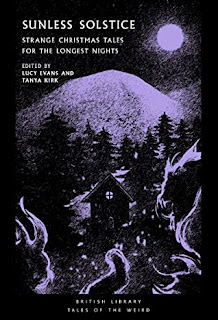
Sunless Solstice: Strange Christmas Tales for the Longest Nights (eds.) Lucy Evans and Tanya Kirk


 9780712354103
British Library, 2021
288 pp

paperback

"Night, and especially Christmas night, is the best time to listen to a ghost story.  Throw on the logs! Draw the curtains! Move your chairs nearer the fire and hearken!"  


For me it's more a case of brewing some cardamom chai tea (with milk, of course), grabbing my favorite blanket, curling up in a cozy chair and opening a book, but I'd say the Victorians (in this case Frederick Manley) had it right:  who wouldn't love to sit in the darkness with only a roaring fire for light and listen to a ghostly tale or two?   

While there are only three stories from Victorian times in this anthology, they are three really good ones.  Frederick Manley's  "The Ghost at the Crossroads: An Irish Christmas Night Story" (1893)  kicks off this anthology, finding a Christmas party in full swing at the "snug home" of the Sweenys in Derry Goland as the winds are howling outside.  Just as it's time for the dancing to begin, with "the fun ... at its height," the revelry is interrupted by "the banshee's cry."  It's not really a banshee, of course, but a young man with a story about a strange card game with a "thing in black."  Definitely the  perfect opener for what's to come, and the weirdness doesn't end there.  Continuing on with the Victorians,  there's Lettice Galbraith's "The Blue Room" (1897) which I've read elsewhere but still love,  and last but not least, a story by American writer Elia Wilkinson Peattie,  "On the Northern Ice" from 1898.   Ralph Hagadorn is on his way to stand as groomsman to his best friend, getting a late start due to a delay caused by business.  Skating across the Sault Ste. Marie region in the dead of night where "in those latitudes men see curious things when the hoar frost is on the earth," he suddenly realizes that not only is he not alone, but that the mysterious "white skater" is leading him away from his intended path.  More than hints of the strange in this story, and we're not just talking about ghosts. 


Of the next two stories, written in the 1920s,  E. Temple Thurston's "Ganthony's Wife" (1926) is completely new to me, while I'd previously read WJ Wintle's  "The Black Cat" from its original source, Ghost Gleams: Tales of the Uncanny (1921), republished by Sundial Press in 2019.     Thurston's story, while beginning with the lament that "The custom of telling stories round the fire on Christmas is dying out," focuses on a ghost story told sitting "round a blazing wood fire" at a house party.  The teller of the tale swears it's true, and that it's definitely not for children.  Trust me, it isn't.  

The 1930s are represented here with Hugh Walpole's 1933 story from The Strand, "Mr. Huffam" which quite honestly I didn't care for and Margery Lawrence's "The Man Who Came Back" from 1935, which I very much enjoyed.   I'm a true fangirl of any story with a séance at its heart; add in a medium's warning, a reluctant spirit guide and some "decidedly non-festive revelations," and well, you have a topnotch story here.  I love Lawrence's work; in her lifetime she was, as the editors reveal, a "committed spiritualist" and member of The Ghost Club;  sadly she's somewhat underappreciated today, which is a true shame. 


from abebooks 


Bypassing the 1940s,  "The Third Shadow" by H. Russell Wakefield was  first published in Weird Tales in November 1950.  To digress a moment, to my great delight because I'm a huge fan of the goat-footed god, the cover of that edition (above) features a Pan-like figure  playing his pipe and cavorting in a forest, cloven hooves and all, with what looks to be a mountain range in the background.  That would make sense as "The Third Shadow" is a tale centered around amateur mountain climbers.  Told to an anonymous narrator by Sir Andrew Poursuivant as they sail to New York on the Queen Elizabeth, it is the story of a man named Brown, "a master in all departments, finished cragsman and just as expert on snow and ice."  It seems that Brown, in one of his reckless streaks, proposed to and married a woman named Hecate, who "made his life hell,"  and who was "a good deal heavier" than her husband.  Two years after their marriage, Brown took Hecate to the Mer de Glâce glacier for a morning of training, during which her rope broke, sending her falling into a crevasse.  Although he swears he'll never climb again,  Sir Andrew reluctantly talks Brown into a trip up the Dent du Géant,  "a needle, some thirteen thousand feet high."  It is a climb Sir Andrew says he will never make again because of what happened that June day.   Following Wakefield is Daphne Du Maurier's "The Apple Tree" (1952) which I've read more than a few times, and then there's a bizarre and rather creepy story by Muriel Spark called "The Leaf-Sweeper" (1956) about a young man who wants to abolish Christmas and whose anti-Yule rantings land him in a mental asylum.   But wait. There's more -- but I will say nothing about what happens next.  Great story, actually, and a personal favorite. 

Robert Aickman's "The Visiting Star" first published in 1966 (in Powers of Darkness: Macabre Stories) tops my list of favorites here.  It  is not the weirdest story I've ever read by this author (whose often-cryptic work I absolutely love) but strange it is all the same, employing here, as he often does, bits of the mythological, the psychological and just plain weirdness to tell the story of Arabella Rokeby, an actress who is set to make a return to the stage in a play she'd starred in years earlier in London, now being produced in an "unused and forgotten" theatre in some out of the way town.  When "the great actress" arrives accompanied by her strange companion named Myrrha, Colvin (an expert on lead and plumbago mining),  expecting an aging woman, is somewhat surprised by her youthful looks, but that's not the only strangeness to be found in this most excellent tale, a truly great choice by the editors for inclusion.  

The closing story in Sunless Solstice is from 1974 by James Turner, from his collection of stories called Staircase to the Sea : Fourteen Ghost Stories. I've looked for this book everywhere and sadly, I can't find a copy anywhere. In  "A Fall of Snow" Nicky, a boy from Cornwall, is staying at his uncle's farm in East Anglia  over the Christmas holidays while his parents are in New York; the arrival of snow both awes and terrifies him.  Why this is so I will not say, but a toboggan ride with his cousin heralds the unexpected and the strange.  

 As is the case with the other books in the British Library Tales of the Weird series, it's a true delight reading the work of past masters of the strange.  The editors of Sunless Solstice  have certainly done their research in putting together this book, leaving their readers with enough scary chills and weirdness to take them through the Christmas holidays, but as always, you don't need to limit yourself to the season to find joy in the reading.    Very nicely done, and of course, definitely recommended.    

Monday, October 11, 2021

Weird Woods: Tales From the Haunted Forests of Britain (ed.) John Miller


9780712353427
British Library, 2020
238 pp

paperback


I've gushed many a time over the books in the British Library Tales of the Weird series over the last few years so I won't do that here -- suffice it to say that I've never been disappointed with any of these books and my current read,  Weird Woods: Tales from the Haunted Forests of Britain, is no exception.  The editor, John Miller, is also responsible for one of my favorites in the series, Tales of the Tattooed.  This time, however, he turns to 
"tales of whispering voices and maddening sights from deep in the Yorkshire Dales to the ancient hills of Gwent and the eerie quiet of the forests of Dartmoor." 

No teddy bears' picnics here; instead there are twelve tales which celebrate "the enduring power of our natural spaces to enthral and terrorise our senses."  

The names listed in the table of contents are familiar to any aficionado of strange or ghostly  tales from yesteryear, here ranging from the 1880s through the 1930s.  Aside from Arthur Machen's "N" which I will gladly read any time, two stories top my list of favorites: E.F. Benson's "The Man Who Went Too Far" and Algernon Blackwood's beyond excellent "Ancient Lights."  The first is set in the New Forest of Hampshire, where one "gets the sense that many presences and companions are near at hand."  The people of the village of St. Faith's know well enough not to "willingly venture" there after dark since
"it seems that a man is not sure in what company he may suddenly find himself..."
 Indeed, it may be the ghost of a young artist, recently deceased, haunting a "certain house, the last of the village, where he lived."  But this is not a haunted house story by any stretch; it seems that the artist, a certain Darcy, has been engaged in "the deliberate and unswerving pursuit of joy,"  but what starts out as an ode to the blissful wonders of the natural world soon takes a darker turn.    Spending years communing with nature, it is his belief that will ultimately become one with it -- and then he hears the "sound of life," aka the pipes of Pan.   At first fearful, he eventually comes around; now, as he tells his friend, there's one more step -- a  "final revelation."   Lots of covert subtext in this story, and it's truly one of the best in the book.  There is also much to discover in Blackwood's "Ancient Lights," which highlights one of the main themes in much of his work -- the insignificance of humans among the towering presence of nature.   A surveyor's clerk looks forward to a "day of high adventure" as he enters a "copse of oak and hornbeam" near Southwater, Sussex, and gets that and more as well.   The owner of that wood has decided to cut this area down for a "better view from the dining-room window," and the clerk is there ahead of the project.   The trees, though,  have other ideas.  


from A Bit About Britain


I came across three stories new to me. First, "An Old Thorn," by WH Hudson, set in the South Wiltshire Downs focuses on a tree described by the editor as "the Satanic double" of the famous Glastonbury thorn.  This particular tree has a very long memory, forgetting absolutely nothing, no matter how much time has passed.   Next is the atmospheric, very nicely told "The White Lady," by Elliott O'Donnell, represented as a true story by the narrator, who as a boy decides to hide in a tree one night to see the infamous White Lady of Rownam Avenue.  He gets much more than he bargains for.  Last but by no means the least of these, in Mary Webb's "The Name-Tree," it is said of the name tree that if it dies,"you die. If you sicken, the tree withers. If you desert it, a curse falls."  After seeing the "real, vital savage passion" young Laura has for her much-beloved cherry orchard, the site of her name tree, the new owner of Bitterne Hall laments that it's all wasted on nature.  It seems that he too has developed quite a passion, not for nature but for Laura.  He offers her a deal as a way to keep the house, the orchard and her name tree, but there will be a cost.  So very good, but oh, so harrowing at the same time. As the editor reveals, this is a story in which "patriarchal authority" is "painfully amplified among trees."  

The remainder of these stories in this volume  I've read before -- Edith Nesbit's "Man-Size in Marble," "The Striding Place," by Gertrude Atherton, "He Made a Woman --," by Marjorie Bowen, "The Tree," by Walter de la Mare, and "A Neighbour's Landmark," by M.R. James -- but no matter, since all are well worth reading again.   

As Miller notes in his introduction,
"Haunted woods are places where narrative and environment are merged, where the imagination and landscape are rooted together,"

and this theme as well as others runs through each and every story in this book.  In some cases the idea of "woods" might seem a bit stretched, but it didn't matter to me.   Just reading these tales brought back many moments I've spent in forests both day and night, remembering all of the creaks and groans of the trees, the crackle of movement by woodland creatures, and the sense of being in an unworldly place where the sky is hard to see through the canopy.  Recommended mainly to those readers who, like me, love these older creepy stories from the past, and to those readers who are fans of the British Library Tales of the Weird series in general.     Don't miss the introduction (but do save it until the end), and be sure to check out the cover art as well.

I'm now psyched for a cool day and a hike through the woods -- and for whatever I may encounter there.  


Wednesday, August 4, 2021

Cornish Horrors: Tales from the Land's End (ed.) Joan Passey


9780712353991
British Library, 2021
365 pp

paperback


"Why not tell them of the Cornish horror ..."

Cornwall, editor Joan Passey reminds her readers in her introduction to this volume, is "not a fantasy land," but rather "real, and close, alternately viewed as the end of the land and its beginning," and her hope is that in reading this anthology, "thinking of Cornwall's rich lore, stories, and creative legacy" will  "serve to illuminate its realities than obscure them."  The history of Cornwall looms large throughout this book,  spectral and real, so that one cannot help but to encounter the past even in the present, as so many Victorian tourists evidently discovered.   As the back-cover blurb notes, the stories in this volume explore "the rich folklore and traditions of the regions in a journey through local mythology, mines, shipwrecks, the emergence of the railway and the rise of tourism."  The editor also takes a moment to introduce each story, explaining how these factors play out in the context of what the reader is about to encounter.  It is a unique way to look at what otherwise might be to some just some entertaining Gothic or ghostly tales, revealing that there is more to the story than what lies on the surface.  

My previous encounters with the stories in this book are limited to four out of the fifteen:  "Ligeia," by Edgar Allan Poe, "The Roll-Call of the Reef," by Arthur Quiller-Couch, "The Screaming Skull," by F. Marion Crawford (and by the way, don't bother to watch the 1958 film supposedly based on this story -- Crawford's version is great, but the movie absolutely stinks), and "The Adventure of the Devil's Foot," by Arthur Conan Doyle.  Moving on to those unread,   "My Father's Secret" written anonymously and published in All the Year Round in 1861, represents a "cultural exchange" between Brittany and Cornwall in the form of the story of the bisclavet, "the tale of the knight who, owing to some fearful but unexplained fatality, was compelled at certain times to assume the shape and nature of a wolf."  No knights here, but this story seems to have its roots in the idea of Cornwall as a "land of barbarous people and uncivilized behavior," as the author notes in the introduction, as well as its perceived isolation.  It's also beyond suspenseful.  Next up is "Cruel Coppinger," by Robert Stephen Hawker from 1866;   Hawker also wrote  "The Botathen Ghost," a popular and atmospheric ghost story set in the Cornish moors.  The action here focuses on a particular "legend of renown," Cruel Coppinger, who arrived during "a terrific hurricane," surviving an ensuing shipwreck after which he  took up a life as captain of "an organised band of desperadoes, smugglers, wreckers, and poachers."  Larger than life he is, indeed.  Of the next story, Mary E. Braddon's "Colonel Benyon's Entanglement", the author notes that it is "less on the villainous side" than another one of Braddon's stories set in Cornwall;  I found it to be the most tame of all the stories in this volume.  Here past and present collide in a not so pleasant way, as the Colonel finds himself staying in the home of an absent old friend whose wife has behaved so very badly.  The "false wife" is also gone, but the Colonel can't help feeling that she'd left an "evil influence upon the scene of her iniquity."  "The Phantom Hare" penned by an author known only as M.H. (1873) thankfully is not tame at all, offering the story of a white hare which bodes "no good when seen."  Any man who finds one passing over his feet should absolutely beware.  "Christmas Eve at a Cornish Manor House" by Clara Venn (1878) is a ghostly story within a story as "heard from an eye-witness," or perhaps rather an "ear-witness. "  


from Kernow Coasteering


When thinking of Cornwall, one of the most popular images that comes to mind is that of the caves hidden along the coastline, often used for smuggling.  This feature plays a role in Mary L. Penn's  "In the Mist" (1881), as a lovers' quarrel at the top of a cliff takes a terrible turn.  "The Baronet's Craze," by Mrs. H.L. Cox (1889) centers on a young man who rushes to Cornwall to find the woman he loves, only to come upon a scene that shakes him to his core.  The port of Pencastle is the scene of Bram Stoker's "The Coming of Abel Behenna" (1893) in which two friends fall in love with the same woman.  The rivalry intensifies until (it seems) the only way of settling the issue is a coin toss. There is a twist: whoever wins also gets the money of both men and use it for trade, thus returning richer after the period of one year.  It sounds like a good idea, but oh, so much can go so very wrong in this scenario. And it does.  


"
the Cornish Coast, from The Book Trail

My favorite story, which also wins my award for most disturbing, is Elliott O'Donnell's "The Haunted Spinney" from 1903.   It is one of those stories where I read it once, did a WTF? double take and immediately read it again.   On a country road  in the Cornish moors, a man takes a walk in the rain and encounters a "woman in a dark cloak" and decides to follow her.  In so doing, he comes across a "poor, common man" who he writes off as just a "stupid, sturdy son of toil" who believed in "Cornish bogies," but there's more to come, including a murder.  Anyone deciding to read Cornish Horrors should leave off reading the editor's introduction to this story until after finishing this eerie tale so as to be completely taken by surprise.  The next story, "A Ghostly Visitation," by E.M. Bray (1907) finds a woman traveling alone stopping at a private hotel.  Of the two rooms available, one is "a miserable little room" and one is "very spacious and better furnished," and it's the latter the landlady wants her to take.  That night we discover why the landlady is so antsy about the woman's choice of the smaller.  Passey notes that this is a story that "builds upon an existing tradition of Gothic tourist fiction set in Cornwall;" it seems that travellers even then enjoyed "seeking out frightening places."   The last of the previously unread is by F. Tennyson Jesse, whose A Pin to See the Peepshow helped to inspire Sarah Waters' novel The Paying Guests.  On offer here is Jesse's "The Mask" from 1912, also quite disturbing and once read, unforgettable.  The woman at the center of things is Vashti Glasson, who is unhappily married but finds solace in another man who has become completely "enslaved" by her.  At the last of their secret meetings things go horribly wrong and all hell breaks loose, but this is not the end of the story, by far.  

For people who think of Cornwall in literature and immediately conjure up Daphne du Maurier, this book reveals that long before she made her way into the literary scene, the Victorians were already capturing readers' attention with their tales of the land's end.  The majority of the stories included in Cornish Horrors stem from that era, and it seems that Victorian Cornwall was indeed fruitful ground for the Gothic imagination for several reasons that the editor covers in her overall introduction to this collection.   Very nicely done; it is a fantastic book, and I have to say that while I've never considered Cornwall as a "fantasy land," it has for some time now been in my reading mind a place rich in history, folklore and adventure, and my shelves are filled with novels and story collections with Cornwall as their home base.  

Very highly recommended, especially to others who have been enjoying the entire series over the last few years.