Showing posts with label fantastical. Show all posts

Friday, February 25, 2022

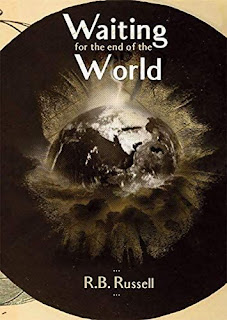
Waiting For the End of the World, by R.B. Russell


978178365958
PS Publishing, 2020
279 pp

hardcover


"It did for those with the eyes to see..."


If your only connection with R.B. Russell is the truly great work he does along with his partner Rosalie Parker in publishing books at  Tartarus Press, you should also be aware that he is also an author and a pretty damn good one.   The last book I read by R.B. Russell was his short-story collection Ghosts, and when I finished that book one of my first thoughts was that I need to read more by this man.  Off to the online realm I went for more, and I picked up two Russell books, Death Makes Strangers of Us All and this one, Waiting for the End of the World.  After reading this book, I enjoyed it so much that this morning I bought his The Stones are Singing.  I mean, I knew after Ghosts that he could do great short stories, but maintaining cohesion and  tension well enough to last the length of  a  novel is another thing altogether.  Some writers just aren't able to bring it, but that's certainly not the case here.  

I will not go too much at all into detail about what happens here, and that is because this is the sort of book where you don't realize until toward the very end that you've been given signs along the way as to what's actually going on.  Even so, I didn't actually understand that until this morning when going through all of the pages I'd tabbed; suddenly all of my synapses were on fire as I made connection after connection.  At that point it became not just a good read, but an eye-opening, crazy good read.  

It all begins as our narrator Elliot Barton is sitting in a train in October of 2006, reflecting on things, including his partner Lana, the joy of sharing life with her at their house on Sapphire Street and his job. On that first page life seems great, and then comes the first clue that there may be some trouble in this paradise.  As he says,
"Above all, I can't believe that what I did so long ago has yet to catch up with me. What I have not told Lana is I live each day as though it is my last of freedom. When the post arrives, the telephone rings, or if there is a knock at the door, I am expecting the worst, even after ... I do the calculation ... eighteen years."

 In what he describes as an "unusually fatalistic mood," he thinks about the "few words" of a  phone message he'd heard after work  and how because of it "the first stone has been loosened from the foundations of our house on Sapphire Street."   Once home, and after a night of strange dreams, the next day Lana's off to her job and Elliot plays the remainder of the message, erasing it afterwards.  It seems that a friend from his school days, Vince Reynolds, wants to talk to him about something that happened in their past.  He continues to avoid Vince on the phone, but eventually speaks to him and learns that Vince is thinking of going to the police to confess and that he would like to get together to talk.  Vince has found religion and wishes to "atone" for his "sin," to "face any punishment;" strangely though, his version of events of that day are quite different than Elliot's.   Elliot, who now has had to tell Lana what it was all about, believes it's the beginning of the end of everything; he doesn't want Vince to do anything and travels to St. Michael's  retreat where Vince and his fellow members of the Children of the Cross are now living, along with none other than a man whom the Children of the Cross believe is Jesus Christ, who has come again "to shepherd his flock."  Elliot's aim: not to have Vince reconsider his plan, but to have him "change his mind and disappear from my life once again."   What Elliot doesn't realize is that his visit to St. Michael's will change everything in ways he could not possibly expect. 


While it may sound like the plot of a crime novel, Waiting for the End of the World is anything but.  Shortly after the beginning of the present timeline, the story begins to move back and forth through  time (and knowing what I know now I'm absolutely fighting with myself to not say anything more about that).  At each move there are added elements of context, suspense and tension that kept me turning pages, yet, as I said in my initial thoughts at goodreads, while reading I kept wondering to myself what all of this was leading to.  Let me just say that there came an OMG moment toward the end where I not only realized what was happening, but also when I realized that everything that had come before has suddenly taken on momentous significance. 

Among other fascinating topics, within Waiting for the End of the World  the reader will encounter themes of religious belief through history, cults and what it is about the need for a Messiah that drives people to  gather around a particular individual to take them through an apocalypse,  the importance of dreams and the idea that one particular event can unknowingly and unwittingly change the course of things.  It's an amazing book, and the writing is utterly fantastic, drawing you in slowly until there comes that above-mentioned moment when everything just explodes.  On top of everything else, I've also made note of all of the book titles that the author included in this one, and I was so pleased to see Machen's Hill of Dreams listed among them; I'm sure that its inclusion as well as that of Rolfe's Hadrian the Seventh (and others) were not simply random choices.   

Very nicely done, and my advice for readers who at some point feel like you're wondering where this story  is headed is to just be patient and enjoy the ride,  but to be sure to pay attention along the way. In this book, things have a habit of turning up again when least expected.   This one I can certainly and very highly recommend.  Like all of my favorite books,  I can honestly and without reservation say that I've never read anything quite like it. 

Sunday, February 28, 2021

The Collected Connoisseur, by Mark Valentine and John Howard


"What we seek, and what we also half-fear, is all around us, always, had we the necessary calm intentness to discern it. "


9781905784202
Tartarus Press, 2010
308 pp

paperback

Over the years I've read my fair share of stories featuring supernatural detectives, and prior to starting this book, that's what I thought I had here. What I discovered was not at all what I was expecting, but something unique instead: an "aesthetical detective extraordinaire" in the form of the Connoisseur.   He is described as a
"connoisseur of the curious, of those glimpses of another domain which are vouchsafed to certain individuals and in certain places." 

The Connoisseur is a nickname given to this man by Valentine, who with the Connoisseur's consent, "dependent on anonymity and all necessary discretion," recounts "some of his encounters with this realm. "  The narrator notes that while the Connoisseur  is far from wealthy, he "supplements a decent inheritance" with "administrative work," he "shuns many of the contrivances of modern living," and is therefore able to indulge in a "keen pleasure in all the art forms."   He is a seeker of knowledge and a walking encyclopedia of the arcane; if there's something he does not know, he knows any number of people to whom he can turn for answers.  The mysteries he encounters are often  built around some sort of cultural artifact either in his possession or brought to his attention, for example, in the first story "The Effigies," the narrator is looking at a "dark earthenware jug of quite perfect form" on the Connoisseur's mantel, sparking a story about his friend's visit to its creator, Austin Blake,  renowned maker of "amphorae and delicate vessels" who had suddenly stopped producing at the height of his fame.   There are also a few occasions in which Valentine accompanies the Connoisseur and witnesses events firsthand.   

It is not difficult at all to recognize the influence in these stories of those writers Valentine notes in his introduction as "lifelong companions," and "household gods":  Arthur Machen, Algernon Blackwood, Lord Dunsany, Walter de la Mare and William Hope Hodgson.  "The Hesperian Dragon," for example, is easily recognized as a delightful sort of play on Machen's "Three Impostors."  Blackwood's finely-tuned sensitivity to the hidden awe of the natural world is reflected in "The Last Archipelago," and as in the case of our narrator throughout The Collected Connoisseur,  Hodgson's Dodgson serves as chronicler of the adventures of Carnacki.    Beyond the recognition of Valentine's "household gods", however, lies something even deeper where these authors are concerned -- in the introduction, in discussing a few other writers of the 1890s he'd read, including M.P. Shiel,  Valentine notes that 
"These then, the wondrous, the spectral and the aesthetical, were the airs floating around me when I began to think whether I could go one step further than reading, and try writing, the sort of fiction I enjoyed."

It is this sense of the "wondrous, the spectral and the aesthetical" that he and in the last few stories, John Howard capture here in a style that reflects the writing of those previously-mentioned authors who came before, but still manages to remain quite original.    Not everyone can carry off the voice of times past in his or her writing, but here it is pitch perfect.  The last six of these stories were collaborations between the two authors, and anyone who's read the work of John Howard will recognize his style immediately.  These tales are also a bit more fleshed out, with a bit more action involved, and provide a great ending to this collection.  

I loved these stories, all of which on the whole offered days of fascinating reading,   but of course and as always there were a few that stood out.   "In Violet Veils" is probably my favorite of the collection, in which an experiment in the "revived art of the tableau vivant" results in a warning by the Connoisseur that 

"such curious re-enactments were not to be essayed without some peril of affecting, in unforeseen ways, those involved: who could tell what might result from such a hearkening back to the original power of the mythological image portrayed?"

He knows whereof he speaks, having experienced firsthand an eventful, bizarre tableau vivant in the past.   "In Violet Veils" has the feel of the decadent/symbolist literature I love to read, with more than a touch of the weird that gives it an extra edge of eerieness.  In "The Craft of Arioch"  the Connoisseur relates to Valentine his strange experience during  a "walking holiday" in Sussex with his cousin Rebecca. Having left "the high roads and the dormitory towns" and traveling the "winding roads and nestling villages," they eventually find themselves at a barn where they expect to find hand-crafted rocking horses.  Let's just say after a ride on a "cross between a horse and a white dragon," and "a winged cat with preternaturally pointed ears and peridot eyes," they return from "unknown regions" and "a plane of experience different to anything we may find in this world."  "Sea Citadels," "The Mist on the Mere," "The White Solander" and "The Descent of the Fire" round out the list.   

At the beginning of "The Secret Stars" The Connoisseur in conversation with Valentine notes the following:

"What we seek, and what we also half-fear, is all around us, always, had we the necessary calm intentness to discern it."

 The Connoisseur's "rare glimpses" are the very heart and soul of this book.


The Collected Connoisseur is one to read curled up in your favorite reading space, hot cup of something or other in hand.  Like the Connoisseur, I am quite partial to Qimen/Keemun tea; I  am also one of those people described on the back cover blurb -- "the lover of esoteric mystery and adventure fiction. " More to the point,  I am also in complete awe of Valentine and Howard's visionary writing here and elsewhere.    Every reader of the weird, the fantastical, and of the occult  should have The Collected Connoisseur sitting on his or her shelves.  No collection would be complete without it.