Showing posts with label British fiction. Show all posts

Tuesday, December 27, 2022

The Shrieking Skull & Other Victorian Christmas Ghost Stories (by) James Skipp Borlase, (ed.) Christopher Philippo

"Truly, we little understand the mysteries of that world unseen, yet so near." 


9781954321854
Valancourt Books, 2022
184 pp

hardcover

 This book marks, I do believe, the first time a Valancourt Christmas edition has featured a single author; here it's a Victorian writer by the name of James Skipp Borlase (1839-1909).    Datewise, the stories in this volume range from 1867 to 1907, part of the "untold number of short stories" he'd written;  Borlase also, according to the editor's informative introduction, wrote "as many as a hundred serialized novels," a seriously major output over a very long career. 

One thing I've discovered while reading this book in particular is that evidently, Victorian readers must have truly enjoyed reading tales based on their own history, as there are a number of stories set in the 17th and 18th centuries.  They seemed to also enjoy stories that hearkened back to old, familiar folklore and legends, and after 1880 Borlase began employing a technique in which he would identify
"short passages regarding ghosts, witches, deals with the devil, and so on from works of local history and folklore, then writing a longer story of his own from that germ of an idea and resetting the events around Christmas."

 Personally, I think that was a good choice on his part, starting with the familiar and then embellishing, and that concept takes shape at the very beginning of this collection, with the first story,  "A Weird Wooing."  It begins on  Christmas Eve in January, 1748 and concerns an ill-fated romance between a young woman and her ardent suitor whose lands had been confiscated because he "drawn his sword, on the losing side, during the Civil War of 1745 and 1746." It  seems that this guy means to make his fortune and win the girl back by going to  Edinburgh where a treasure lies hidden in a house beset by the plague in 1645, sealed up "lest the pestilence should burst forth ..."  It seems that Death guards the place, so we shall wish him well.  The titular story, "The Shrieking Skull,"  set in Lancashire, begins in 1650, the year after Charles I was executed at the hands of Oliver Cromwell.  Once again politics divides a young couple in love.  She, Ruth,  the daughter of a Puritan is being (once again -- a very common theme throughout many of these stories) forced into a marriage to which she refuses to agree, and he, Ralph Osbaldiston, a Cavalier having lost his ancestral lands to her father when they were confiscated by Cromwell.  His family has long been known to have the "second sight," and he puts a curse on her groom-to-be that on the wedding day, he will either die "the death of a wolf" or will live "the life of a tortured fiend in hell."   As the next chapter heading begins, "Enter the Shrieking Skull."  I did not know this, but according to the editor,  a shrieking skull is a "British tradition," and with just a bit of googling, I found a few examples  of this phenomenon.  Actually, there are two different skull stories in the book, but this one is the best.    Yet another story, "The Black Cat or The Witch Branks of Loughborough,"  goes back even further in history, set in Leicestershire in the 1630s in a small town of  Loughborough, where one young woman, Madge Calvert,  covets the admirer of Muriel Fenton and will do absolutely anything to have him for herself.  The idea of just how to obtain her goal begins when Muriel finds a black kitten.  You may likely guess where this might be heading, but there are a few surprises yet to come.   


from Folk Horror Revival, Twitter


A somewhat bizarre tale  that I thought fit quite well in the weird fiction zone is "Tale of Two Christmases," which employs the old "White Lady" legend (which, I might add, is not limited solely to the UK, but is famous on a global scale in different variations) along with a wee bit of fairy lore.  It seems that a "family spectre"  guides two brothers, one a widower still missing his much beloved wife, to a small hill of snow, where they make a surprising discovery of a young girl who likely would have died without their White Lady's help.  The strangest thing about all of this is that this child bears a striking resemblance to the older brother's dead wife, who had promised on her deathbed that she would one day return.   And finally, the story that gets my nomination as most Christmas-y is "The Haunted Silk Mill; or the Ghost-Guarded Treasure," first appearing in 1905.  Set twenty years earlier, the story begins on a "blazing hot day" in Derby when at 6:30  p.m. the local silk mill catches fire. Fast forward five months plus and the heat has given way to the freezing cold and a "most severe winter."  A strike has closed the silk mills and the workers are starving.  Jane Morgan is with her beau, Joe Need and his mother, Joe having been seriously injured in the earlier fire and unable to work.  He tries to convince her to throw him over, since his injury prevents him from any labor, and he won't stand in the way of her marrying someone else who might take better care of her.  Jane refuses to hear it, having loved Joe since childhood, and hits on a plan to better all of their lives.  According to rumor,  there is a treasure hidden in Joe Lombe's silk mill, and she plans to go and get it.  She hands Joe a "scrap of discoloured, mouldy parchment, which smells as though it had recently been taken out of some grave" with the key to gaining the treasure.   The note promises that "no grizzly ghost can do her ill" if she fulfills certain conditions; in fact it's just the opposite.  If all goes well, it says, "... perhaps a ghost may point the way."  

This is probably the most different of all of the Valancourt Christmas volumes, and the stories included in The Shrieking Skull may not be the most frightening ghostly tales ever written,  but more important than leaving modern readers with a case of the heebie-jeebies, I think, is what Philippo says about Borlase's stories here, that 
"... this first collection of so many of his Christmas ghost stories should provide an informative and enjoyable window into the tastes of the Victorian era."
That it definitely does, and really, it's not too difficult to imagine a Victorian dad with his family all cozied up in the dark around the blazing fire in the hearth as he reads a few of these tales (in my head by candlelight),  inducing many a shiver among the wee ones.   My only complaint here is that many of the stories tend to center around romantic rivalries or lost loves that  make for one-note reading at times, and really, it's like a breath of fresh air when something different actually pops up in the story lineup.   On the flip side though, it's very much a plus to have been introduced to the work of James Skipp Borlase, whose name has never before blipped up on my reading radar.  I happen to very much enjoy this sort of thing because I'm a total folklore fanatic and a three-times history major, and I especially enjoyed the way Borlase reworked old history and old legends in his own way to fit the bill for the Christmas holiday season.  

As the editor notes, 
"Victorian readers' concept of 'ghost stories' generally and 'Christmas ghost stories' in particular was broader than the conception of some readers today,"
something I totally understand having read so many of these, and something for other readers to keep in mind as they read through these old tales.  I totally appreciate all of the work Christopher Philippo has put into this book, and for me, it's a welcome addition to my home library,  a book I'd certainly recommend, especially for regular readers of Victorian ghostly tales.   My advice -- be patient, but then again, if you've read a lot of Victorian ghost stories, you already know that you should.


Thursday, June 23, 2022

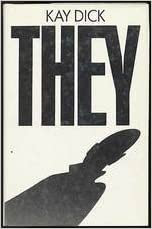
They: A Sequence of Unease by Kay Dick


9781946022288
McNally Editions, 2022
first published in 1971
112 pp

paperback

Since finishing this book a couple of weeks back, I've been reading everything I can find on both book and author, and I found a great article in The New Yorker about how this book came back into being after a long period of obscurity.  Bear with me here because it's a great story and I love reading about this sort of thing, otherwise, skip this first couple of  paragraphs and just scroll on down.   It seems that a British literary agent by the name of Becky Brown had gone to stay with her parents in Bath during the pandemic, and "with nothing better to do" made her way to an Oxfam shop there in August, 2020.   Her work involves the representation of "dead authors," and so she had developed the knack of  quickly scanning bookshelves in places like thrift stores or used bookstores, "looking for particular colors, colophons, publishers' logos."  During one such scan, she came across a Penguin paperback, orange, with cracked spine which  she bought for fifty pence -- this book, as it happened.     


Penguin, 1977 edition.  from Amazon

About a week later, Ms. Brown received an email from a friend of hers, Lucy Scholes, a contributor to The Paris Review about found old books and the senior editor at McNally Editions, had come across the author's obituary in The GuardianShe had never heard of Kay Dick but decided she'd look into the author's work, most of which she'd found "particularly unexciting," until she came upon this book.  She wrote about it for Paris Review, and following that article, because of newly-arisen interest in publishing this book, she emailed Brown for help in tracking down the author's estate.  Noting the "strangest timing,"  Brown revealed that she'd just read They.   Scholes was surprised, asking her how she had even found a copy, which as Sam Knight notes in The New Yorker article, was "virtually impossible" to find at the time.   Brown was "stunned" at just "how thoroughly the book had disappeared," saying that "It's incredibly unusual to find a book this good that has been this profoundly forgotten."  

I'd never even heard of this book nor its author, and I stumbled onto both accidentally when an email came to me from McNally Editions, advertising their book bundle that included They.  (By the way, it's also available from Faber, published in March of this year with an introduction by Carmen Maria Machado.)   I bought said bundle and put the books aside for later, but then I got another email from a reader friend who was blown away by They and  highly recommended it.  I took that as a sign that maybe I should read it sooner rather than later.   Much like Becky Brown's experience, reading They "just punched me in the face."   

I suppose for some people it may be a stretch to call this book a novel; it is a series of nine short stories which are linked by the recurrence of an unnamed, ungendered narrator, the "I" who travels around the "rolling hills and sandy shingle beaches of coastal Sussex"  with a dog visiting  pockets of artist/intellectual friends during a time when mobs are roaming throughout England bent on the destruction of the arts (including literature), working to stifle creative freedom  and to impose their own version of conformity.  "They"  are "over a million, nearer two,"  but how this situation developed is not explained; the author, I think, is less interested in the hows and whys than the idea of what it may be like to live in a world (to quote the book blurb) "hostile to beauty, emotion, and the individual."    At the same time, perhaps the not knowing makes it all the more horrific, heightening the sense of menace and paranoia that grows with each chapter.  

 Things are already ominous enough as this book opens -- in a seaside village the narrator learns that the mob has destroyed "the books at Oxford," and from a friend nearby finds out that the National Gallery had been "cleared." But it's not just cities that are affected -- in the countryside the narrator's friends cluster together in "pockets of quietude" for support and to go on with their work as much as possible; communal living  is a also a means of survival, as They fear "solitary living" --  those who live alone "are a menace to them."  The mobs watch all the time, ready to mete out punishment to those who stand out from the norm or who offer resistance.   As time and the book moves on, the situation grows worse as They take over more of the countryside, imposing more stringent measures against individual freedoms, tightening their control.   People are forcibly moved to newly-built houses,  young children often having to go "with or without parents."  Gunshots are commonly heard, signaling that "intractability is a punishable offense," and "senseless violence" becomes usual.  "Retreats" are built, constructed with no doors or windows, part of an effort to cure the offenders "of identity."  Lobotomies are a form of punishment.   Grief becomes an unforgivable offence, resulting in removal to a specialized grief tower where memory purges are performed.   And yet, through it all, the narrator who "allowed myself the luxury of going utterly to pieces for forty-eight hours" continues on, "greeting another day." 

In her afterword Lucy Scholes notes that this "strong allegory" can be read in numerous ways, 
" -- as a straightforward satire, a sequence of vividly-drawn nightmares, even a metaphor for artistic struggle -- but above all it's perhaps best understood as a plea for individual freedoms made by an artist who refused to live by many of society's rules"

and writer Eli Cugini in an article at XTRA*  discusses how They "deserves reappraisal,"  written by this "bisexual writer and editor who was ahead of her time," examining how  the "queer sensibility" remains evident throughout the book.   It can also be read as a straight-up look at the encroachment of fascism, and I have to say that I'm absolutely floored  by how the author managed to convey such menace, paranoia  and unease in such a short amount of space, but more importantly, by how what she wrote still resonates nearly fifty years later.  The lack of backstory in this book didn't bother me as it did some readers, nor did the fact that the chapters were so brief so that the characters were never really explored; for me it's more about the bigger picture here -- quite honestly, when I think about the last administration's lack of respect for the arts, labeling funding for institutions like PBS, the NEA, the NEH and the Institute of Museum and Library Services a waste of money, the current wave of book bannings,  it makes me angry and afraid.  And of course, considering the concept of "the mob"  in our own contemporary context, well, it's pretty damn scary.   Definitely a book that should not be missed, and this is coming from someone who rarely reads dystopian novels.  


Friday, May 28, 2021

Creatures of Another Age: Classic Visions of Prehistoric Monsters (ed.) Richard Fallon


9781948405874
Valancourt Books, 2021
223 pp

hardcover


I have to be honest here and say that when I first heard about this book, I was a wee bit iffy as to whether I'd be reading it, since a) my interest in paleontology has generally been limited to the nonfictional side of things and b) I'm not much of a creature-involved story kind of reader.  But because it is from Valancourt and they haven't yet steered me wrong,  I took a chance and it paid off. Even before finishing, I was so impressed that I started looking online everywhere for more of this sort of thing, resulting in a few novels written in the general time frame as the selections here in Creatures of Another Age, noted in the introduction as being
"between the 1830s, when the popularity of geology and paleontology skyrocketed, up to the end of the First World War, when cinema began to offer its own primordial prospects." 
The authors included in this collection, as the editor also states, "took geoscientific research to original and creative places,"  resulting in "necromantic fantasies, time-travel narratives, political poetry, weird ffin-de-siècle short stories, and even pseudo-Elizabethan verse drama."  Not only does this book make for hours of fun reading, but it also opens a window or two into scientific and social concerns of the time, both in the UK and here in the US.   

Not uncommon for me, my favorite stories were those written by authors I knew absolutely nothing about and whose work I didn't even know existed.    Hands down the strangest, most off-the-charts different (and in my mind for those reasons the best) of these is the work of an obscure writer by the name of Wardon Allan Curtis, whose "The Monster of Lake LaMetrie" reveals much about evolutionary anxieties (and so much more) of the time. I am not at all going into any detail here,  and I'm even offering a caveat  to anyone interested in reading this story against reading anything about it at all beforehand.  Set in the state of Wyoming,  it  first appeared in Pearsons Magazine, September 1899, and Fallon reveals in his brief introduction that in this tale the author "melds Wyoming's prehistoric associations" with the hollow-earth theory proposed by John Cleves Symmes in 1818.  What I will divulge is that it has awesome shock value in a weird/sci-fi sort of way, and it gave me a serious case of the willies once I considered the implications.      Another top-notch offering is "The Dragon of St. Paul's, by Reginald Bacchus and Cyril Ranger Gull (1899).  Fleming, the editor of a daily newspaper in London, holds the presses after hearing an incredible story so that journalist Tom Trant can write an article for a "special"  that should boost sales into the hundreds of thousands.  Back at home,  Tom relates a story that to him,  his fiancée and her brother seems to be "gaudy nonsense," "simply laughable" and "absurd"  about a strange discovery solidly encased in ice found on the return voyage of a two-year Arctic scientific expedition headed by the now-deceased Professor Glazebrook. Just hours before reaching the Channel, everything was going as planned up until the moment the professor decided to melt the ice containing his spectacular find, which turns out to have been a rash decision indeed.  As has been repeatedly revealed in old sci-films, sometimes what's been stuck in polar ice for eons should probably just be left alone.   "The Last of the Vampires," published in 1893 and penned by another unknown-to-me writer, Phil Robinson  (1847-1902),  is also on my list of favorites.   As with the previous two stories I've mentioned here, it involves humans pitted against "eerie creatures previously thought extinct," as Richard Fallon notes, so familiar to readers of popular periodicals during the Victorian fin-de-siècle.  This story is more atmospheric than the previous two, and starts out with a legend familiar to the Zaporo Indians of Peru.  As the legend goes, "Very long ago ...
there were many vampires in Peru, but they were swallowed up in the year of the Great Earthquake when the Andes were lifted up, and there was left behind only one 'Arinchi' who lived where the Amazon joins the Marañnon, and he would not eat dead bodies, only live ones, from which the blood would flow."

Local superstition also said that when a sacrificial victim was offered to "the Vampire," he would be "bound in a canoe," and after some time on the river,  the canoe would stop in "banks of slimy mud" to a creek  through which a "very slow current flowed," taking anything in the water there to a cave. Into this milieu comes a University professor and "mighty hunter of beetles" from Germany who decides to explore the cave for himself, his fate recorded in journal entries over the ensuing months.

Worthy of honorable mention is "Our Phantom Ship on An Antediluvian Cruise," by Henry Morley, part of a series making its appearance in Household Words in which the phantom ship took the periodical's readers  on "informative trips around the world."  In this installment the ship leaves London to go back "into the depths of time." 

Another fine Valancourt publication, Creatures of Another Age is neither limited to short stories nor obscure writers.  There are poems, essays, and even a short play, as well as selections by more familiar authors such as George Sand, Charlotte Perkins Gilman, Jack London, Arthur Conan Doyle and Thomas Hardy. While not all of the entries included here worked for me personally (as is always the case),  in putting this collection together editor Richard Fallon hopes that readers will "see the distant past in a strange new light," and that's exactly what happened to me here.   Very much recommended.   What a great idea for a book!! 


Tuesday, February 2, 2021

arachnaphobes beware: Tenebrae, by Ernest G. Henham


9781934555293
Valancourt Books, 2014 (reprint)
213 pp

paperback

Just about a quarter of the way through this novel, I remarked on Goodreads that Tenebrae is a book so filled with gloom that even when the characters are out in the garden it's hard to imagine sunlight.  Mind you, I had no idea that it was about to get even darker before all was said and done, but considering that the Latin word tenebrae translates to "darkness," I should have at least had an inkling.   Originally published in 1898, Tenebrae  is the story of two brothers, with "extraordinary affection for each other," right up until the time a woman came between them.  

The two brothers (names are not used here)  "formed the last representatives of an ancient family, proud of its history and its name," although the house itself has been left in a state of "gradual decay." The family home sits near a cliff above the sea, with the property also containing a "desolate moor." Some of its windows had been "closed up" by "forgotten ancestors,"  now 
"peered blankly through the clinging ivy, striking into the spectator's mind a latent suggestion of guarded horrors lying concealed behind..."

all of which, it seems, was pleasing to the elder brother's "naturally morbid imagination."  As just a brief aside, let me say that those three words struck a chord, keeping me on guard through the remainder of the novel.  We also learn that aside from the two brothers, this family also consisted of an uncle, who had once been a "nameless adventurer and wanderer"  now a "human derelict" whose mind had been affected by a long history of drug use of every kind, as well as an old nurse who in her own way continues to look after the two siblings.  

I won't say much in the way of plot -- I could talk about it all day but in the long run, it's better to go into this book knowing little more than what's revealed on the back cover blurb.  I will say that it is quite clear that there is something not right from the outset.  As the elder brother begins writing this account of events, he reveals that he is "curiously liable to ... fits" when thinking of the younger, now dead, to the point of  the ink turning "red upon the paper," the pen "dripping with blood," and "the horror" surging before his eyes.  This is quite strange, given that he goes on to describe their past relationship as one of "great unspoken love," sharing "the same heart, the same mind, equal portions of the same soul," and the fact that they "understood each other so well that speech was often unnecessary."  Something has obviously changed, and throughout the first part of this book, so aptly entitled "The Foreshadowing," we discover what that is as we follow the course of events involving two men who loved the same woman driving the elder to, as the back-cover blurb notes,  a "murderous jealousy" that will change the lives of all three involved.  The second and darkest part of Tenebrae, "The Under-Shadow," becomes a dizzying amalgamation of madness, mania, guilt and vengeance, all coming together in the form of a giant spider, "the most hideous of gaolers." 

This isn't a book I read in fits and starts -- it's actually impossible to stop reading once begun.  It is a novel that moves well beyond disturbing, owing to Henham's most excellent and atmospheric writing that has produced some of the most nightmarish imagery I've encountered over the course of my reading.   Do not bypass the excellent introduction by Gerald Monsman, but I would suggest leaving it until the last.  

Very highly recommended, especially to readers who like myself, love this older stuff -- it may be well over one hundred years old, but the horror it carries hasn't faded over the years. Not one iota. 


Thursday, November 21, 2019

Starve Acre, by Andrew Michael Hurley


9781529387261
John Murray, 2019
243 pp

hardcover


"That is a quiet place --
That house in the trees with the shady lawn."
If, child, you knew what there goes on
You would not call it a quiet place.
Why, a phantom abides there, the last of its race,
And a brain spins there till dawn."

-- Thomas Hardy, "The House of Silence"
epigraph


(read earlier this month)

I don't read a lot of contemporary horror novels, but there are a few authors whose books I will preorder once I know they're on the horizon for publication.  Andrew Michael Hurley is one of these people -- I absolutely loved his The Loney (in my opinion the best book he's written),   quite enjoyed his Devil's Day,  and now he's back with another fine novel,  Starve Acre.  This time around Hurley  is much more straightforward in terms of horror than the previous two, but don't be fooled: what happens here, as in the case of his earlier books,  plays out on many different levels other than simply gut-reaction horror.  It is truly one of the most disturbing contemporary novels on the darker side I've read in a while, in a good way, of course. 

Once again, Hurley sets his story in a remote, rural locale, more specifically in the Yorkshire Dales.  It is here where Richard Willoughby  and his wife  Juliette have come to live in his family home, Starve Acre, handed down to Richard after the death of his mother.  Juliette was convinced that it would be better to start and raise their family in the Dales rather than the city in which they live, and eventually their son Ewan was born.  As the novel begins,  it is clear however that this is a couple in the depths of grief, as their only child has died.  Juliette spirals into deep depression and despondency to the point of spending each night on a mattress in Ewan's room, where she hopes to "pick up the faintest traces of Ewan," still remaining there by filling the space with mirrors and making recordings every night, hoping for "moments of contact."  Richard, who is on a sort of enforced sabbatical from teaching History at university, copes by staying busy with some sort of work, organizing his father's library and after discovering old woodcuts there, seeking the location of and hoping to excavate the roots of the old Stythwaite Oak, which, as legend has it served as the local gallows tree.  His friend Gordon tries to warn Richard away from continuing his search, but disregarding his advice,  Richard continues on, finding nothing but a skeleton of a hare which he brings into his home to study it.   In the meantime, Gordon, hoping to offer help to Juliette in some measure, introduces her to a strange group of mystics called The Beacons who organize a sort of seance in the Willoughby home.  The story truly launches from this point, and we are taken back in time to Ewan's childhood and life at Starve Acre up to the time of his death.   A few somewhat cryptic hints by the author clue us in that perhaps not all was well there, but   little by little we get a more complete picture as to why.


the April 2020 paperback cover, from Amazon 

Anyone who has read Starve Acre will recognize key hallmarks of Hurley's writing, and I'll offer only two here.    For one thing, upon entering this story, you will find yourself caught in an overwhelming atmosphere of isolation.  He sets this up so very nicely, not only in terms of Starve Acre's remote location outside of the village, but  as events transpire, the growing distance between the Willoughbys and the local villagers becomes palpable, as Richard and Juliette slowly become outsiders and "outcasts" among them.  It also strikes me that he portrays the world of the Willoughbys as becoming ever more enclosed and slowly shrinking, as the majority of what happens in this story happens within the space of the Willoughby home and its immediate environs.  Further isolating this family, both before and after Ewan's death,  there is also much that occurs solely within the space of this couple's respective minds, into which neither wants to intrude.   But perhaps the key feature so well done in Hurley's novels is his trademark use of the landscape.  Aside from the physical bleakness of Starve Acre, the rooks that fly everywhere, and other features described throughout the story,  much of the sadness evoked here turns on this piece of land which had first captured Juliette's imagination as being the perfect place to raise children.  While she saw it as a "natural physical playground" that would grow as "they grew," the reality is that the Willoughby land lingers under a curse that leaves it doomed to having "not an inch of soil that's still alive."  And as young as he is, even little Ewan realizes a particularly close connection not just to the land, but to the very spirit of the place, which as this family will discover, is by no means benign.   This is a landscape upon which the past has been inscribed; it may well seem a "quiet place," but it is one which hides secrets that perhaps were better left undisturbed. 

I have to say that this is the sort of contemporary horror story I actually enjoy reading, very rare in my repertoire these days.    Starve Acre is a novel about what is left behind after the loss of a child, with much of the story focusing on the landscape of grief itself.  The supernatural elements are subtle and nicely layered,  secrets are unfolded little by little, and there is that lovely sense of ambiguity that kept this book in my mind for a long time while thinking about it.  While it may seem to move a bit slowly, that's actually a plus in this case since it culminates in one of the most unexpected, horrific endings I've encountered in a very long time.   My single complaint centers around Richard and the hare,  to which the author provides a not-so satisfying explanation toward the end of the novel which I didn't buy at all.    Since I don't want to spoil things I can't go into detail, but astute readers will figure it out. Despite that particular flaw, I can without hesitation recommend Starve Acre   --  Hurley is so very talented, his work is refreshingly original, and I've become a true fangirl.


Tuesday, November 12, 2019

Six Ghost Stories, by Montague Summers

978164520074
Snuggly Books, 2019
214 pp

paperback


"Gare à qui nous touche"


There is nothing quite like a good ghost story.  I read them all the time, and am beyond happy when I come across spectral tales previously unknown to me.  When Snuggly published this volume of ghost stories by Montague Summers, the add-to-your-cart button couldn't be pushed quickly enough.  It wasn't just that these were six more ghostly tales to be added to my reading repertoire, but the sad truth is that I don't believe I've ever read anything by Summers before.   I have a copy of  The Supernatural Omnibus which he edited (no Summers stories included), and of course his translation of The Malleus Maleficarum of Heinrich Kramer and James Sprenger, but that's about it. Mistake rectified now, with Six Ghost Stories, which sadly, as stated in the introduction written by Daniel Corrick, doesn't cover "the entirety" of Summers' "ghost oeuvre," but I will take what I can get.

In the author's preface to these six ghostly tales, he writes the following:
"When like Owen Glendower we 'call Spirts from the vasty deep,' let us be sure that the Spirits are no kindly commonplace apparitions but veritable powers of darkness, grisly evil things of terror and dread and doom, able to send a cold shiver through the reader who sits alone at eleven o'clock on a winter night, and perhaps even to make him hesitate a moment before he switches out the light in bed."
He goes on to say that
"unless the stage is well set and the situation made intensely real, ground-work which save in very exceptional cases entails fairly ordinary and not too romantic surroundings with everyday characters, the ghost story goes for naught."
I mention these bits of Summers' preface since they make clear what will be going on between these covers.  There will be no "beneficent" ghosts to be found here, and most of the haunting that goes on takes place in rather ordinary circumstances, happening to rather ordinary people.


Toy Theatre, from V&A


The winner of this collection is  "A Toy Theatre," because of which I will never think of Shakepeare's Othello in the same way again.  The story begins as Sir Gilbert Richie makes a promised visit over the Easter holiday to the country house of his friend Tom Hunstanton.  Life follows a somewhat strict pattern there (Sundays being described as "at Northanger"), so on the day before he is about to leave, he is happy to step out and heads to the old nearby town to go to the post office.  He has some time afterward to  meander through the "quaint streets" of the old town, where he takes a look in the window of one of the "shabbier and dustier" old shops.  Having been an avid collector since boyhood of "tinsel actors, toy theatres, and colored sheets of characters," he is attracted by a "maple-framed tinsel picture of some absurd actor at Astley's of the Grecian Salon in the role of Aureato, the Golden Knight." Having ascertained that this picture and another like it had belonged to the now-deceased husband of the snuff-pinching proprietor, Sir Gilbert makes the mistake of asking if perhaps she has more of his belongings she'd like to sell.  "A Toy Theatre" sent a chill right through my bones, making me identify with the aforementioned "reader who sits alone at eleven o'clock on a winter night," hesitating just a moment before turning out my reading light.

The  five other stories in this book are also highly satisfying and quite delicious.   "The House Agent" finds a London couple married less than a year finding a perhaps too-perfect cottage for their weekend getaways in a small village.  "The Governess" begins as a tale told by an aunt to her nephew about a certain Miss Howard, the new governess at 27 Harley Crescent, St. John's Wood NW.  It seems that some strange phenomena began to follow her arrival there in 1890, which the inhabitants of the house could deal with, but for Miss Howard it was a different story altogether. "Romeo and Juliet" begins as a story told with curtains drawn, two people sitting in the firelight, providing the perfect atmosphere for recounting the tale of a young girl honoring her father's dying wish  that she "remain on the operatic stage for at least three years."  Looking forward to the end of that time, she has a feeling that "something is going to happen... ," which, of course, it does.  Along with "The Toy Theatre," another of my favorites from this volume is  "The Grimoire," a most outstanding story about a "collector of books on alchemy, witchcraft and the occult sciences" who lays hands on a rare volume he's previously never seen just prior to a visit to a Canon friend of his who shares his interests in old books.  The final story, "The Man on the Stairsis also quite brilliant, providing a bizarre take on the stereotypical haunted house story.  The owner of Cherton Manor is upset when a friend refuses to visit him because of his home's reputation, and is so upset with "this spook business" that he makes an offer another man finds hard to refuse.


Montague Summers, from Goodreads


There are two things potential readers may wish to know before plunging into this book.  First, Summers seems to take his time in more than a few of these stories  setting the scene prior to the actual appearance of the "veritable powers of darkness."  While this is a necessary step, he tends to be a bit long winded at times, especially in terms of dialogue.    Second, I found that there were a couple of instances in which I found the outcomes predictable, but I chalk that up to having read a large number of ghost stories in my time.  While they're valid concerns, these minor flaws did not at all detract from my enjoyment of this book since these are definitely NOT your average ghost stories, and I have to applaud Snuggly for publishing this volume which may otherwise have never actually been put into print.

recommended, most certainly.


Tuesday, October 15, 2019

Ziska: The Problem of a Wicked Soul, by Marie Corelli

9781934555682
Valancourt, 2009
originally published 1897
184 pp

paperback

"In certain men and women spirit leaps to spirit, -- note responds to note -- and if all the world were to interpose its trumpery bulk, nothing could prevent such tumultuous forces rushing together."


Think what you will, but I love Marie Corelli's novels, at least the few I've read so far, with others waiting for my attention on their shelves.  The critics of her day had little nice to say about her work, but her reading public loved her, from "the eccentrics at society's lower end" to Queen Victoria herself.  One Corelli scholar notes that more than half of her novels were "world-wide best sellers," with more than an estimated 100,000 copies selling annually for several years.  Corelli's  1895 The Sorrows of Satan, according to Annette R. Federico in her book Idol of Suburbia: Marie Corelli and Late-Victorian Literary Culture, had an "initial sale greater than any previous English novel," selling twenty-five thousand copies its first week with and fifty thousand over the next seven weeks (2000, University Press of Virginia, 7).  Curt Herr, in his introduction to this Valancourt edition of Ziska, notes that 1897 also saw the publication of Stoker's Dracula and Richard Marsh's The Beetle, and that Corelli  outsold "Stoker and Marsh by the hundreds of thousands" (xi), which sort of begs the question as to why today she is all but forgotten, which is a true pity.


1897 original edition, from WorthPoint

There is no messing around as the story begins; the prologue puts us in the Egyptian desert of long ago, on a night when  "the air was calm and sultry; and not a human foot disturbed the silence."  A "Voice" breaks the stillness towards midnight,  "as it were like a wind in the desert," crying out for
" 'Araxes! Araxes!' and wailing past, sank with a profound echo into the deep recesses of the vast Egyptian tomb. Moonlight and the Hour wove their own mystery; the mystery of a Shadow and a Shape that flitted out like a thin vapour from the very portals of Death's ancient temple, and drifting forward a few paces resolved itself into the visionary fairness of a Woman's form -- a Woman whose dark hair fell about her heavily, like the black remnants of a long--buried corpse's wrappings; a Woman whose eyes flashed with an unholy fire and waved her ghostly arms upon the air."  
Flash forward to contemporary Cairo, where "full season" is in swing, where the "perspiring horde of Cook's 'cheap trippers' " have flocked for their holidays. We are introduced to one such group of British tourists, some of whom are in the lounge of the Gezireh Palace Hotel discussing  the arrival of the famous French painter Armand Gervase while others are preparing for a costume ball.  Expectations are highest, however, over the attendance at the ball of a certain Princess Ziska, of "extra-ordinary" beauty.  As the festivities begin and Gervase and the Princess meet, he is stunned:
"There was something strangely familiar about her; the faint odours that seemed exhaled from her garments, -- the gleam of the jewel-winged scarabei on her breast, -- the weird light of the emerald-studded serpent in her hair; and more, much more familiar than these trifles was the sound of her voice -- dulcet, penetrating, grave and haunting in its tone."
Ziska captivates this small group of tourists with her dazzling beauty and stories of ancient Egypt, but none more so than Gervase, who begins to believe himself in love with her, and  Denzil Murray, whose sister Helen knows that his obsession with the princess will eventually come to no good.  After confiding her woes to keen observer/researcher Dr. Dean of their party,  he notes that they have been caught up in "a whole network of mischief, " and that the
"...spider, my dear, -- the spider who wove the web in the first instance, -- is the Princess Ziska and she is not in love! ... She is not in love with anybody any more than I am. She's got something else on her mind -- I don't know what it is exactly, but it isn't love."
 As Gervase, as the back-cover blurb states, becomes more and more "haunted by strange and distant memories of her" over the short time in which this story occurs, it will become ever clearer exactly what it is that Ziska has on her mind.

The pulp/supernatural/gothic/occult-fiction reader in me of course positively swooned over Ziska, and if story alone was what it had amounted to I would have been happy enough.  Although I knew eventually what was going to happen here, it didn't matter -- the novel makes for an intense, compelling read.   But of course, there's always more that is not-so hidden under the surface with Corelli, whose beliefs often make their way into her work as debate between characters, and this book is no exception.  She begins right away with a look at the cultural imperialism of her day before tackling upper-class society, love, marriage, gender, and  her stock in trade, the undying soul.  Curt Herr has provided an excellent introduction that discusses all of this and more, including brief comparisons to the two other novels published the same year that I mentioned above.

'tis an old book, but a fine one, and I loved every second of it.  I really can't ask for more.

Thursday, May 16, 2019

From The Depths and Other Strange Tales of the Sea (ed.) Mike Ashley

"...the sea is another world and one of which we should be wary."

When I'm on vacation, books that require a lot of thought are off the menu.  When I'm laying under a seaside palapa, listening to the sound of the waves while sipping a foo-foo umbrella drink, the last thing on my mind is wanting to think, so I pack accordingly.  Among the others that ended up in my suitcase, I brought this book, From the Depths and Other Strange Tales of the Sea, my second foray into the British Library Tales of the Weird. It is my favorite kind of ahhh-time compilation, a mix of horror, ghostly tales, the supernatural, and pure unadulterated pulp, with stories ranging from 1891 to 1932.  There are a few entries here written by authors already known to me:  William Hope Hodgson, F. Austin Britten, Elinor Mordaunt, Morgan Robertson, but for the most part, it seems that Ashley has put together the work of a number of  writers I'd never heard of.   Such is my joy in reading these tales -- not only are they fun, dark, and in some cases, actually frightening, but they've been rescued from the depths of obscurity to be enjoyed all over again.


9780712352369
British Library Publishing, 2018
310 pp
paperback

Not wasting any time at all in setting the tone for what's to follow, Ashley presents us first with Albert R. Wetjen's  "The Ship of Silence" from 1932.  The narrator of this story doesn't waste time either, giving us a hint about what's coming as he sits with a group of friends aboard a ship in a Brazilian harbor  "drinking long, cold gin tonicas and talking of the sea in general and of ships that had vanished into its mysterious immensity."  But it's his own experience after coming upon an abandoned ship out of San Francisco that makes for the best and most chilling yarn of them all.  As he relates, "It is a curious thing -- but I swear I had had gooseflesh all over from the first moment I put foot on the Robert Sutter's main deck."  I had gooseflesh just reading this one,  so I knew right away I was going to be in for a great time.


doomed ships after having been stuck in the dense weeds of the Sargasso Sea, from globalsecurity 


Wetjen's  is only the first of fifteen stories, and I have to say that out of these there were only two which if you'll pardon the expression, didn't really float my boat. There is a wide range of tales being told here covering everything from encounters with bizarre sea creatures, the sheer horror of being stuck in the thick weeds of the Sargasso Sea and being unable to move on,  shipboard and other hauntings, clairvoyance, revenge (human and otherwise), and then some that  can only be put in the category of strange weirdness.  

The table of contents is as follows:
"The Ship of Silence," by Albert R. Wetjen, 1932
"From the Darkness and The Depths," by Morgan Robertson, who also wrote The Wreck of the Titan, or Futility (1898)  which supposedly prefigured the sinking of the Titanic. That one I have on my shelf, but haven't read it yet.
"Sargasso," by Ward Muir (1908), one of my favorites and certainly one of the most atmospheric of all of the stories in this volume.
"Held by the Sargasso Sea," by Frank Shaw (1908) another favorite that just creeped me to the bone
"The Floating Forest" by Herman Scheffauer (1909), in which a ship's captain and his wife get more than they bargained for in a shady deal
"Tracked: A Mystery of the Sea" by C.N. Barnam (1891), which reveals the British fascination with spiritualism
"The Mystery of the Water-Logged Ship" by William Hope Hodgson (1911).  Ashley notes of this one that he could have selected from a number of  stories by Hodgson that take place on the sea, but ultimately he chose this "little-known story."  It had me going for a long, long time. 


from culture trip


"From the Depths," by F. Austen Britten (1920).  After having read Britten's "Treasure of the Tombs" in Ashley's Glimpses of the Unknown, I picked up a copy of his volume of strange tales On the Borderland (1922) which contains this story. Creepy doesn't begin to describe this one, which like "The Murdered Ships" by James Francis Dwyer (1918), takes place after just shortly after World War I.  
"The Ship That Died" by John Gilbert (1917) is the account of "the last chapters of a strange story," that haunted me long after I'd finished it.  
"Devereaux's Last Smoke" by Izola Forrester (1907) is another hair-raising tale, this time set on a cruise ship.  
In "The Black Bell Buoy" (1907) Rupert Chesterton explains exactly what is it about this bell-buoy that made it become such  an "emblem of bad luck" that even though a reward is offered to bring it in, "most of the skippers ... would as soon have thought of hooking on to it as of taking Davy Jones for a messmate."  


from Sputnik News

"The High Seas" by Elinor Mordaunt (1918) is the story of two brothers, one of who has murder on his mind, but must wait for the right moment ...
Ashley says that he believes "The Soul-Saver" by  Morgan Burke (1926) is "the most unusual story in this volume," and I have to agree.  This may just be my favorite story in the entire collection, but sadly to say anything about his one would be to spoil so I'm staying quiet.  
Last but in no way least is Lady Eleanor Smith's "No Ships Pass" (1932)  in which a shipwrecked sailor finds himself washed up on a lush, tropical island, but there's a catch.  I was so impressed with this story (and its horrors) that I bought a used copy of Smith's Satan's Circus (Ashtree, 2004) so I could read more of her work.

From the Depths is great fun and perfect for vacation reading,  but also perfect for anyone who loves old pulp, the supernatural, and in some cases, straight-up horror stories.  I am so grateful to Mike Ashley for putting this volume together and bringing these tales to light.  In his introduction, he says that this book is probably not the best thing to read on a cruise, but I can see myself at night, tucked up safely in bed somewhere in the mid-Atlantic,  reading it in the dark with only a book light and letting my imagination run completely wild.  Recommended.  If the rest of the British Library Tales of the Weird series is as good as this one and Glimpses of the Unknown, I will be a very happy camper when they finally arrive, and probably even happier once I've read them.    

Tuesday, February 5, 2019

taking a walk down Obscurity Lane: Leslie's Fate; and Hilda, or the Ghost of Erminstein, by Andrew Haggard

asin: M0D1002837898
British Library Historical Collection, 2010
originally published 1892
212 pp

paperback

This book comes just after three darker ones in a row, so it's labeled "fluff" in my head.  First was the book by Zelenyj  I talked about in my previous post here, followed by Autumn of the Patriarch by Gabriel Garcia Marquez and I The Supreme by Augusto Roa Bastos, both of which seriously messed with my head.  I decided I needed something on the lighter side before embarking on my next novel, presumably another head messer-upper, Alejo Carpentier's Reasons of State, and voilà, here we are. 

I first read about this book in L.W. Currey's catalogue one morning, something I do now and then which I probably shouldn't since it tends to make me want to find reprints of these old tomes, which adds to the already groaning bookshelves and my husband's serious eyerolls when new books arrive at my doorstep.  He's already convinced that when the Library of Congress needs a copy of a book they'll phone here, but that's another story for later.


from LW Currey, original 1892 edition

Anyway, for fluff reading you can't beat this little volume of two short novels in one.    Lieutenant Colonel Andrew Haggard was not as well known as his brother Sir Henry Rider Haggard, and as a writer at Fine Books Magazine reveals,
"The larger part of Haggard's canon of work comprised French histories, poetry, historical fiction, and roving accounts of his military exploits and sporting excursions."
 Leslie's Fate doesn't really fall into any of these categories; for that matter, neither does  Hilda (subtitled "the Ghost of Ermenstein)."   The first of these two tales is set in the Scottish Highlands, where the Lord of Dumbarton and Duncaid falls victim to his family's curse.  It seems that anyone born in the the north wing of Castle Duncaid will
"not only have the power to view beings from another world, but be absolutely unable to avoid doing so from time to time; and no matter how painful or awful such manifestations of the hidden world might be to a sensitive mind, they will have to be endured." 
Naturally, the pregnant women of the castle have taken great pains to avoid the North Wing, but Charles Leslie's mother was looking for something there, "tripped and fell," and before she could be moved  elsewhere, went into labor, bringing young Charles into the world right then and there.  The ghosts young Charles saw as a boy were ancestral and meant no physical harm; they gave what Charles refers to as  "ghostly performances" where they were
"cutting each other's throats, or throwing each other out of the window, down the cliff, into the rushing Arrow."
Sometimes the "performances" varied and the ghosts took turns putting each other on the rack, but young Charles took it all in stride and actually took a weird sort of pride in the fact that "no one but a Leslie was ever thus honoured."   But it's not these "beings from another world" that Charles needs to worry about, as he discovers on a hike while looking for the source of a "considerable affluent" of the River Arrow, and wanders on into an area known as the Fairy Burn,  which has the reputation of being "bewitched."  However, despite the name of the place,  it's not fairies on the program for our young Lord, but something completely unexpected; all I'll say is that if ever a promise made in the past had consequences for the future, it's the one Leslie makes during his strange encounter.   Truth be told, this is one of the silliest and most bizarre tales I've ever had the pleasure to have read, but as I said, I was looking for fluff so in that sense it worked.  [If anyone else ever reads this story, was it me, or was the timeline way off here?]  The seriously pulpy vibe in this one, along with spectral encounters made it fun, and it also set off a few rounds of the giggles here and there.


from page 141, original illustration by Evelyn Stuart Hardy (my photo)


Even more spectral (and not as silly as Leslie's Fate) is Hilda; or, the Ghost of Ermenstein, which takes place in an ancient castle in the forests of Hungary.   After reading about the location, my ahhh reading sensors were put on alert, but really, outside of a wolf pack which one sort of associates with that area, it might have taken place anywhere.  "Hilda" is the story of a love triangle -- two women who love the same man -- gone very, very wrong.   The Schloss Ermenstein in 1876 is the setting for this one, the abode of the Graf von Ermenstein, whose niece, Hilda von Schrieden, is making her first visit as this story opens.  At age nineteen, she is "everybody's pet," the total opposite of her cousin Frederica von Ermenstein, another niece of the Graf.  Frederica loves "admiration," is a bit jealous of Hilda, and the man they both love is Louis de Fontach, a lieutenant in the Austrian Hussars and "protégé" of the Graf, who is also at the castle.  Louis, however, only has eyes for Hilda.  Left alone one day, while the rest of the inhabitants are all out, Hilda decides to go and do some exploring in the castle, which leads her to a particular gallery which she'd seen but had never really got a look at,  one that the old housekeeper  had only quickly led her through but had never stopped at, saying there were "better things" just beyond this gallery.  While exploring the tapestries there, Hilda sees one that catches her eye because it was something altogether different than the others on either side.  Those depicted "gloomy battle scenes" but this one was striking;
"It was a representation of the Crucifixion, with the Virgin Mother kneeling at the foot of the cross. Everything was carefully depicted, even to the blood gushing from the wound of the Saviour's side."
Curious now, she moves the tapestry only to find a locked door, but events make her forget the gallery until much later, when she mentions her find to Frederica, who reveals that the tapestry is located in the "ghost gallery," somewhere Hilda should completely avoid.  That warning, plus that of the old housekeeper only furthers her curiosity, and she goes back, Louis in tow,  which sets off a chain of unforeseen tragic events having to do with (dare I say it?) a family curse.

It's not great by any stretch, but this book is  a fun little volume for whiling away a few hours, if family curses  are your thing, since this is pretty much what ties together these two tales outside of the ghostly visitations.  While Leslie's Fate is certainly a bit giggleworthy at times because it is soooo out there (L.W. Currey's catalogue refers to it as a "mass of absurdities," a description with which I concur),  and Hilda is at its heart a tale of tragic tale of romance, both should be read by true-blue, Victorian ghost-story aficionados who might wonder what else is out there.    I didn't love it, but then again, I'm happy I read it because I  had a good time with it.  Sometimes that's all I really want from a book, especially when I'm on brain detox.  And then, of course, there's the obscurity factor, which in and of itself also brought joy.

Read at your own risk, really, but as I said, if you're a diehard fan of ghost stories, you won't want to miss it.


Thursday, April 12, 2018

The Stone Dragon and Other Tragic Romances, by Robert Murray Gilchrist

"It has ever been my belief that love, nay, life itself, should terminate at the moment of excess bliss."  -- from "The Noble Courtesan," 108

When the gloves made of human skin first made their appearance in the titular story, "The Stone Dragon," I knew I was going to love this book. And I did. A lot.


Robert Murray Gilchrist (1867-1917 -- you can read about his life here) first appeared on my radar after I read Prince Zaleski, by MP Shiel.  I picked up this book after doing a bit of reading in Brian Stableford's most excellent study Glorious Perversity, and discovered that Stableford added The Stone Dragon and Other Tragic Romances into the mix of his  "most intensely lurid products of English Decadence" between 1893 and 1896, along with Studies of Death, by Count Eric Steinbock, the aforementioned Prince Zaleski, Shapes in the Fire (also by Shiel), and  Machen's The Great God Pan and the Inmost Light (119).   [As an aside,  two months ago I  preordered Of Kings and Things: Strange Tales and Decadent Poems by Count Eric Stanislaus Stenbock, supposedly published in July of this year.  That will be a drop-everything book, for sure.]

the original 1894 cover of this book, from ifsdb 
As the article in Derbyshire Life and Countryside I linked to above states, this book was "initially scantly-praised," but "interest in Gilchrist has revived," with The Stone Dragons and Other Tragic Romances becoming a modern favorite.   That article referred to this book as including "ghost stories, Gothic horror and 'weird tales'"; it also, in my opinion, has a nice Beaudelaire sort of feel (from Les Fleurs du Mal), an eeriness that reminds me of Poe, and in some stories, it reminded me of the French contes cruels that I love so much, since Gilchrist doesn't resort to contrived happy or expected endings.  Au contraire -- his stories, for the most part, reflect the quotation with which I started this post -- "...love, nay, life itself, should terminate at the moment of excess bliss."  This sort of theme is played out time and time again, along with another idea that permeates this book, stated most clearly in the story "Althea Swarthmoor."  He lets us know (in case we haven't figured this out by the time we get to that tale) that we are going to be talking about

"...Passion and of Death, and how they oft walk hand in hand together..."

Considering what happens repeatedly throughout this book, it turns out to be one of the most morbid set of tales I've ever encountered, and the moment I finished I seriously wanted to read it all again.  I didn't, but I really wanted to. 

Here's what's in the book (with just the vaguest of hints but absolutely nothing more):
"The Stone Dragon," in which a domineering aunt reaches out from beyond the grave to continue her control over her nephew via a strange passage in her will.  This story is followed by "The Manuscript of Francis Shackerley," an absolutely stunning and disturbing tale of a husband's revenge.  Next up is "Midsummer Madness," another bizarre tale where a bridegroom learns that "it is well to be mad..." and then there's "The Lost Mistress," a beyond-tragic tale of a man who was "grotesque, even to ugliness" and the woman who once loved him. 

the author, 1903,  from Wikipedia

About "Witch In-Grain" I will say nothing;  "The Noble Courtesan" follows the story of two brothers who had the unfortunate pleasure of the company of the strange woman in the green veil.  Check it out, French contes cruels lovers -- one of the brothers here is named Villiers -- a nod, perhaps, to Villiers L'Isle Adam??  "Althea Swarthmoor" has one of the most hypocritical characters ever in this story, told largely via letters; at this point we turn to a creepy tale whose ending should make anyone gasp, "The Return." That one is followed by another frighteningly weird story called "The Basilisk" about a woman who talks of seeing something in her childhood that turned her to stone. The meaning of that rather curious remark will be made clear later in this tale.  Yet another creepy tale is next, "Dame Inowslad," a perfect late-night read. No details here -- this one you must experience.

Rounding out the remainder of the stories here are "Witherton's Journal," an artist's story and that's all I'll give away;  'My Friend," which is different enough to merit a second read -- here, instead of passion between a man and a woman, we find a "friendship" between two men.  The narrator of the tale reveals that "farther and farther" he had "ventured down the heretical abyss," and given the time frame, well ...  It is an excellent story with some surprises in store.  The last story is "The Pageant of Ghosts," yet another one about which to tell is to spoil.

It's not so much the content of the stories in this book that did it for me, but rather the way in which they are related.  It's hard to convey in words the aesthetic beauty I discovered in the author's writing, since it's sort of a gut thing, but when I'd put the book down it continued to call to me, kind of like a disembodied hand in a floaty sort of darkness waving me back to it each time.  The atmosphere is intense, dark, and eerie to the point where once inside the book I didn't want to leave.  Honestly, it's still haunting me, and it's rare for me to encounter a book that will just not leave my head.  Now here's the caveat -- it's definitely Victorian, meaning that it is not an easy read in terms of prose style.  Another thing: anyone deciding to read this book strictly for its weirdness or hoping for shocking horror may be a bit disappointed.  There are stories that are supernatural in nature, there is a lot of weirdness going on, but for the most part we're looking, as the author tells us in no uncertain terms, for that mingling of "Passion and Death."  Going into it solely with the expectation of a few supernatural thrills is not the reason for picking up this book.  It's well beyond that, and to label it as simply "weird" or "horror" doesn't begin to touch what's in here.

For readers who want more in their reading of the strange, and don't mind having to be patient with the prose, the payoff is immeasurable.

by the way, my copy is the British Library reprint edition (2010), but Valancourt also published The Stone Dragon and Other Tragic Romances as an e-book for those who don't do print any more.


Tuesday, January 2, 2018

and another by Andrew Michael Hurley, Devil's Day

9781473619869
John Murray, 2017
295 pp
hardcover

"Like salt boiled out of water, these things remain. Everything else has evaporated."


read in December

Andrew Michael Hurley is a gifted author; there is absolutely no doubt in my mind that I will be reading every book this man writes.  He has this uncanny ability to bring nature and landscape to life to the point where they are inextricably bound to plot and characters.  The Loney  is a perfect example of how he does this, and he's managed it once again here, in Devil's Day, set in a remote farming village in Northern Lancashire.

The book starts out with a bang.  As the back cover blurb reveals, "All stories in the valley have to begin with the Devil,"  and this one is no exception:
"One late October day, just over a century ago, the farmers of the Endlands went to gather their sheep from the woods as they did every autumn. Only this year, while the shepherds were pulling a pair of wayward lambs from a peat bog, the Devil killed one of the ewes and tore off her fleece to hide himself among the flock." 
According to the legend, the Devil moved down among "the heathen folk of the Endlands," to become "the maggot in the eye of the good dog, the cancer that rotted the ram's gonads, the blood in the baby's milk."  There are hundreds of stories that can be told about this place, but as our narrator, John Pentecost, reveals,
"The problem is that in the Endlands one story begs the telling of another and another and in all of them the Devil plays his part."
Things pick up from this point, beginning with the return of John to his family home for the funeral of his grandfather that everyone called "The Gaffer."  He has brought his pregnant wife Kat with him; they plan to stay on for the traditional "Devil's Day" celebration, which is built on more rural myth about the "Owd Feller" being driven away for another year, and return to their normal lives once everything is over.  However, a number of strange things begin to happen during their stay there that defy explanation, leading the reader to ponder whether they're of this world, or whether the Owd Feller has put on his fleece once again and taken his place among these people.


from Bibleblenders


At the very core of this story, which completely envelops the reader in the Endlands, its mythologies, and its history, is John's return home.  Watching his father trying to manage the family farm under adverse conditions  after the death of the Gaffer tugs at something within him that had been trying to surface since John and Kat's wedding.   And while this book definitely has all of the trappings of a horror or supernatural tale, it comes down to a question of family ties and tradition, memory, and the legacy of one's ancestors. As in The Loney, the author once again does his beautiful thing with opposites, to explore tradition and change, insiders and those who don't belong, as well as a number of other issues that crop up throughout the story.  He also sets up the narrative to move between present and past as he explores the secrets held in this place.

I can't really explain in writer or reviewer terms (because I'm neither -- just an average reader person) the depth that this man can reach in his writing but his ability to get there is, for me, what sets him apart from a number of writers at work these days.  When I said above that he "envelops the reader," I meant exactly that.  I'm there in the Endlands and I'm just as steeped in rural mythology/tradition as the locals. I felt the cold during the big snowstorm.  On and on.   Now, having said that, I felt that the pace of this novel was just plain dragging in parts -- it starts out so well and is so lovely, and then it slows to where a snail could have traveled the distance of the Endlands before things picked up again.  And then there's the constant telegraphing of  John and Kat's future (no surprise there) and as I'd waited for an explanation of how all that came about, I was rather disappointed that it was all tied up in a few paragraphs.  To add to my disappointment, the story of John's boyhood was rather obvious in how things were all going to turn out -- it was almost to the point where I'm just like "get it over already, since I know what's going to happen."  On the other hand, the big secret that lies at the bottom of what happens in this book was well done, and completely unexpected, and added a new dimension to several questions I had while reading.

So I'm sort of torn -- I love the writing, I love the central focus of this book, I love the landscape.  I wasn't exactly enamored of parts of this story, which I thought could have been handled better. What can I say? I'm a picky audience.  However, yes to recommending this book, because this man is an author to keep an eye on, and no one should bypass the first two novels or any that he plans to write in the future. I don't often find novelists I admire this much, and even though I had issues with Devil's Day, in the long run it's all about the writing for me.